

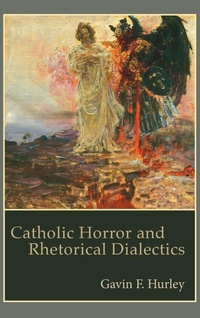
Catholic Horror and Rhetorical Dialectics
Published on 24. June 2024
Book
Hardback
202 pages
978-1-61146-362-0 (ISBN)
Description
Identifying an important subgenre of horror literature, this book argues that Catholic horror fiction works distinctively to inspire the philosophical, theological, and spiritual imaginations of readers from all backgrounds and faith traditions. Hurley analyzes four novels that are foundational to the genre of Catholic horror: J.K. Huysmans's La-Bas (1891), Robert Hugh Benson's The Light Invisible (1903) and A Mirror of Shalott (1907), and William Peter Blatty's The Exorcist (1971). Putting these texts in conversation with the classical liberal arts, the book shows how Catholic horror fiction coheres in a commitment to dialectical thinking that aims both to resolve-and to accommodate-contrasting world views. Given its use of this methodology, Catholic horror literature is uniquely positioned to draw readers into a contemplative mindset. In presenting ghost stories, tales of possession, and narratives about evil, Catholic horror invites audiences to confront and reflect on profound existential questions-questions about the line between life and death, the nature of being, and the meaning of reality.
Reviews / Votes
In textually applying his established criteria, Hurley also effectively sets up a framework that future critics could use in their own analyses of Catholic (or even Catholic-inflected) horror ... If one of the goals of Catholic horror is to open up a thoughtful dialogue on transcendental matters through tales of terror, then Hurley's book could surely stand as a good conversation starter. * Papers on Language and Literature * Catholic Horror and Rhetorical Dialectics successfully argues that Catholic truths can be perceived and understood through works of horror literature ranging from nineteenth-century novels to The Exorcist. In asserting that rhetorical dialectics is an ideal methodology for a distinctively Catholic mode of horror, this eminently readable and thought-provoking study reminds us that horror fiction should be taken seriously rather than seen as mere entertainment. -- Kevin J. Wetmore, Jr., professor of theatre arts at Loyola Marymount University There is a difference between the dark arts and the art of darkness which is as wide as the distance that separates hell from heaven. The art of darkness exposes the evil and ugliness of the dark arts, exorcising its power with the light of goodness, truth, and beauty. In this much needed volume, Gavin Hurley explores the power of some of the great classics of horror fiction to exercise reason and rhetoric to exorcise demons, demonstrating the power of fiction to convey the deepest truths. -- Joseph Pearce, visiting professor of Literature at Ave Maria University Catholic Horror and Rhetorical Dialectics is a welcome contribution to the growing studies on horror and religion. Gavin Hurley offers penetrating insight on Catholic horror literature that is not content to leave anything simply on the surface in what is perhaps an unexpected juxtaposition. -- Steve A. Wiggins, PhD, author of Holy Horror and Nightmares with the BibleMore details
Series
Language
English
Place of publication
Cranbury
United States
Publishing group
Associated University Presses
Target group
College/higher education
Dimensions
Height: 235 mm
Width: 157 mm
Thickness: 17 mm
Weight
486 gr
ISBN-13
978-1-61146-362-0 (9781611463620)
Copyright in bibliographic data and cover images is held by Nielsen Book Services Limited or by the publishers or by their respective licensors: all rights reserved.
Schweitzer Classification
Other editions
Additional editions
Gavin F. Hurley
Catholic Horror and Rhetorical Dialectics
E-Book
06/2024
1st Edition
Lehigh University Press
€90.99
Available for download
Person
Gavin F. Hurley is associate professor of communication at Ave Maria University.
Content
Introduction: Contemplative Horror and Rhetoric
Chapter One: What is Catholic Horror Literature?
Chapter Two: What are Rhetorical Dialectics?
Chapter Three: Rhetorical Dialectics of J.K. Huysmans's La-Bas (1891)
Chapter Four: Rhetorical Dialectics of Robert Hugh Benson's The Light Invisible (1903)
Chapter Five: Rhetorical Dialectics of Robert Hugh Benson's A Mirror of Shallot (1907)
Chapter Six: Rhetorical Dialectics of William Peter Blatty's The Exorcist (1971)
Conclusion: Orienting the Head and Heart
Chapter One: What is Catholic Horror Literature?
Chapter Two: What are Rhetorical Dialectics?
Chapter Three: Rhetorical Dialectics of J.K. Huysmans's La-Bas (1891)
Chapter Four: Rhetorical Dialectics of Robert Hugh Benson's The Light Invisible (1903)
Chapter Five: Rhetorical Dialectics of Robert Hugh Benson's A Mirror of Shallot (1907)
Chapter Six: Rhetorical Dialectics of William Peter Blatty's The Exorcist (1971)
Conclusion: Orienting the Head and Heart