

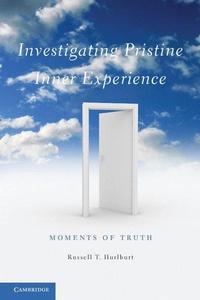
Investigating Pristine Inner Experience
Moments of Truth
Published on 27. June 2011
Book
Paperback/Softback
472 pages
978-0-521-27912-3 (ISBN)
Description
You live your entire waking life immersed in your inner experiences (thoughts, feelings, sensations and so on) - private phenomena created by you, just for you, your own way. Despite their intimacy and ubiquity, you probably do not know the characteristics of your own inner phenomena; neither does psychology or consciousness science. Investigating Pristine Inner Experience explores how to apprehend inner experience in high fidelity. This book will transform your view of your own inner experience, awaken you to experiential differences between people and thereby reframe your thinking about psychology and consciousness science, which banned the study of inner experience for most of a century and yet continued to recognize its fundamental importance. The author, a pioneer in using beepers to explore inner experience, draws on his 35 years of studies to provide fascinating and provocative views of everyday inner experience and experience in bulimia, adolescence, the elderly, schizophrenia, Tourette's syndrome, virtuosity and more.
Reviews / Votes
"Professor Hurlburt was among the early pioneers in the scientific study of ongoing thought. Now he has extended his technique to capture the most basic elements of the phenomenon. This book is a careful and self-critical presentation of his discoveries with the Descriptive Experience Sampling procedures. It will intrigue and challenge consciousness researchers including a new generation of neuroscientists using brain imaging to study the cerebral default-system."- Jerome Singer, Yale University "...the book is well written, engaging, and full of humorous retorts..."
-Dr. Henderikus Stam and Basia D. Ellis, University of Calgary, PsycCRITIQUES
More details
Language
English
Place of publication
Cambridge
United Kingdom
Target group
Professional and scholarly
Product notice
Paperback (trade)
Illustrations
8 Tables, unspecified; 3 Halftones, unspecified; 12 Line drawings, unspecified
Dimensions
Height: 229 mm
Width: 152 mm
Thickness: 26 mm
Weight
678 gr
ISBN-13
978-0-521-27912-3 (9780521279123)
Copyright in bibliographic data and cover images is held by Nielsen Book Services Limited or by the publishers or by their respective licensors: all rights reserved.
Schweitzer Classification
Other editions
Additional editions
E-Book
12/2011
1st Edition
Cambridge University Press
€21.99
Available for download
Book
06/2011
Cambridge University Press
€96.50
Shipment within 15-20 days
Person
Russell T. Hurlburt pioneered the investigation of inner experience (thoughts, feelings and so on), inventing (in 1973) the beepers that launched 'thought sampling', the attempt to measure characteristics of inner experience. Despite the sophistication of his thought-sampling measurements, Hurlburt concluded, by about 1980, that science needs a better understanding of inner phenomena themselves. Therefore he developed Descriptive Experience Sampling (DES), the attempt to apprehend inner experience in high fidelity. That has led to four books: Sampling Normal and Schizophrenic Inner Experience (1990), Sampling Inner Experience in Disturbed Affect (1993), Exploring Inner Experience (with Chris Heavey, 2006) and Describing Inner Experience: Proponent Meets Skeptic (with Eric Schwitzgebel, 2007). A special issue of the Journal of Consciousness Studies (January 2010) was devoted to DES. Hurlburt is Professor of Psychology at the University of Nevada, Las Vegas and is also the author of a highly regarded statistics textbook, Comprehending Behavioral Statistics (fourth edition, 2006).
Content
1. Moments of truth; 2. Fragmented experience in bulimia nervosa with Sharon Jones-Forrester; 3. Apprehending pristine experience; 4. Everyday experience; 5. Moments are essential; 6. Experience in Tourette's syndrome with Michael J. Kane; 7. The moment (not): happy and sad; 8. Subjunctification; 9. Before and after experience?: Adolescence and old age; 10. Iteration is essential; 11. Epistemological q/a; 12. A consciousness scientist as DES subject; 13. Pristine experience (not): emotion and schizophrenia; 14. Multiple autonomous experience in a virtuoso musician with Ricardo Cobo; 15. Unsymbolized thinking with Sarah A. Akhter; 16. Sensory awareness with Chris Heavey and Arva Bensaheb; 17. The radical nonsubjectivity of pristine experience; 18. Diamonds vs. glass; 19. Into the floor: a right-or-wrong-answer natural experiment with Chris Heavey; 20. The emergence of salient characteristics; 21. Investigating pristine inner experience.