

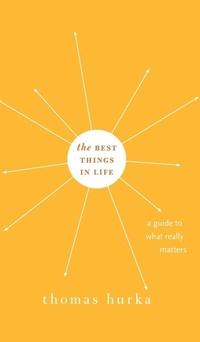
The Best Things in Life
A Guide to What Really Matters
1st Edition
Published on 24. February 2011
Book
Hardback
208 pages
978-0-19-533142-4 (ISBN)
Description
For centuries, philosophers, theologians, moralists, and ordinary people have asked: How should we live? What makes for a good life?
In The Best Things in Life, distinguished philosopher Thomas Hurka takes a fresh look at these perennial questions as they arise for us now in the 21st century. Should we value family over career? How do we balance self-interest and serving others? What activities bring us the most joy? While religion, literature, popular psychology, and everyday wisdom all grapple with these questions, philosophy more than anything else uses the tools of reason to make important distinctions, cut away irrelevancies, and distill these issues down to their essentials. Hurka argues that if we are to live a good life, one thing we need to know is which activities and experiences will most likely lead us to happiness and which will keep us from it, while also reminding us that happiness isn't the only thing that makes life good. Hurka explores many topics: four types of good feeling (and the limits of good feeling); how we can improve our baseline level of happiness (making more money, it turns out, isn't the answer); which kinds of knowledge are most worth having; the importance of achieving worthwhile goals; the value of love and friendship; and much more. Unlike many philosophers, he stresses that there isn't just one good in life but many: pleasure, as Epicurus argued, is indeed one, but knowledge, as Socrates contended, is another, as is achievement. And while the great philosophers can help us understand what matters most in life, Hurka shows that we must ultimately decide for ourselves.
This delightfully accessible book offers timely guidance on answering the most important question any of us will ever ask: How do we live a good life?
In The Best Things in Life, distinguished philosopher Thomas Hurka takes a fresh look at these perennial questions as they arise for us now in the 21st century. Should we value family over career? How do we balance self-interest and serving others? What activities bring us the most joy? While religion, literature, popular psychology, and everyday wisdom all grapple with these questions, philosophy more than anything else uses the tools of reason to make important distinctions, cut away irrelevancies, and distill these issues down to their essentials. Hurka argues that if we are to live a good life, one thing we need to know is which activities and experiences will most likely lead us to happiness and which will keep us from it, while also reminding us that happiness isn't the only thing that makes life good. Hurka explores many topics: four types of good feeling (and the limits of good feeling); how we can improve our baseline level of happiness (making more money, it turns out, isn't the answer); which kinds of knowledge are most worth having; the importance of achieving worthwhile goals; the value of love and friendship; and much more. Unlike many philosophers, he stresses that there isn't just one good in life but many: pleasure, as Epicurus argued, is indeed one, but knowledge, as Socrates contended, is another, as is achievement. And while the great philosophers can help us understand what matters most in life, Hurka shows that we must ultimately decide for ourselves.
This delightfully accessible book offers timely guidance on answering the most important question any of us will ever ask: How do we live a good life?
Reviews / Votes
A stimulating read and a great way to get you focused on the right things at the beginning of the year. * Fareed Zajkaria, CNN * That rare thing: a philosophical work written with such simplicity and verve that it will engage students, and reward specialists. * Notre Dame Philosophical Reviews *More details
Series
Language
English
Place of publication
New York
United States
Target group
College/higher education
General audience interested in philosophy; students and scholars of philosophy
Dimensions
Height: 209 mm
Width: 132 mm
Thickness: 16 mm
Weight
349 gr
ISBN-13
978-0-19-533142-4 (9780195331424)
Copyright in bibliographic data and cover images is held by Nielsen Book Services Limited or by the publishers or by their respective licensors: all rights reserved.
Schweitzer Classification
Other editions
Additional editions
Book
05/2015
Oxford University Press Inc
€15.90
Shipment within 15-20 days
E-Book
12/2010
1st Edition
OUP eBook
€5.99
Available for download
E-Book
12/2010
1st Edition
OUP eBook
€5.99
Available for download
Person
Thomas Hurka is Professor of Philosophy at the University of Toronto and the author of Virtue, Vice, and Value; Principles: Short Essays on Ethics; and Perfectionism.
Content
Chapter 1: Introduction
Chapter 2: Feeling Good
Chapter 3: Knowing What's What
Chapter 4: Achieving Goals
Chapter 5: Being Good
Chapter 6: Loving and Being Loved
Chapter 7: Putting it Together
Chapter 2: Feeling Good
Chapter 3: Knowing What's What
Chapter 4: Achieving Goals
Chapter 5: Being Good
Chapter 6: Loving and Being Loved
Chapter 7: Putting it Together