

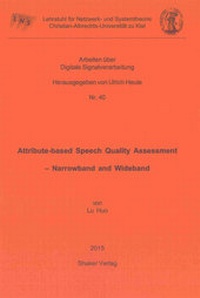
Attribute-based Speech Quality Assessment
- Narrowband and Wideband
1st Edition
Published on 28. May 2015
Book
Paperback/Softback
218 pages
978-3-8440-3661-9 (ISBN)
Description
After decades of rapid development in the field of telecommunication, the modern speech transmission has evolved from the simple analog system into a huge hybrid network of diverse principles such as Voice over IP (VoIP), the wireless communications, as well as the conventional telephone systems. In all cases, an important step led from the "classical" narrow telephone bandwidth of the 3 kHz to "wideband" or even "superwideband" telephony, with 7 kHz or even 14 kHz.
In this work, an attribute-based diagnostic objective estimation model for the speech quality at the output of such modern telecommunication systems is under investigation.
This approach is a further study in the sequence of investigations in TU Berlin and TF/CAU at Kiel. All the three already identified quality dimensions coloration, discontinuity, and noisiness are labeled here as the global quality dimensions. They are further decomposed into more specific attributes, here called subdimensions, which provide more details or insights to the corresponding global quality dimensions. These subdimensions are directness and frequency content for the quality dimension coloration, interruptedness, musical noise and clipping rate for the dimension discontinuity, as well as signal-correlated noise, additive LF noise and additive HF noise for the dimension noisiness.
Firstly, a thorough study of each of these subdimensions has been made and the corresponding objective estimation algorithm was investigated and evaluated; secondly, the estimation model of each global quality dimension was built based on these subdimensions; thirdly, a multi-step estimation model of the overall speech quality was established and evaluated using the given databases.
In this work, an attribute-based diagnostic objective estimation model for the speech quality at the output of such modern telecommunication systems is under investigation.
This approach is a further study in the sequence of investigations in TU Berlin and TF/CAU at Kiel. All the three already identified quality dimensions coloration, discontinuity, and noisiness are labeled here as the global quality dimensions. They are further decomposed into more specific attributes, here called subdimensions, which provide more details or insights to the corresponding global quality dimensions. These subdimensions are directness and frequency content for the quality dimension coloration, interruptedness, musical noise and clipping rate for the dimension discontinuity, as well as signal-correlated noise, additive LF noise and additive HF noise for the dimension noisiness.
Firstly, a thorough study of each of these subdimensions has been made and the corresponding objective estimation algorithm was investigated and evaluated; secondly, the estimation model of each global quality dimension was built based on these subdimensions; thirdly, a multi-step estimation model of the overall speech quality was established and evaluated using the given databases.
More details
Series
Thesis
Doctoral thesis
2015
Christian Albrechts Universität Kiel
Language
English
Place of publication
Aachen
Germany
Target group
Professional and scholarly
Product notice
Unsewn / adhesive bound
Illustrations
20
20 farbige Abbildungen
106
Dimensions
Height: 21 cm
Width: 14.8 cm
Weight
327 gr
ISBN-13
978-3-8440-3661-9 (9783844036619)
Schweitzer Classification