

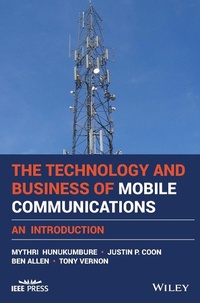
The Technology and Business of Mobile Communications: An Introduction
An Introduction
1st Edition
Will be published approx. on 2. December 2021
Book
Hardback
480 pages
978-1-119-13029-1 (ISBN)
Description
Provides an introduction to the technical and business aspects of mobile telecommunications, exploring the complete eco-system of the industry with the key segments and how they interact with each other. This industry has seen rapid technical advancements in recent years, yet the basics of providing coverage and capacity to the end users have not changed. The authors introduce these technical basics to the reader and then show how a network is deployed. Technical innovation has been pivotal to the rapid advancement of this industry and the book details some of the main innovations over the years. The book highlights some of the current challenges the industry is facing and how innovation is driven by these challenges.
Mobile operators? business structures are examined, from the purchasing spectrum to deploying the network and attracting and retaining customers. The role of the regulator is not overlooked, and its role in ensuring a competitive market where consumers have sufficient choice. The authors detail current challenges faced by the operators and how they are using business innovation to overcome these challenges. In describing the changing face of mobile telecoms, the book covers business challenges as well as the technological challenges faced today by the industry. The advent of the Smart phones, which support multiple technologies that compliment and sometimes compete with mobile cellular technology has had a profound impact on the industry, sometimes challenging the role of the mobile operator. A discussion of these yet-unanswered challenges provides some insight into where the industry is heading. The technical aspects of this book are pitched at undergraduate first year mathematics and physics subject levels, making it easily comprehensible to the undergraduate students studying relevant fields. As the title denotes, this book will be at an introductory level, giving a broad coverage to many of the significant technical and business aspects of the industry.
More details
Other editions
Additional editions
Mythri Hunukumbure | Justin P. Coon | Ben Allen
The Technology and Business of Mobile Communications
An Introduction
E-Book
12/2021
1st Edition
Wiley-ISTE
€67.99
Available for download
Mythri Hunukumbure | Justin P. Coon | Ben Allen
The Technology and Business of Mobile Communications
An Introduction
E-Book
11/2021
1st Edition
Wiley-ISTE
€67.99
Available for download
Persons
Dr. Mythri Hunukumbure, Principal Researcher, Fujitsu Labs of Europe Ltd. Dr. Hunukumbure has worked in both the wireless communications industry and academia for over 10 years. He completed his BSc (Honours) degree from University of Moratuwa, Sri Lanka in 1998. He joined University of Bristol, UK, completing his PhD in 2004. He joined Fujitsu Labs of Europe Ltd in 2006, currently serving as a Principal Researcher. During his time at Fujitsu, he has researched into many aspects of mobile communications, developing innovative solutions for 4G LTE and WiMAX systems. In 2012, he received the Fujitsu Foundation Award for excellence in Green Wireless research. In his career so far, he has published over 25 Journal and IEEE conference papers.
Prof. Ben Allen, Head of Centre for Wireless Research, University of Bedforshire, UK. Professor Allen received his PhD from the University of Bristol in 2001. In 2002 he joined Tait Electronics Ltd, Christchurch, New Zealand, before becoming a Research Fellow with the Centre for Telecommunications Research, King's College London, UK. He is a Chartered Engineer, Fellow of the IET, Fellow of the Higher Education Academy and a Senior Member of the IEEE. He is a Member of the editorial board of the IET Microwaves, Antennas, and Propagation Journal, BizTech Advisory Board member and mVCE Visions Group member.
Dr Justin P. Coon, Associate Professor, University of Oxford. Dr Coon received a PhD in communications from the University of Bristol, UK in 2005. In 2004, he joined Toshiba Research Europe Ltd. (TREL) as a Research Engineer working in its Bristol based Telecommunications Research Laboratory (TRL), where he conducted research on a broad range of communication technologies and theories, including single and multi-carrier modulation techniques, estimation and detection, diversity methods, system performance analysis and networks. Dr Coon is the recipient of TRL's Distinguished Research Award for his work on block-spread CDMA, aspects of which have been adopted as mandatory features in the 3GPP LTE Rel-8 standard. He is also a co-recipient of two "best paper" awards for work presented at ISWCS '13 and EuCNC '14.
Tony Vernon, Director, Vector Sum Consulting Limited, UK.
Content
Contents
Chapter 1: A technology that changed the world 9
1.1 Social and economic impact of mobile communications 10
1.1.1 Social Impact 10
1.1.2 Economic Impact 12
1.2 A Brief history of Mobile (Cellular) communications 15
1.3 The Journey of mobile communications as seen from user and operator perspectives 24
REFERENCES 27
Chapter 2 - The Mobile Telecoms Ecosystem 30
2.1 Introduction 30
2.2 Telecommunications ecosystem 30
2.3 Regulation and spectrum 32
2.3 Standardisation 34
2.4 Research 35
2.5 End users 36
2.6 The role of operators (carriers) 36
2.7 The role of vendors/ manufacturers 37
2.8 The role of standard bodies and regulators 37
2.9 Telecoms ecosystem dynamics and behaviour 38
2.10 5G Ecosystem 40
2.10.1 Datacentres 40
2.10.2 RF Chip and component manufacturers 41
2.10.3 Telecom operators (carriers) 41
2.10.4 Infrastructure Service Providers 41
2.10.5 Gaming 41
2.10.6 Over The Top (OTT) 42
2.10.7 Low-Cost Processing Unit Manufacturer 42
2.10.8 Investors 42
2.10.9 Potential disruptions in the 5G eco system
43
2.11 Summary 45
References 46
3 The Business of a Mobile Operator 49
3.1 Business Challenges Faced by Operators 49
3.1.1 Third Party Costs 49
3.1.2 Radio Access Network Costs 50
3.1.3 Transmission Costs 54
3.1.4 Physical Locations 58
3.1.5 Power Costs for Multiple Technologies 58
3.2 MVNOs ? Mobile Virtual Network Operators 59
3.2.1 Economics of an MVNO 60
3.2.2 Modelling MVNOs and SPs 63
3.3 Operator business around International roaming 67
3.3.1 The EU roaming regulation ?roam like at home? 68
3.3.2 Covid-19 impact on roaming revenues 70
3.4 The likely operator business models in 5G 70
3.5 Conclusion 72
REFERENCES 73
Chapter 4 ? Why Standards matter 76
4.1 The creation of a new ?G? 76
4.1.1 Research 77
4.1.2 Standardisation 77
4.1.3 Commercialisation 80
4.1.4 Continued Innovation 81
4.1.5 Intellectual Property as a metric and
political currency 83
4.2 Shifting political power and the making of an
ecosystem 84
4.2.1 2G GSM ? Europe leads 84
4.2.2 3G UMTS ? Universal (except not quite) 87
4.2.3 4G EPS ? Avoiding old mistakes (and making
new ones?) 91
4.2.4 5G NR ? new world order? 96
4.3 Future Standards 99
REFERENCES 101
Chapter 5: The mobile network 102
5.1 Mobile Network Architecture 102
5.2 The Radio Access Network (RAN) 103
5.2.1 Synchronisation: 104
5.2.2 Broadcast messages: 104
5.2.3 Paging: 105
5.2.4 Random Access: 105
5.2.5 Scheduling: 106
5.2.6 Power control: 106
5.2.7 Handover: 106
5.2.8 Link Adaptation: 108
5.2.9 HARQ, error correction: 108
5.2.10 MIMO techniques: 108
5.2.11 The control/data channels and reference signals 109
5.3 The Core Network (CN) 109
5.3.1 Circuit switching and packet switching networks: 110
5.3.2 Tunnelling and Encapsulation: 111
5.4 The protocol stack 112
5.4.1 The OSI model of 7 layer protocol stack 113
5.4.2 Protocol stacks for mobile communications 115
5.5 The 2G Network 117
5.5.1 The network architecture of 2G 117
5.5.2 The GSM frame structure 119
5.5.3 GSM (and GPRS) RAN features 121
5.5.4 2G evolutions 122
5.6 The 3G Network 123
5.6.1 The UMTS Terrestrial Radio Access Network (UTRAN) 124
5.6.2 UTRAN Features: 127
5.6.3 The IP Multimedia Subsystem (IMS): 128
5.6.4 Issues with the UMTS air interface: 129
5.6.5 3G evolution to HSPA 129
5.7 The 4G Network 131
5.7.1 LTE system Architecture: 132
5.7.2 LTE Protocol Layers 134
5.7.3 LTE Multiple Access schemes: 136
5.7.4 LTE Frame structures: 140
5.7.5 LTE reference signals: 141
5.7.6 LTE main RAN procedures: 142
5.7.7 Main features of subsequent LTE releases: 146
5.8 The 5G Network 148
5.8.1 5G-NR Deployment options: 149
5.8.2 5G-NR System Architecture: 150
5.8.3 Spectrum options for 5G-NR 151
5.8.4 5G-NR Protocol layers: 152
5.8.5 The 5G-NR Air Interface 154
5.8.6 5G-NR RAN procedures: 156
5.8.7 5G-NR Reference signals: 158
5.8.8 5G Core - concepts and functionalities: 158
5.9 The Centralization and Virtualization of the mobile
network 160
5.9.1 The Centralized RAN (C-RAN) 160
5.9.2 NFV (Virtualized Network Functions) and SDN
(Software Defined Networking) concepts 162
5.10 Conclusions 165
REFERENCES 166
Chapter 6: Basics of Network Dimensioning and Planning
169
6.1 Properties of Signal Strength, Noise and Interference 169
6.2 The link budget and coverage dimensioning 173
6.2.1 The Transmit power: 173
6.2.2 The Antenna gains: 173
6.2.3 Transmit and Receive diversity gains: 174
6.2.4 The EIRP: 174
6.2.5 Modelling the path loss: 175
6.2.6 Modelling the Log Normal Fade Margin 178
6.2.7 The FFM 179
6.2.7 Building Penetration Loss 179
6.2.8 Building the link budget 179
6.3 The capacity dimensioning 181
6.3.1 The capacity demand estimation process: 182
6.3.2 Capacity demand estimation ? worked example
184
6.3.3 Resource provision ? worked example 187
6.4 The dimensioning of backhaul links 192
6.4.1 LTE Backhaul provision ? general aspects
193
6.4.2 LTE Backhaul provision - Capacity aspects: 194
6.4.3 New developments in backhaul/fronthaul provision 200
6.5 The network planning process 201
6.5.1 The network area maps 201
6.5.2 Site placement and Antenna radiation patterns 202
6.5.3 Traffic modelling and capacity provision information 203
6.5.4 Fine tuning and optimisation 204
6.6 A look at 5G networks 205
REFERENCES 208
7 Spectrum ? the life blood of radio communications 210
7.1 Introduction 210
7.2 Spectrum management and its objectives 210
7.2.1 The role of the ITU 210
7.2.2 Regional bodies 211
7.2.3 National regulators and their roles 212
7.2.4 The spectrum management process 213
7.3 Spectrum allocations 215
7.4 Spectrum assignment 216
7.4.1 Administrative assignments 216
7.4.2 Market based mechanisms 216
7.4.3 Beauty contests 216
7.5 Spectrum licensing 217
7.5.1 Spectrum for mobile services 218
7.5.2 Dimensions of spectrum sharing 222
7.6 Spectrum bands considered for 5G 224
7.6.1 Example illustration of spectrum deployment strategy for MNOs 225
7.6.2 Local access spectrum 226
REFERENCES 228
Chapter 8: Fundamentals of Digital Communication 230
8.1 Basic Digital Communication System Overview 230
8.2 Encoding Information 232
8.2.1 Sampling 232
8.2.2 Source Coding 233
8.2.3 Channel Coding 235
8.3 Signal Representation and Modulation 240
8.3.1 Mapping Bits to Signals 241
8.3.2 Signal Spectrum 244
8.4 Signal Demodulation and Detection 245
8.4.1 System Model and Sources of Noise 245
8.4.2 Demodulation 246
8.4.3 Detection 248
8.5 Performance Analysis 248
8.5.1 Capacity 249
8.5.2 Bit-error Rate and Symbol-error Rate 250
8.6 Communication Through Dispersive Channels 251
8.6.1 Time-domain Equalization and Detection 252
8.6.2 Frequency-domain Equalization 255
8.7 Multiple Access: A Second Look 261
8.7.1 CDMA and 3G 261
8.7.2 OFDMA/SC-FDMA and 4G 263
8.7.3 NOMA and 5G 265
8.8 System Impairments 267
8.8.1 Carrier Phase Estimation 267
8.8.2 Timing Recovery 268
8.8.3 Channel Estimation 268
8.9 Further Reading 269
REFERENCES 270
Chapter 9: Early Technical Challenges and Innovative
Solutions 271
9.1 Wireless Channels: The Challenge 271
9.1.1 Propagation 272
9.1.2 Fading and Multipath 274
Rayleigh Fading 275
Rician Fading 276
Nakagami Fading 276
9.1.3 Signal-to-Noise Ratio in Fading Channels
279
9.2 Multicarrier Modulation: A Second Look 281
9.2.1 Coded OFDM 281
9.2.2 Capacity and Adaptive Modulation 281
9.3 Diversity 283
9.3.1 Macro Diversity 283
9.3.2 Time Diversity 284
9.3.3 Frequency Diversity 286
9.3.4 Spatial Diversity 286
Maximum Ratio Receiver Combining 287
Selection Combining 288
Maximum Ratio Transmission 289
Transmit Antenna Selection 289
Delay Diversity 290
Space-Time/Frequency Coding 291
9.4 Multiple Input Multiple Output (MIMO) 292
9.4.1 Capacity 293
9.4.2 MIMO Transmission Techniques 295
9.4.3 MIMO Reception Techniques 296
9.4.4 MIMO vs Multicarrier 298
9.4.5 Multi-User and Massive MIMO 298
REFERENCES 300
Chapter 10: Small Cells - an evolution or a revolution 301
10.1 Introduction 301
10.2 Small Cells concept formation 302
10.3 Multi-tier Cellular Networks/HetNets Architecture 304
10.3.1 Interference Management 304
10.3.2 Mobility Management 305
10.3.3 Backhaul 305
10.4 Interference Management and Modelling in Small cell/HetNets 305
10.4.1 Interference Management 305
10.4.2 Interference Modelling 308
10.5 Mobility Management 312
10.6 Backhaul 315
10.7 Small Cell Deployment 318
10.8 Future Evolution of Small Cells 323
10.9 Conclusion 324
REFERENCES 324
Chapter 11: Today?s and Tomorrow?s Challenges 327
11.1 The capacity crunch 327
11.1.1 A historical perspective 327
11.1.2 Methods for capacity enhancement 328
11.1.3 Impact on Transport and core networks 331
11.1.4 Complementary technologies 333
11.2 Increasing network complexity 336
11.2.1 The Self-Organising Networks 336
11.2.2 Network Automation in 5G 340
11.2.3 The business rationale for network automation
342
11.3 The need for Greener and lower EMF networks 343
11.3.1 Greener Mobile Networks 343
11.3.3 Green manufacturing and Recycling 345
11.3.4 Applications of mobile networks for energy reduction 345
11.3.5 Electromagnetic Field Exposure and Mobile Networks 346
11.4 Covering the unserved and under-served regions 349
11.4.1 New Access Technologies 349
11.4.2 Initiatives driven by government funding and policy 352
REFERENCES 354
Chapter 12: The changing face of mobile communications 357
12.1 Changes with the centralization and virtualization of the mobile network 357
12.2 Supporting multiple vertical Industries through 5G 359
12.2.1. Automotive sector 360
12.2.2. Smart City 363
12.2.3. Industry 4.0 365
12.2.4. Critical communications sector 368
12.2.5. Other vertical areas under development 371
12.3 The continuous evolution of the mobile device 372
12.4 What will 6G look like? 374
12.4.1 Machine Learning and Artificial Intelligence
375
12.4.2 Blockchain and the Internet of Things 376
12.4.3 Evolutions in Cloud and Edge Computing 376
12.4.4 Advanced Hybrid Beamforming 377
12.4.5 New Modulation schemes 378
12.4.6 Tera-Hertz (THz) communications 378
12.4.7 Orbital Angular Momentum 379
12.4.8 Unmanned Aerial Vehicles 380
12.4.9 Quantum Technology 380
REFERENCES 381