

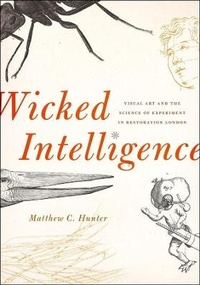
Wicked Intelligence
Visual Art and the Science of Experiment in Restoration London
Published on 15. October 2013
Book
Hardback
352 pages
978-0-226-01729-7 (ISBN)
Description
In late seventeenth-century London, the most provocative images were produced not by artists, but by scientists. Magnified fly-eyes drawn with the aid of microscopes, apparitions cast on laboratory walls by projection machines, cut-paper figures revealing the "exact proportions" of sea monsters - all were created by members of the Royal Society of London, the leading institutional platform of the early Scientific Revolution. Wicked Intelligence reveals that these natural philosophers shaped Restoration London's emergent artistic cultures by forging collaborations with court painters, penning art theory, and designing triumphs of baroque architecture such as St Paul's Cathedral. Offering an innovative approach to the scientific image-making of the time, Matthew C. Hunter demonstrates how the Restoration project of synthesizing experimental images into scientific knowledge, as practiced by Royal Society leaders Robert Hooke and Christopher Wren, might be called "wicked intelligence."
Hunter uses episodes involving specific visual practices-for instance, concocting a lethal amalgam of wax, steel, and sulfuric acid to produce an active model of a comet-to explore how Hooke, Wren, and their colleagues devised representational modes that aided their experiments. Ultimately, Hunter argues, the craft and craftiness of experimental visual practice both promoted and menaced the artistic traditions on which they drew, turning the Royal Society projects into objects of suspicion in Enlightenment England. The first book to use the physical evidence of Royal Society experiments to produce forensic evaluations of how scientific knowledge was generated, Wicked Intelligence rethinks the parameters of visual art, experimental philosophy, and architecture at the cusp of Britain's imperial power and artistic efflorescence.
Hunter uses episodes involving specific visual practices-for instance, concocting a lethal amalgam of wax, steel, and sulfuric acid to produce an active model of a comet-to explore how Hooke, Wren, and their colleagues devised representational modes that aided their experiments. Ultimately, Hunter argues, the craft and craftiness of experimental visual practice both promoted and menaced the artistic traditions on which they drew, turning the Royal Society projects into objects of suspicion in Enlightenment England. The first book to use the physical evidence of Royal Society experiments to produce forensic evaluations of how scientific knowledge was generated, Wicked Intelligence rethinks the parameters of visual art, experimental philosophy, and architecture at the cusp of Britain's imperial power and artistic efflorescence.
Reviews / Votes
"No study in recent years on the arts in early modern Britain is as intelligent and inventive as Wicked Intelligence. Always attuned to the elusiveness of objects and their capacity to stimulate unexpected thoughts, Matthew C. Hunter follows Latourian hybrids as they circulate through Restoration experimental culture and brilliantly articulates the material intelligence at work in the Royal Society. Hunter's writing is compelling and witty, and this book exemplifies the very wicked intelligence that he traces through Restoration experimental philosophy." -Michael Gaudio, University of Minnesota"More details
Language
English
Place of publication
Chicago
United States
Publishing group
The University of Chicago Press
Target group
College/higher education
Dimensions
Height: 26 mm
Width: 18 mm
Thickness: 3 mm
Weight
822 gr
ISBN-13
978-0-226-01729-7 (9780226017297)
Copyright in bibliographic data and cover images is held by Nielsen Book Services Limited or by the publishers or by their respective licensors: all rights reserved.
Schweitzer Classification
Other editions
Additional editions
E-Book
10/2013
1st Edition
University of Chicago Press
€79.49
Available for download
Person
Matthew C. Hunter is assistant professor in the Department of Art History and Communication Studies at McGill University. He is coeditor of Beyond Mimesis and Convention: Representation in Art and Science and The Clever Object and an editor of Grey Room.