

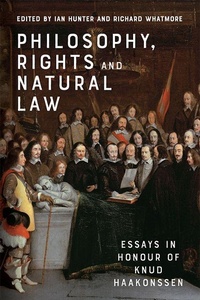
Philosophy, Rights and Natural Law
Essays in Honour of Knud Haakonssen
Published on 28. February 2019
Book
Hardback
384 pages
978-1-4744-4922-9 (ISBN)
Description
Over his long and illustrious career, Knud Haakonssen has explored the role of natural law in formulating doctrines of obligation and rights in accordance with the interests of early modern polities and churches. The essays collected in this volume range across this exciting and contested field. These 13 new essays acknowledge Haakonssen's immense academic achievement and give us new insights into the cultural and political role of law and rights in a variety of historical contexts and circumstances.
Reviews / Votes
No-one has done more than Knud Haakonssen to facilitate and lead the study of Protestant Natural Law in early modern Europe, and to explain its significance for moral and political philosophy. This volume repays that achievement with an excellent set of essays on the subject. A combination of outstanding contributors, well-chosen topics, and broad geographical coverage ensures that the volume is not only an apt tribute to Haakonssen, but will be an essential reference-point for future development of the field. * John Robertson, Professor Emeritus of the History of Political Thought, University of Cambridge *More details
Language
English
Place of publication
Edinburgh
United Kingdom
Target group
College/higher education
Product notice
sewn/stitched
Cloth over boards
Dimensions
Height: 231 mm
Width: 160 mm
Thickness: 28 mm
Weight
680 gr
ISBN-13
978-1-4744-4922-9 (9781474449229)
Copyright in bibliographic data and cover images is held by Nielsen Book Services Limited or by the publishers or by their respective licensors: all rights reserved.
Schweitzer Classification
Other editions
Additional editions
E-Book
01/2019
1st Edition
Edinburgh University Press
€0.00
Available for download
Persons
Ian Hunter is Emeritus Professor of History at the University of Queensland. He is author of The Secularisation of the Confessional State: The Political Thought of Christian Thomasius (Cambridge University Press, 2007). He is co-editor of Law and Politics in British Colonial Thought (Palgrave Macmillan, 2010), Essays on Church, State and Politics (Liberty Fund, 2007), The Philosopher in Early Modern Europe (Cambridge University Press, 2006), Heresy in Transition (Ashgate, 2005) and Natural Law and Civil Sovereignty (Palgrave Macmillan, 2002). Richard Whatmore is Professor of History at the University of St Andrews and Director of the St Andrews Institute of Intellectual History. He is the author of What is Intellectual History? (Polity, 2015), Against War and Empire (Yale University Press, 2012) and Republicanism and the French Revolution (OUP, 2000). He is the co-editor of Commerce and Peace in the Enlightenment (Cambridge University Press, 2017), Companion to Intellectual History (Wiley-Blackwell, 2016), David Hume (Ashgate, 2013), Advances in Intellectual History (Palgrave, 2006) and Economy, Polity and Society: Essays in British Intellectual History, 2 volumes (Cambridge University Press, 2000).
Content
Introduction; Part I: Rights, Religion and Morality: 1. Calvinists, Arminians, Socinians: Popular sovereignty and natural rights in early modern political thought, James Moore; 2. Truth and Toleration in the Early Modern Period, Maria Rosa Antognazza; 3. The History of the History of Ethics and Emblematic Passages, Aaron Garrett; 4. Natural law and natural rights in early enlightenment Copenhagen , Mads Jensen; Part II: Natural Law and the Philosophers: 5. Natural Equality and Natural Law in Locke's Two Treatises, Kari Saastamoinen; 6. Dignity and Equality in Pufendorf's Natural Law Theory, Simone Zurbuchen; 7. Theory and Practice in the Natural Law of Christian Thomasius, Ian Hunter; 8. The 'iura connata' in the Natural Law of Christian Wolff, Frank Grunert; 9. Hume's peculiar definition of justice, James A. Harris; Part III: Rights and Reform: 10. Economizing Natural Law: Pufendorf on Moral Quantities and Sumptuary Legislation, Michael Seidler; 11. The Legacy of Smith's Jurisprudence in Late-Eighteenth-Century Edinburgh, John W. Cairns; 12. Declaring Rights: Bentham and the Rights of Man, David Lieberman; 13. Rights After the Revolutions, Richard Whatmore; Index.