

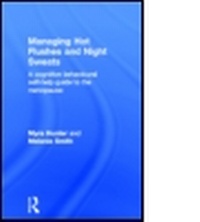
Managing Hot Flushes and Night Sweats
A cognitive behavioural self-help guide to the menopause
1st Edition
Published on 19. September 2013
Book
Hardback
194 pages
978-0-415-62514-2 (ISBN)
Description
The menopause is still a taboo topic and a source of uncertainty and embarrassment for many women. In Managing Hot Flushes and Night Sweats Myra Hunter and Melanie Smith aim to provide women with up to date and balanced information about menopause and a self-help guide to reduce the impact of hot flushes and night sweats in just four weeks.
This book sets out an interactive four-week programme using cognitive behavioural therapy, with exercises and worksheets designed to enable women to develop strategies for managing menopausal symptoms. This approach is based on the authors' research and has been shown to be effective in recent clinical research trials. This guide can help you to:
Understand the biological as well as the psychological and cultural influences on menopause
Understand and manage hot flushes in social situations
Learn to modify triggers and use paced breathing to reduce the impact of hot flushes
Reduce stress and improve well-being
Develop strategies to help if night sweats disturb your sleep
With a companion audio exercise and downloadable resources available online, Managing Hot Flushes and Night Sweats offers a complete and effective framework to approach menopause with confidence and to manage symptoms without the use of medication. The book is ideal for women approaching or going through the menopause, for women having menopausal symptoms following treatment for breast cancer, for their friends and relatives, and healthcare professionals working with women.
This book sets out an interactive four-week programme using cognitive behavioural therapy, with exercises and worksheets designed to enable women to develop strategies for managing menopausal symptoms. This approach is based on the authors' research and has been shown to be effective in recent clinical research trials. This guide can help you to:
Understand the biological as well as the psychological and cultural influences on menopause
Understand and manage hot flushes in social situations
Learn to modify triggers and use paced breathing to reduce the impact of hot flushes
Reduce stress and improve well-being
Develop strategies to help if night sweats disturb your sleep
With a companion audio exercise and downloadable resources available online, Managing Hot Flushes and Night Sweats offers a complete and effective framework to approach menopause with confidence and to manage symptoms without the use of medication. The book is ideal for women approaching or going through the menopause, for women having menopausal symptoms following treatment for breast cancer, for their friends and relatives, and healthcare professionals working with women.
Reviews / Votes
"Professor Hunter and Dr Smith provide a truly accessible and informative account of current knowledge relating to the menopause and its implications. The self-help programme is eminently doable. At every point the exercises are fully explained and there are illustrations with quotes from women from a range of different circumstances. This book is written by women for women... please read on, as your menopausal experiences will certainly seem different on your completion of this book." Professor Pauline Slade, University of Liverpool, from the foreword."I would say that it's been excellent for me. I initially thought that I could do absolutely nothing to help myself with menopausal symptoms.... going through the book and realizing that I could control things has been excellent for me.....I hardly have any hot flushes now." Angela.
More details
Language
English
Place of publication
London
United Kingdom
Publishing group
Taylor & Francis Ltd
Illustrations
13 s/w Abbildungen, 6 s/w Tabellen, 13 s/w Zeichnungen
Following Owen - Facing the Storm (978-0-415-67659-5); 13 Line drawings, black and white; 6 Tables, black and white; 13 Illustrations, black and white
Dimensions
Height: 216 mm
Width: 140 mm
Weight
380 gr
ISBN-13
978-0-415-62514-2 (9780415625142)
Copyright in bibliographic data and cover images is held by Nielsen Book Services Limited or by the publishers or by their respective licensors: all rights reserved.
Schweitzer Classification
Other editions
New editions
Myra Hunter | Melanie Smith
Managing Hot Flushes and Night Sweats
A Cognitive Behavioural Self-help Guide to the Menopause
Book
07/2020
2nd Edition
Routledge
€195.70
Shipment within 15-20 days
Additional editions
Myra Hunter | Melanie Smith
Managing Hot Flushes and Night Sweats
A cognitive behavioural self-help guide to the menopause
Book
09/2013
1st Edition
Routledge
€44.79
Withdrawn from sale
Persons
Myra Hunter is professor of clinical health psychology at the Institute of Psychiatry, King's College London. She has worked in the area of women's health for over thirty years and her research on menopause has established her as an international expert in the field.
Melanie Smith is a clinical psychologist who has specialised in helping people to manage physical health conditions through the use of cognitive behavioural therapy. She is currently working with the Manchester and Salford Pain Centre.
Melanie Smith is a clinical psychologist who has specialised in helping people to manage physical health conditions through the use of cognitive behavioural therapy. She is currently working with the Manchester and Salford Pain Centre.
Content
Introduction. Chapter 1 The Menopause: A bio-psycho-social transition. Chapter 2 Menopausal symptoms: Hot Flushes and Night Sweats. Chapter 3 A Cognitive Behavioural Approach. What is Cognitive Behaviour Therapy? Chapters 4 to 7 Managing Menopausal Hot Flushes and Night Sweats: a Four-week Self-help Guide. Chapter 4 Week 1: Being Informed and Reducing Stress. Chapter 5 Week 2: Managing Hot Flushes. Chapter 6 Week 3: Managing Sleep and Night Sweats. Chapter 7 Week 4: Review and Maintaining Changes. Resources. References.