

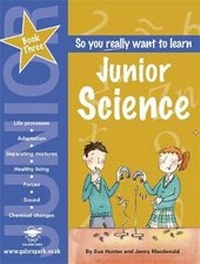
Junior Science: Book 3
Published on 25. November 2010
Book
Paperback/Softback
184 pages
978-1-905735-32-7 (ISBN)
Description
As pupils move into Year 5, they are introduced to more advanced material such as habitats, chemical changes and forces. Challenging but fun, Junior Science Book 3 builds on the material covered in the first two books and feeds directly into So you really want to learn Science 1 for a seamless transition in learning. - Packed with challenging exercises and practical activities to stimulate and enthuse young scientists - 'Did you know?' boxes encourage an active interest in Science and the world around us - Rigorous extension questions will stretch and challenge the most able - Feeds directly into So you really want to learn Science 1 for a seamless transition in learning - Answers for this book are available as a free download.
More details
Series
Language
English
Place of publication
United Kingdom
Publishing group
Hachette Learning
Target group
Primary & secondary/elementary & high school
Illustrations
col. Illustrations
Dimensions
Height: 244 mm
Width: 189 mm
Thickness: 9 mm
Weight
418 gr
ISBN-13
978-1-905735-32-7 (9781905735327)
Copyright in bibliographic data and cover images is held by Nielsen Book Services Limited or by the publishers or by their respective licensors: all rights reserved.
Schweitzer Classification
Other editions
New editions
Sue Hunter | Jenny Macdonald
Science Year 5
Book
06/2015
Galore Park Publishing Ltd
€46.00
Shipment within 10-20 days
Persons
Sue Hunter's teaching experience includes a choir school, a London middle school, GCSE and A Level in the Netherlands. She is Head of Science at St Hugh's School, Oxfordshire, and a member of the Common Entrance 11+ setting team. She has run training courses for prep school teachers, at Malvern College and for the IAPS, and is currently IAPS Support Cp-ordinator for science and a member of the Independent Schools Inspectorate. Jenny Macdonald has been a teacher since 1973 at both state and private schools, and for 10 years has taught Years 3 to 6 at St Hugh's School, Oxfordshire. She also assists her husband with wildlife conservation projects around the world.
Content
Please note that this is a provisional table of contents and is subject to change.Life processes'Mrs Nerg'Animals and plants carry out life processes in their habitatsHabitats and AdaptationHow animals and plants are adapted to survive in different habitatsAdaptations to seasonal changes; hibernation, migration, colour changes and leaf fall Plant life cycles; adaptations to ensure pollination and seed dispersalStudying a habitat Using and making keysEffect of habitat destruction and the need for conservationSoilsWhat is soil?Different types of soil, separation by sieving and drainageLife in the soil; soils as habitats Separating mixturesFurther work on solutions, extension of vocabulary and differing solubilitiesSeparating mixtures by filtration, decanting and evaporationHealthy livingBalanced diet, including all nutrients and the starch testHeart and circulation; the effect of exercise, arteries and veins, and the benefits of exerciseHealth issues; tobacco, drugs and alcoholMore about forcesMagnets, the Earth's magnetic field and compassesComparing the strength of magnetsPulling down and pushing up; gravity and support forcesFloating and sinking; upthrustHear the soundSounds are made when something vibrates; vibrations are not always visibleChanging pitch and loudnessSounds travel through solids, liquids and gases but not a vacuumHearing sounds; the earChemical changesWhat is a chemical change?Changes in action; cooking and manufacturing processes Rusting is caused by oxygen in the presence of waterFuels and burningLooking after the atmosphere; global warming