

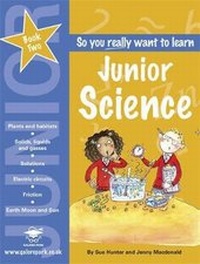
Junior Science: Book 2
Published on 11. December 2009
Book
Paperback/Softback
160 pages
978-1-905735-19-8 (ISBN)
Description
Junior Science Book 2 is suitable for pupils aged 8+ (Year 4 upwards) and covers habitats, plants, solids, liquids and gases, electrical circuits, friction and more. Rigorous exercises and scientific activities throughout are certain to challenge and engage your young scientists. Together with books 1 and 3 this book is ideal to underpin a course of study leading to Common Entrance and entrance exams at 11+. - Packed with challenging exercises and practical activities to stimulate and enthuse young scientists - 'Did you know?' boxes encourage an active interest in science and the world around us - Rigorous extension questions will stretch and challenge the most able - Answers for this book are available as a free download.
More details
Language
English
Place of publication
United Kingdom
Publishing group
Hachette Learning
Target group
Primary & secondary/elementary & high school
Dimensions
Height: 248 mm
Width: 191 mm
Thickness: 8 mm
Weight
364 gr
ISBN-13
978-1-905735-19-8 (9781905735198)
Copyright in bibliographic data and cover images is held by Nielsen Book Services Limited or by the publishers or by their respective licensors: all rights reserved.
Schweitzer Classification
Other editions
New editions
Sue Hunter | Jenny Macdonald
Science Year 4
Book
10/2015
Galore Park Publishing Ltd
€46.00
Shipment within 10-20 days
Persons
Sue Hunter's teaching experience includes a choir school, a London middle school, GCSE and A Level in the Netherlands. She is Head of Science at St Hugh's School, Oxfordshire, and a member of the Common Entrance 11+ setting team. She has run training courses for prep school teachers, at Malvern College and for the IAPS, and is currently IAPS Support Cp-ordinator for science and a member of the Independent Schools Inspectorate. Jenny Macdonald has been a teacher since 1973 at both state and private schools, and for 10 years has taught Years 3 to 6 at St Hugh's School, Oxfordshire. She also assists her husband with wildlife conservation projects around the world.
Content
Please note that this is a provisional table of contents and is subject to change.Chapter 1: HabitatsPlants and animals in different habitatsFood chains in different habitats, herbivores, carnivores and omnivoresChapter 2: PlantsFlowering plant structure and the functions of leaf, stem, roots and flowerHow plants feed; Introduction to photosynthesisPlant growth; the effect of light, temperature, water and mineral saltsChapter 3: Solids, liquids and gasesProperties of solids, liquids and gasesParticle theory Changes of state, thermometers and water cycleChapter 4: SolutionsSoluble and insoluble materialsFactors affecting the rate of dissolvingChapter 5: Keeping warm, keeping coolThermal insulators and conductorsChapter 6: Electric circuitsMaking a complete circuitUsing components in series circuits; Cells, lamps, motors, buzzers and switchesChanging circuits; The effect of changing number of cells/lamps on brightnessElectrical conductors and insulatorsChapter 7: FrictionUsing force metersFriction can be useful or a nuisanceInvestigations into friction between different surfacesReducing frictionAir resistance and streamliningChapter 8: Earth, Moon and SunEarth, Moon and Sun are all sphericalWhat orbits round what?How do we get day and nightPlanets in the Solar System