

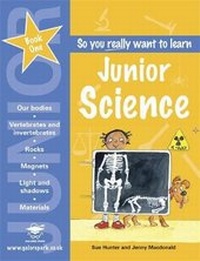
Junior Science: Book 1
Published on 2. October 2008
Book
Paperback/Softback
128 pages
978-1-905735-17-4 (ISBN)
Description
Junior Science Book 1 is suitable for pupils aged 7+ (Year 3 upwards) and builds an excellent foundation for scientific study, exploring the study of our bodies, vertebrates and invertebrates, light and shadows, materials, rocks and dinosaurs. - Packed with challenging exercises and practical activities to stimulate and enthuse young scientists - 'Did you know?' boxes encourage an active interest in science and the world around us - Rigorous extension questions will stretch and challenge the most able - Answers for this book are available as a free download.
Reviews / Votes
"An excellent resource with differentiated questions, clear diagrams and interesting pictures." Charlie Minogue, Head of Science, Aldwickbury School "Children today are growing up in a world where the significance of science is increasingly evident and impinges on many aspects of their lives, generating interest, amazement and curiosity. It is the responsibility of educators to foster and stimulatethese traits and excite children to learn and understand the world of science that surrounds them. This book, the first in a series of 3, is written by experienced teachers of this age range, provides a superb mix of relevant scientific fact, suggested practical activities and exercises. It will excite the curiosity of the young and stimulate their natural demand to know andunderstand more of the world of science about them. So often I hear: 'Grandpa, do you know...?' Children are innately curious and demand knowledge; it is our role to stimulate and guide their development. This book does this in full measure." David Penter, Chairman of the ISEB Science Panel "Fantastic! The most scientifically detailed textbook I know for this age range. A colourful, vibrant book that is jam-packed with great science. Pupils will love to read this in school and at home." Andrew Magnay, New College School, OxfordMore details
Language
English
Place of publication
United Kingdom
Publishing group
Hachette Learning
Target group
Primary & secondary/elementary & high school
Dimensions
Height: 247 mm
Width: 191 mm
Thickness: 7 mm
Weight
300 gr
ISBN-13
978-1-905735-17-4 (9781905735174)
Copyright in bibliographic data and cover images is held by Nielsen Book Services Limited or by the publishers or by their respective licensors: all rights reserved.
Schweitzer Classification
Other editions
New editions
Sue Hunter | Jenny Macdonald
Science Year 3
Book
09/2015
Galore Park Publishing Ltd
€46.00
Article exhausted; check different version
Persons
Sue Hunter's teaching experience includes choir school, a London middle school, GCSE and A Level in the Netherlands. She is Head of Science at St Hugh's School, Oxfordshire and a member of the Common Entrance 11+ setting team. She has run training courses for prep school teachers, at Malvern College and for the IAPS, and is currently IAPS Support Co-ordinator for science and a member of the Independent Schools Inspectorate. Jenny MacDonald has been a teacher since 1973 in both state and private schools, and for 10 years has taught Years 3 to 6 at St Hugh's School, Oxfordshire. She also assists her husband with wildlife conservation projects around the world.
Content
IntroductionWhat is science?How to be a scientistChapter 1: Our bodiesWhat is inside?Fuel for our bodiesTeethBones and jointsThe story of scurvyChapter 2: Vertebrates and invertebratesSorting plants and animalsVertebratesInvertebratesThe humble bumble or the busy honey bee: Do you know the difference?Chapter 3: Rocks Inside the EarthDifferent types of rocksWhat are fossils?DinosaursChapter 4: Looking at magnetsMagnetic or non-magnetic?Attracting and repellingInvestigating magnetic force fieldsA short history of compassesChapter 5: Light and shadowsWhere does light come from?SeeingLight travellingOpaque, transparent and translucentShadowsChapter 6: MaterialsWhat are materials?Properties of materialsTesting of materialsNatural or manmade?A lucky walk