

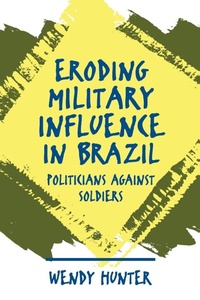
Eroding Military Influence in Brazil
Politicians Against Soldiers
Published on 31. March 1997
Book
Paperback/Softback
260 pages
978-0-8078-4620-9 (ISBN)
Description
Wendy Hunter explores civil-military relations in Brazil following the transition to civilian leadership in 1985. She documents a marked, and surprising, decline in the political power of the armed forces, even as they have remained involved in national policy making. To account for the success of civilian politicians, Hunter invokes rational-choice theory in arguing that politicians will contest even powerful forces in order to gain widespread electoral support. Many observers expected Brazil's fledgling democracy to remain under the firm direction of the military, which had tightly controlled the transition from authoritarian to civilian rule. Hunter carefully refutes this conventional wisdom by demonstrating the ability of even a weak democratic regime to expand its autonomy relative to a once-powerful military, thanks to the electoral incentives that motivate civilian politicians. Based on interviews with key participants and on extensive archival research, Hunter's analysis of developments in Brazil suggests a more optimistic view of the future of civilian democratic rule in Latin America.
More details
Edition
New edition
Language
English
Place of publication
Chapel Hill
United States
Target group
College/higher education
Professional and scholarly
Edition type
New edition
Dimensions
Height: 234 mm
Width: 156 mm
Thickness: 15 mm
Weight
448 gr
ISBN-13
978-0-8078-4620-9 (9780807846209)
Copyright in bibliographic data and cover images is held by Nielsen Book Services Limited or by the publishers or by their respective licensors: all rights reserved.
Schweitzer Classification
Other editions
Additional editions
E-Book
11/2000
The University of North Carolina Press
€29.49
Available for download
Person
Wendy Hunter is assistant professor of government at the University of Texas at Austin.