

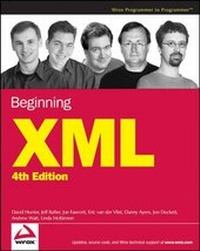
Beginning XML
4th Edition
Published on 18. May 2007
Book
Paperback/Softback
1080 pages
978-0-470-11487-2 (ISBN)
Description
The perfect resource for beginning XML programmers, this guidebook clearly shows you what XML is, how to use it, and what technologies surround it. The authors build on the strengths of previous editions while covering the latest changes in the XML landscape such as XQuery, RSS and Atom, and Ajax. The most recent specifications are presented along with best practices to follow when developing XML solutions.
The fourth edition will help you quickly progress from XML basics to more advanced programming techniques. You'll delve into the state of the art for XML and databases, discover how to query XML information, retrieve data, and create new XML documents. In addition, you'll learn how to publish information on the web, design dynamic interactive graphics, and make interactive forms. You'll be able to apply this information to build robust applications in real-world situations.
What you will learn from this book
* Specific rules to follow for constructing XML
*
How to create and use different XML vocabularies
*
Steps for extracting information and converting it to HTML or other formats
*
Strategies for storing and retrieving XML documents
*
How to manipulate XML using DOM and SAX
*
Tips for improving communication with XML by using Ajax techniques, RSS, and SOAP
*
How to use CSS to add visual styles to your XML documents
Who this book is for
This book is for any programmer interested in learning how to use XML. Some knowledge of web programming or data exchange techniques is helpful but not necessary.
Wrox Beginning guides are crafted to make learning programming languages and technologies easier than you think, providing a structured, tutorial format that will guide you through all the techniques involved.
The fourth edition will help you quickly progress from XML basics to more advanced programming techniques. You'll delve into the state of the art for XML and databases, discover how to query XML information, retrieve data, and create new XML documents. In addition, you'll learn how to publish information on the web, design dynamic interactive graphics, and make interactive forms. You'll be able to apply this information to build robust applications in real-world situations.
What you will learn from this book
* Specific rules to follow for constructing XML
*
How to create and use different XML vocabularies
*
Steps for extracting information and converting it to HTML or other formats
*
Strategies for storing and retrieving XML documents
*
How to manipulate XML using DOM and SAX
*
Tips for improving communication with XML by using Ajax techniques, RSS, and SOAP
*
How to use CSS to add visual styles to your XML documents
Who this book is for
This book is for any programmer interested in learning how to use XML. Some knowledge of web programming or data exchange techniques is helpful but not necessary.
Wrox Beginning guides are crafted to make learning programming languages and technologies easier than you think, providing a structured, tutorial format that will guide you through all the techniques involved.
More details
Edition
4., Auflage
Language
English
Place of publication
Chichester
United Kingdom
Publishing group
John Wiley and Sons Ltd
Target group
College/higher education
Edition type
Revised edition
Dimensions
Height: 23.3 cm
Width: 18.7 cm
Thickness: 50 mm
Weight
1338 gr
ISBN-13
978-0-470-11487-2 (9780470114872)
Schweitzer Classification
Other editions
New editions
Joe Fawcett | Danny Ayers | Liam R. E. Quin
Beginning XML
Book
07/2012
5th Edition
Wrox Press
€37.50
Shipment within 15-20 days
Previous edition

David Hunter | Andrew Watt | Jeff Rafter
Beginning XML
Book
09/2004
3rd Edition
Hungry Minds Inc,U.S.
€42.90
Article exhausted; check for reprint
Persons
David Hunter is a Senior Technical Consultant for CGI, a full-service IT and business process services partner. Providing technical leadership and guidance for solving his clients' business problems, he is a jack-of-all-trades and master of some. With a career that has included design, development, support, training, writing, and other roles, he has had extensive experience building scalable, reliable, enterprise-class applications. David loves to peek under the hood at any new technology that comes his way, and when one catches his fancy, he really gets his hands dirty. He loves nothing more than sharing these technologies with others.
Jeff Rafter is an independent consultant based in Redlands, California. His focus is one emerging technology and web standards, including XML and validation. he currently works with Baobab Health Partnership with a focus on improving world health.
Joe Fawcett (http://joe.fawcett.name) started programming in the 1970s and worked briefly in IT when leaving full-time education. he then pursued a more checkered career before returning to software development in 1994. In 2003 he was awarded the title of Microsoft Most Valuable Professional in XML for community contributions and technical expertise; he has subsequently been re-awarded every year since. Joe currently works in London and is head of software development for FTC Kaplan Ltd., a leading international provider of accountancy and business training.
Eric van der Vlist is an independent consultant and trainer. His domains of expertise include web development and XML technologies. He is the creator and main editor of XMLfr.org, the main site dedicated to XML technologies in French, the lead author of Professional Web 2.0 Programming, the author of the O'Reilly animal books XML Schema and RELAX NG and a member or the ISO DSDL (http://dsdl.org) working group focused on XML schema languages. he is based in Paris and can be reached at vdv@dyomedea.com, or meet him at one of the many conferences where he presents his projects.
Danny Ayers is a freelance developer and consultant specializing in cutting-edge web technologies. His blog (http://dannyayers.com) tends to feature material relating to the Semantic Web and/or cat photos.
Linda McKinnon has more than 10 years of experience as a successful trainer and network engineer, assisting both private and public enterprises in network architecture design, implementation, system administration, and RP procurement. She is a renowned mentor and has published numerous Linux study guide for Wiley Press and Gearhead Press.
Jeff Rafter is an independent consultant based in Redlands, California. His focus is one emerging technology and web standards, including XML and validation. he currently works with Baobab Health Partnership with a focus on improving world health.
Joe Fawcett (http://joe.fawcett.name) started programming in the 1970s and worked briefly in IT when leaving full-time education. he then pursued a more checkered career before returning to software development in 1994. In 2003 he was awarded the title of Microsoft Most Valuable Professional in XML for community contributions and technical expertise; he has subsequently been re-awarded every year since. Joe currently works in London and is head of software development for FTC Kaplan Ltd., a leading international provider of accountancy and business training.
Eric van der Vlist is an independent consultant and trainer. His domains of expertise include web development and XML technologies. He is the creator and main editor of XMLfr.org, the main site dedicated to XML technologies in French, the lead author of Professional Web 2.0 Programming, the author of the O'Reilly animal books XML Schema and RELAX NG and a member or the ISO DSDL (http://dsdl.org) working group focused on XML schema languages. he is based in Paris and can be reached at vdv@dyomedea.com, or meet him at one of the many conferences where he presents his projects.
Danny Ayers is a freelance developer and consultant specializing in cutting-edge web technologies. His blog (http://dannyayers.com) tends to feature material relating to the Semantic Web and/or cat photos.
Linda McKinnon has more than 10 years of experience as a successful trainer and network engineer, assisting both private and public enterprises in network architecture design, implementation, system administration, and RP procurement. She is a renowned mentor and has published numerous Linux study guide for Wiley Press and Gearhead Press.
Content
Acknowledgments.
Introduction.
Part I: Introduction.
Chapter 1: What Is XML?
Chapter 2: Well-Formed XML.
Chapter 3: XML Namespaces.
Part II: Validation.
Chapter 4: Document Type Definitions.
Chapter 5: XML Schemas.
Chapter 6: RELAX NG.
Part III: Processing.
Chapter 7: XPath.
Chapter 8: XSLT.
Part IV: Databases.
Chapter 9: XQuery, the XML Query Language.
Chapter 10: XML and Databases.
Part V: Programming.
Chapter 11: The XML Document Object Model (DOM).
Chapter 12: Simple API for XML (SAX).
Part VI: Communication.
Chapter 13: RSS, Atom, and Content Syndication.
Chapter 14: Web Services.
Chapter 15: SOAP and WSDL.
Chapter 16: Ajax.
Part VII: Display.
Chapter 17: Cascading Style Sheets (CSS).
Chapter 18: XHTML.
Chapter 19: Scalable Vector Graphics (SVG).
Chapter 20: XForms.
Part VIII: Case Study.
Chapter 21: Case Study: Payment Calculator.
Chapter 22: Case Study: Payment Calculator--Ruby on Rails.
Appendix A. Exercise Solutions.
Appendix B. XPath Reference.
Appendix C. XSLT Reference.
Appendix D. The XML Document Object Model.
Appendix E. XML Schema Element and Attribute Reference.
Appendix F. XML Schema Data Types Reference.
Appendix G. SAX 2.0.2 Reference.
Index.
Introduction.
Part I: Introduction.
Chapter 1: What Is XML?
Chapter 2: Well-Formed XML.
Chapter 3: XML Namespaces.
Part II: Validation.
Chapter 4: Document Type Definitions.
Chapter 5: XML Schemas.
Chapter 6: RELAX NG.
Part III: Processing.
Chapter 7: XPath.
Chapter 8: XSLT.
Part IV: Databases.
Chapter 9: XQuery, the XML Query Language.
Chapter 10: XML and Databases.
Part V: Programming.
Chapter 11: The XML Document Object Model (DOM).
Chapter 12: Simple API for XML (SAX).
Part VI: Communication.
Chapter 13: RSS, Atom, and Content Syndication.
Chapter 14: Web Services.
Chapter 15: SOAP and WSDL.
Chapter 16: Ajax.
Part VII: Display.
Chapter 17: Cascading Style Sheets (CSS).
Chapter 18: XHTML.
Chapter 19: Scalable Vector Graphics (SVG).
Chapter 20: XForms.
Part VIII: Case Study.
Chapter 21: Case Study: Payment Calculator.
Chapter 22: Case Study: Payment Calculator--Ruby on Rails.
Appendix A. Exercise Solutions.
Appendix B. XPath Reference.
Appendix C. XSLT Reference.
Appendix D. The XML Document Object Model.
Appendix E. XML Schema Element and Attribute Reference.
Appendix F. XML Schema Data Types Reference.
Appendix G. SAX 2.0.2 Reference.
Index.