

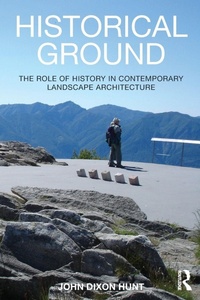
Historical Ground
The role of history in contemporary landscape architecture
1st Edition
Published on 10. February 2014
Book
Paperback/Softback
184 pages
978-0-415-81413-3 (ISBN)
Description
Historical Ground investigates how contemporary landscape architecture invokes and displays the history of a site. In the light of modernism's neglect of history, these essays by John Dixon Hunt explore how, in fact, designers do attach importance to how a location manifests its past.
The process involves, on the one hand, registering how geography, topography and climate determine design and, on the other, how history discovered or even created for a site can structure its design and its reception. History can be evident, exploited, invented or feigned - it can be original or a new history which becomes part of how we view a place.
Landscapes discussed in this book come from across Europe and the United States, highlighting the work of designers who have drawn from site history in their design, or have purposefully created their own historical account of the location. The author explores not just the historical past, but how new ground can be given a life and a future.
The process involves, on the one hand, registering how geography, topography and climate determine design and, on the other, how history discovered or even created for a site can structure its design and its reception. History can be evident, exploited, invented or feigned - it can be original or a new history which becomes part of how we view a place.
Landscapes discussed in this book come from across Europe and the United States, highlighting the work of designers who have drawn from site history in their design, or have purposefully created their own historical account of the location. The author explores not just the historical past, but how new ground can be given a life and a future.
Reviews / Votes
"This thin gem of a book presents a dense topography of ideas reflecting the career-long imaginative energy that the author has put into understanding the evolution of place. As designer and critic, Hunt (emer., Univ. of Pennsylvania) has contributed to the education of generations of landscape architects. Through his senses (as detailed here), the ancient concept of "genius of place" takes on new meanings as people strive to comprehend landscape and nature in a complex framework of history and evolution. Critical of the contemporary "consumption" of landscape, Hunt does not shy from critiquing his colleagues' work as well. Summing Up: Highly recommended. Upper-division undergraduates and above." - S. Hammer, Boston University, CHOICE Review, December 2014.More details
Language
English
Place of publication
London
United Kingdom
Publishing group
Taylor & Francis Ltd
Target group
College/higher education
Illustrations
74 s/w Photographien bzw. Rasterbilder
74 Halftones, black and white
Dimensions
Height: 234 mm
Width: 156 mm
Thickness: 10 mm
Weight
289 gr
ISBN-13
978-0-415-81413-3 (9780415814133)
Copyright in bibliographic data and cover images is held by Nielsen Book Services Limited or by the publishers or by their respective licensors: all rights reserved.
Schweitzer Classification
Other editions
Additional editions
Book
02/2014
1st Edition
Routledge
€260.70
Shipment within 15-20 days
Person
John Dixon Hunt is Emeritus Professor of the History and Theory of Landscape at the University of Pennsylvania. He is the author of more than a dozen books and edits the Taylor & Francis journal Studies in the History of Gardens & Designed Landscapes and is the series editor of the Penn Studies in Landscape Architecture.
Content
1. Preliminary orientations 2. History as geology, topography and weather 3. Examples of history in earlier landscape architecture (Renaissance Rome, Desert de Retz, Les Buttes Chaumont) 4. Five Paris sites: a scale of contemporary interventions and inventions 5. History found and exploited in a specific place today 6. History "invented" for a site today 7. Land Art, Garden Festivals & historical ground 8. Afterword/Afterlife