

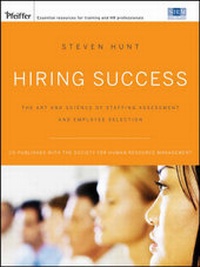
Hiring Success
The Art and Science of Staffing Assessment and Employee Selection
2nd Edition
Published on 3. July 2007
Book
Paperback/Softback
304 pages
978-0-7879-9648-2 (ISBN)
Description
Hiring Success is a comprehensive guide for using staffing assessments to hire the best employees. Research-based, but written in easy-to-understand terms, the book explains what staffing assessments are, why they work, and how to use them. Hiring Success is an important resource for improving the accuracy and efficiency of hiring selection decisions and effectively incorporating assessments into any company's staffing process.
Reviews / Votes
"Hiring Success will prove to be a useful handbook and reference guide to HR professionals seeking to better understand and utilize employee selection and assessment tools."?Adam Malamut, vice president, human resources, Marriott International "Dr. Hunt's book is the perfect combination of decision science and management practice. If you are interested in successful hires you must read this book."
?Jac Fitz-enz, Ph.D., CEO, Human Capital Source
"Dr. Hunt clearly illustrates the critical contribution of improved employee selection methods to the achievement of strategic business goals."
?Ann Gowdey, manager, assessment and development, United Technologies Corporation, Learning and Development
"It is simply a useful toolkit filled with helpful suggestions. . . it will make the process a lot smoother in the long-run!"
?Maggie Ricketts, PHR, director, recruitment & administration, Luxottica Retail
"A book that is both accessible and scientifically rigorous, an excellent resource for both students and practitioners of HR."
?Donald Truxillo, professor of Industrial Organizational Psychology, Portland State University, fellow, Society for Industrial & Organizational Psychology (SIOP)
"Strikes a superb and much needed balance between the complexities of assessments and the practical application and effectiveness they offer as a selection tool."
?Paul Riddle, organizational and leadership development manager, Southeastern Freight Lines
"Hiring Success is a must read for anyone interested in creating a hiring process that is both sound and maximally effective. An excellent reference for using assessments to achieve measurable business results."
?Charles Handler, Ph.D. PHR, president, Rocket-Hire Inc.
"Full of useful nuggets, this book helps guide businesses of all kinds. . . . Ensures what you measure aligns with your business objectives and culture."
?Vito Romano, director of employee development, Costco Inc.
More details
Edition
2nd edition
Language
English
Place of publication
United States
Publishing group
John Wiley & Sons Inc
Target group
Professional and scholarly
Dimensions
Height: 235 mm
Width: 179 mm
Thickness: 15 mm
Weight
490 gr
ISBN-13
978-0-7879-9648-2 (9780787996482)
Copyright in bibliographic data and cover images is held by Nielsen Book Services Limited or by the publishers or by their respective licensors: all rights reserved.
Schweitzer Classification
Other editions
Additional editions
E-Book
07/2008
2nd Edition
Pfeiffer
€41.99
Available for download
Person
Steven Hunt, Ph.D., SPHR, is chief scientist for Kronos Talent Management Division. He has helped designed staffing assessment processes that have supported hundreds of thousands of hiring decisions for positions ranging from entry-level staff to senior-level executives. The Society for Human Resource Management (SHRM) is the world's largest association devoted to human resource management. Representing more than 210,000 individual members, the Society's mission is both to serve human resource management professionals and to advance the profession. Founded in 1948, SHRM currently has more than 550 affiliated chapters within the United States and members in more than 100 countries. Visit SHRM Online at www.shrm.org.
Content
List of Sidebars, Tables, and Figures xi
Author's Foreword xiii
Acknowledgments xv
ONE Introduction 1
What Information Is the Book Based On? 7
Assessments: The Difference Between Success and Failure 14
TWO What Staffing Assessments Measure, Why They Work, and When to Use Them 19
What Do Assessments Measure? 20
Why Do Assessments Work? 25
When Is It Useful to Use Staffing Assessments? 27
Concluding Remarks: Why Assessments Work 36
THREE Different Types of Staffing Assessments 39
Categorizing Assessments Based on How They Collect 40
Candidate Information
Physical Exams 41
Investigations 51
Interviews 52
Resume Screens 55
Self-Report Measures 56
Knowledge, Skill, and Ability Tests 65
Situational Measures 69
Behavioral Versus Direct Assessments 72
Concluding Remarks: Different Types of Assessments 75
FOUR Evaluating the Effectiveness of Staffing Assessments 79
How Assessments Work 80
Assessment Validity: How to Determine How Well an Assessment Is Working 86
Concluding Remarks: Choosing What Assessments to Use 109
FIVE Defining Job Performance and Its Relationship to Assessments 119
Step 1. Identify Key Performance Outcomes 121
Step 2. Use Job Analysis to Define and Describe Critical Employee Behaviors 124
Step 3. Choose an Effective Assessment 128
Step 4. Appropriately Collecting and Interpreting Assessment Data 136
Concluding Remarks: Linking Assessment Processes to Job Performance 138
SIX Common Criticisms of Staffing Assessments 141
Criticism 1: Staffing Assessments are Not Very Accurate 142
Criticism 2: Staffing Assessments can Be Faked by Applicants 146
Criticism 3: Staffing Assessments Are Not Worth the Cost Required to Use Them 150
Criticism 4: Staffing Assessments Pose a Legal Risk 152
Criticism 5: Staffing Assessments Are an Unfair Way to Evaluate People 157
Criticism 6: Staffing Assessments Are Offensive to Candidates 160
Criticism 7: Staffing Assessments Add Too Much Time to the Hiring Process 167
Concluding Remarks: Should Companies Use Staffing Assessments? 170
SEVEN Choosing Among Different Assessment Methods 175
Method 1. No Standardized Assessment: Start at the Bottom and Work Up 183
Method 2. Self-Report Pre-Screening Questionnaires: The Value of Structure 184
Method 3. Applicant Investigations: Avoiding Catastrophic Hiring Mistakes 184
Method 4. Structured Interviews: Maximizing Time Spent with Candidates 185
Method 5. Broad Self-Report and Situational Judgment Measures: Asking Candidates for Greater Levels of Self-Description 186
Method 6. Broad Knowledge and Skills Tests: Testing Basic Job Requirements 189
Method 7. Broad Ability Tests: Getting a General Sense of Candidates' Ability to Learn and Solve Problems 190
Method 8. Integrating Broad Self-Report Measures, Knowledge and Skills Tests, and Ability Tests: Predicting Maximal and Typical Performance 193
Method 9. Localized Scoring: Accurately Interpreting Candidate Responses 194
Method 10. Context-Specific Self-Report Measures: Asking Candidates to Describe Themselves in Greater Detail 199
Method 11. Context-Specific Knowledge, Skills, and Ability Tests: Seeing What a Candidate Can Actually Do 201
Method 12. Integrating Context-Specific Self-Report Measures and Knowledge, Skills, and Ability Tests: Predicting Highly Specific Types of Maximal and Typical Performance 202
Method 13. Advanced, Non-Linear Scoring: "Turbo-Charging" Assessment Results 202
Concluding Remarks: Determining What Assessment Methods to Use 206
EIGHT Incorporating Staffing Assessments into the Hiring Process 209
Principles of Staffing Assessment Process Design 209
Designing Staffing Processes for Entry-Level Jobs 215
Sample Staffing Assessment Process for Professional Jobs 227
Concluding Remarks: Using Assessments 235
NINE Conclusion 237
Glossary of Common Assessment Terms 243
Index 271
About the Author 281
Pfeiffer Publications Guide 283
Author's Foreword xiii
Acknowledgments xv
ONE Introduction 1
What Information Is the Book Based On? 7
Assessments: The Difference Between Success and Failure 14
TWO What Staffing Assessments Measure, Why They Work, and When to Use Them 19
What Do Assessments Measure? 20
Why Do Assessments Work? 25
When Is It Useful to Use Staffing Assessments? 27
Concluding Remarks: Why Assessments Work 36
THREE Different Types of Staffing Assessments 39
Categorizing Assessments Based on How They Collect 40
Candidate Information
Physical Exams 41
Investigations 51
Interviews 52
Resume Screens 55
Self-Report Measures 56
Knowledge, Skill, and Ability Tests 65
Situational Measures 69
Behavioral Versus Direct Assessments 72
Concluding Remarks: Different Types of Assessments 75
FOUR Evaluating the Effectiveness of Staffing Assessments 79
How Assessments Work 80
Assessment Validity: How to Determine How Well an Assessment Is Working 86
Concluding Remarks: Choosing What Assessments to Use 109
FIVE Defining Job Performance and Its Relationship to Assessments 119
Step 1. Identify Key Performance Outcomes 121
Step 2. Use Job Analysis to Define and Describe Critical Employee Behaviors 124
Step 3. Choose an Effective Assessment 128
Step 4. Appropriately Collecting and Interpreting Assessment Data 136
Concluding Remarks: Linking Assessment Processes to Job Performance 138
SIX Common Criticisms of Staffing Assessments 141
Criticism 1: Staffing Assessments are Not Very Accurate 142
Criticism 2: Staffing Assessments can Be Faked by Applicants 146
Criticism 3: Staffing Assessments Are Not Worth the Cost Required to Use Them 150
Criticism 4: Staffing Assessments Pose a Legal Risk 152
Criticism 5: Staffing Assessments Are an Unfair Way to Evaluate People 157
Criticism 6: Staffing Assessments Are Offensive to Candidates 160
Criticism 7: Staffing Assessments Add Too Much Time to the Hiring Process 167
Concluding Remarks: Should Companies Use Staffing Assessments? 170
SEVEN Choosing Among Different Assessment Methods 175
Method 1. No Standardized Assessment: Start at the Bottom and Work Up 183
Method 2. Self-Report Pre-Screening Questionnaires: The Value of Structure 184
Method 3. Applicant Investigations: Avoiding Catastrophic Hiring Mistakes 184
Method 4. Structured Interviews: Maximizing Time Spent with Candidates 185
Method 5. Broad Self-Report and Situational Judgment Measures: Asking Candidates for Greater Levels of Self-Description 186
Method 6. Broad Knowledge and Skills Tests: Testing Basic Job Requirements 189
Method 7. Broad Ability Tests: Getting a General Sense of Candidates' Ability to Learn and Solve Problems 190
Method 8. Integrating Broad Self-Report Measures, Knowledge and Skills Tests, and Ability Tests: Predicting Maximal and Typical Performance 193
Method 9. Localized Scoring: Accurately Interpreting Candidate Responses 194
Method 10. Context-Specific Self-Report Measures: Asking Candidates to Describe Themselves in Greater Detail 199
Method 11. Context-Specific Knowledge, Skills, and Ability Tests: Seeing What a Candidate Can Actually Do 201
Method 12. Integrating Context-Specific Self-Report Measures and Knowledge, Skills, and Ability Tests: Predicting Highly Specific Types of Maximal and Typical Performance 202
Method 13. Advanced, Non-Linear Scoring: "Turbo-Charging" Assessment Results 202
Concluding Remarks: Determining What Assessment Methods to Use 206
EIGHT Incorporating Staffing Assessments into the Hiring Process 209
Principles of Staffing Assessment Process Design 209
Designing Staffing Processes for Entry-Level Jobs 215
Sample Staffing Assessment Process for Professional Jobs 227
Concluding Remarks: Using Assessments 235
NINE Conclusion 237
Glossary of Common Assessment Terms 243
Index 271
About the Author 281
Pfeiffer Publications Guide 283