

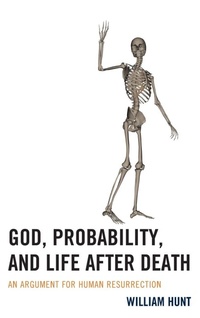
God, Probability, and Life after Death
An Argument for Human Resurrection
Published on 22. November 2017
Book
Hardback
286 pages
978-1-4985-2606-7 (ISBN)
Description
God, Probability and Life after Death reveals its objective in its title, namely, to present an exploratory argument concerning the probability of human resurrection. The exploratory argument follows a probabilistic passage along an evidential trail to the discovery of the probability of life after death. It is a trail that the reader can personally engage with in order to reach their own conclusion and even introduce additional evidence they think relevant.
The argument begins with the probability of the existence of God, and once a position is established on this issue, the argument becomes empowered for the next stage, which is to address the evidence for human resurrection, namely, the Resurrection of Jesus, near-death experiences and apparitions.
The probabilistic relationship between the evidence and the resurrection hypothesis is critically examined throughout the book by engaging the potential views of an atheist and agnostic in addition to that of a theist. On this probabilistic journey, other issues relevant to the resurrection argument are introduced, such as personal identity and the possibility of resurrection given the nature of our world. Evidence and argument for a non-supernatural possibility for human resurrection are also considered.
Significantly, the author does not assume the normal spiritual approach to human resurrection, when a disembodied soul leaves the body to continue a spiritual existence in a ghostly realm. Instead, a materialistic approach is taken, whereby the resurrected person survives in bodily form in a physical realm.
The use of probability theory is intended to keep the evidential argument within the bounds of coherent reasoning. It also enables the argument to link one piece of evidence to the next in a probabilistic sequence that eventually leads to the conclusion that human resurrection is not only possible, it is also very likely.
The argument begins with the probability of the existence of God, and once a position is established on this issue, the argument becomes empowered for the next stage, which is to address the evidence for human resurrection, namely, the Resurrection of Jesus, near-death experiences and apparitions.
The probabilistic relationship between the evidence and the resurrection hypothesis is critically examined throughout the book by engaging the potential views of an atheist and agnostic in addition to that of a theist. On this probabilistic journey, other issues relevant to the resurrection argument are introduced, such as personal identity and the possibility of resurrection given the nature of our world. Evidence and argument for a non-supernatural possibility for human resurrection are also considered.
Significantly, the author does not assume the normal spiritual approach to human resurrection, when a disembodied soul leaves the body to continue a spiritual existence in a ghostly realm. Instead, a materialistic approach is taken, whereby the resurrected person survives in bodily form in a physical realm.
The use of probability theory is intended to keep the evidential argument within the bounds of coherent reasoning. It also enables the argument to link one piece of evidence to the next in a probabilistic sequence that eventually leads to the conclusion that human resurrection is not only possible, it is also very likely.
Reviews / Votes
. . . . [this] book is valuable for the challenge it offers the scholar. What should theology look like? What are appropriate theological questions? What should be the relationship between theology and other disciplines? In this book the scholar is forced to confront these, and other, worthwhile quandaries. * Reading Religion *More details
Language
English
Place of publication
United States
Publishing group
Bloomsbury Publishing Plc
Target group
Professional and scholarly
Dimensions
Height: 235 mm
Width: 157 mm
Thickness: 22 mm
Weight
622 gr
ISBN-13
978-1-4985-2606-7 (9781498526067)
Copyright in bibliographic data and cover images is held by Nielsen Book Services Limited or by the publishers or by their respective licensors: all rights reserved.
Schweitzer Classification
Other editions
Additional editions
E-Book
11/2017
1st Edition
Lexington Books
€107.99
Available for download
E-Book
11/2017
1st Edition
Lexington Books
€107.99
Available for download
Person
William Hunt is visiting research fellow at Heythrop College.
Content
Introduction
PART I: Divine Chance: God and Probability Theory
Chapter 1: Who's God? Divine Quintessence
Chapter 2: A Sporting Chance: Probability
PART II: Under Starter's Orders: Evidence for God
Chapter 3: They're Off: Evidence from Divine Creation
Chapter 4: The bookie's Favourite: The Problem of Evil
Chapter 5: A Short Head: Evidence from the Divine/Human Relationship
PART III: The Winning Post: The Chances of Human Resurrection
Chapter 6: A Dark Horse: Person-identity
Chapter 7: The Field: The Possibility of Resurrection
Chapter 8: Home Straight: The Probability of Resurrection
Stewards' Enquiry: Conclusion
Appendix 1: The Auxiliary Assumption Requirement
Appendix 2: Overdetermination of Evidence
PART I: Divine Chance: God and Probability Theory
Chapter 1: Who's God? Divine Quintessence
Chapter 2: A Sporting Chance: Probability
PART II: Under Starter's Orders: Evidence for God
Chapter 3: They're Off: Evidence from Divine Creation
Chapter 4: The bookie's Favourite: The Problem of Evil
Chapter 5: A Short Head: Evidence from the Divine/Human Relationship
PART III: The Winning Post: The Chances of Human Resurrection
Chapter 6: A Dark Horse: Person-identity
Chapter 7: The Field: The Possibility of Resurrection
Chapter 8: Home Straight: The Probability of Resurrection
Stewards' Enquiry: Conclusion
Appendix 1: The Auxiliary Assumption Requirement
Appendix 2: Overdetermination of Evidence