

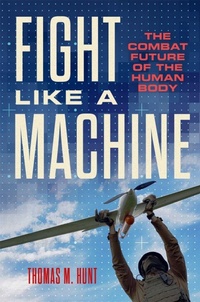
Fight Like a Machine
The Combat Future of the Human Body
Will be published approx. on 14. July 2026
Book
Hardback
240 pages
978-0-8061-9708-1 (ISBN)
Description
Emerging technologies-from AI and robotics to digital gaming-are transforming the role of the human body in warfare, even as a decline in the mental and physical fitness of the U.S. population is presenting new challenges for building a strong military force. In light of these cultural changes, Fight Like a Machine: The Combat Future of the Human Body makes an eloquent case for rethinking what it means to be "fighting fit" in today's military-and what this means, in turn, for military recruitment, training, and strategy.
Drawing on military history, kinesiology, and defense studies, Thomas M. Hunt argues that the traditional paradigm of physical prowess in warfare is being eclipsed by a new model of human-machine integration. His extensive research suggests that the conventional image of the soldier-defined by physical strength, speed, and endurance-is being reshaped by digital tools, robotics, and artificial intelligence. As seen in Ukraine and elsewhere, success in today's wars demands cognitive agility and technological fluency alongside brute military force-a trend that favors greater inclusion of women in combat roles, as well as greater emphasis on digital-native skill sets and the demands of human-machine collaboration. Ukraine, employing an armed force of largely middle-aged soldiers with great technical proficiency, offers a prime example of how nations must evolve militarily if they are to successfully conduct-or withstand-war.
Hunt's book marks a starting point for just such an evolution-and lays out in clear, accessible terms what sort of change is needed, why, and what's at stake: nothing less than the future of the American military.
Drawing on military history, kinesiology, and defense studies, Thomas M. Hunt argues that the traditional paradigm of physical prowess in warfare is being eclipsed by a new model of human-machine integration. His extensive research suggests that the conventional image of the soldier-defined by physical strength, speed, and endurance-is being reshaped by digital tools, robotics, and artificial intelligence. As seen in Ukraine and elsewhere, success in today's wars demands cognitive agility and technological fluency alongside brute military force-a trend that favors greater inclusion of women in combat roles, as well as greater emphasis on digital-native skill sets and the demands of human-machine collaboration. Ukraine, employing an armed force of largely middle-aged soldiers with great technical proficiency, offers a prime example of how nations must evolve militarily if they are to successfully conduct-or withstand-war.
Hunt's book marks a starting point for just such an evolution-and lays out in clear, accessible terms what sort of change is needed, why, and what's at stake: nothing less than the future of the American military.
Reviews / Votes
"Does every soldier need to look like G.I. Joe? To understand the realities of the modern battlefield, first look to Thomas Hunt's fascinating history of the human-machine interface on the frontlines. His provocative analysis offers a useful guide to thinking about military success in the decades ahead."-Admiral James Stavridis, US Navy (Ret.), 16th Supreme Allied Commander of NATO and author of 2084: A Novel of Future War"A thought-provoking and creative rethinking of the human body's role within modern warfare. Hunt combines a careful historical understanding of what it meant for bodies for be 'fit to fight' with a wide-ranging insight that encourages readers to think about the relationship between physical fitness, war, gender, and embodiment in fresh and compelling ways."-Rachel Louise Moran, author of Governing Bodies: American Politics and the Shaping of the Modern Physique
"Fight Like a Machine makes a robust case for urgently reevaluating longstanding military paradigms around human physicality and technological integration. It is essential reading for understanding the dynamics of warfare and military readiness as economies and militaries shift from the industrial age to the information age." -Jahara Matisek, coauthor of Old and New Battlespaces: Society, Military Power, and War
More details
Language
English
Place of publication
Oklahoma
United States
Target group
College/higher education
Product notice
With dust jacket
Dimensions
Height: 229 mm
Width: 152 mm
ISBN-13
978-0-8061-9708-1 (9780806197081)
Copyright in bibliographic data and cover images is held by Nielsen Book Services Limited or by the publishers or by their respective licensors: all rights reserved.
Schweitzer Classification
Person
Thomas M. Hunt is Associate Professor of Kinesiology and Health Education at the University of Texas at Austin. He is author of Drug Games: The International Olympic Committee and the Politics of Doping, 1960-2008 and co-editor of A Global History of Doping in Sport: Drugs, Policy, and Politics.