

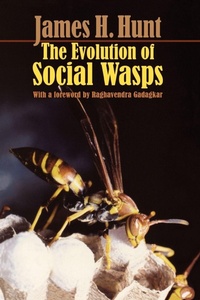
The Evolution of Social Wasps
Published on 5. April 2007
Book
Paperback/Softback
280 pages
978-0-19-530797-9 (ISBN)
Description
Social behavior occurs in some of the smallest animals as well as some the largest, and the transition from solitary life to sociality is an unsolved evolutionary mystery. In The Evolution of Social Wasps, James H. Hunt examines social behavior in a single lineage of insects, wasps of the family Vespidae. He presents empirical knowledge of social wasps from two approaches, one that focuses on phylogeny and life history and one that focuses on individual
ontogeny, colony development, and population dynamics. He also provides an extensive summary of the existing literature while demonstrating how it can be clouded by theory. Hunt's fresh approach to the
conflicting literature on sociality highlights how oft repeated models can become fixed in the thinking of the scientific community. Instead, Hunt presents a mechanistic scenario for the evolution of sociality in wasps that changes our perspective on kin selection, the paradigm that has dominated thinking about social evolution since the 1970s. This innovative new model integrates life history, nutrition, fitness and ecology in which social insect biologists will find a rich storehouse of
ideas and information, and behavioral ecologists will find a bracing challenge to long accepted models. Engagingly written, bold, and provocative, The Evolution of Social Wasps marks a milestone in our
understanding of one of lifes major evolutionary transitions - the origin of social behavior.
ontogeny, colony development, and population dynamics. He also provides an extensive summary of the existing literature while demonstrating how it can be clouded by theory. Hunt's fresh approach to the
conflicting literature on sociality highlights how oft repeated models can become fixed in the thinking of the scientific community. Instead, Hunt presents a mechanistic scenario for the evolution of sociality in wasps that changes our perspective on kin selection, the paradigm that has dominated thinking about social evolution since the 1970s. This innovative new model integrates life history, nutrition, fitness and ecology in which social insect biologists will find a rich storehouse of
ideas and information, and behavioral ecologists will find a bracing challenge to long accepted models. Engagingly written, bold, and provocative, The Evolution of Social Wasps marks a milestone in our
understanding of one of lifes major evolutionary transitions - the origin of social behavior.
Reviews / Votes
"This is an important synthetic work, one that should be read by all students of animal behaviour and of related disciplines. The latter part of the book is most likely to generate controversy and is therefore of great general interest and importance." -- Sean O'Donnell, Animal Behaviour"I am going to have to read it again to let it really sink in, but I felt as if thick iron chains had been lifted from my limbs when I finished. Freedom! ... The final section (especially) should be REQUIRED reading for all organismal biologists- training or senior."--Sean Odonnell, University of Washington
"Advanced students, faculty, and wasp and bee researchers will find this appealing, enlightening, well-written book controversial but useful and interesting."--Choice
"A lifetime of research, hard thinking, and devotion to detail shine through Hunt's conversational style. The book is clear about many questions that remain unanswered, and will inspire both controversy and new synthetic research on the evolution of social behavior." -Quarterly Review of Biology
"I am going to have to read it again to let it really sink in, but I felt as if thick iron chains had been lifted from my limbs when I finished. Freedom! ... The final section (especially) should be REQUIRED reading for all organismal biologists- training or senior."--Sean Odonnell, University of Washington
"...presents a great deal of detailed and useful information on the biology of social wasps. The book will be an important point of reference for anyone wanting to learn more about wasps." -- BioScience Vol. 58, No. 7
More details
Language
English
Place of publication
New York
United States
Target group
College/higher education
Professional and scholarly
Illustrations
13 halftones, 69 line illus.
Dimensions
Height: 234 mm
Width: 156 mm
Thickness: 15 mm
Weight
433 gr
ISBN-13
978-0-19-530797-9 (9780195307979)
Copyright in bibliographic data and cover images is held by Nielsen Book Services Limited or by the publishers or by their respective licensors: all rights reserved.
Schweitzer Classification
Other editions
Additional editions
James H. Hunt
The Evolution of Social Wasps
E-Book
03/2007
1st Edition
OUP eBook
€33.99
Available for download
James H. Hunt
The Evolution of Social Wasps
E-Book
03/2007
1st Edition
OUP eBook
€33.99
Available for download
Person
Content
Part One - History
Chapter One: Plant Feeders and Parasitoids
Chapter Two: Pollen Wasps, Potter Wasps, and Hover Wasps
Chapter Three: Paper Wasps and Vespines
Chapter Four: The Historical Scenario of Social Evolution
Part Two - Dynamics
Chapter Five: Individuals
Chapter Six: Colonies
Chapter Seven: Populations
Chapter Eight: The Dynamic Scenario of Social Evolution
Part Three - Paradigm Lost - And Found?
Chapter Nine: Kin Selection
Chapter Ten: Behavioral Ecology
Chapter Eleven: A Post-Modern Synthesis
Conclusion
References
Chapter One: Plant Feeders and Parasitoids
Chapter Two: Pollen Wasps, Potter Wasps, and Hover Wasps
Chapter Three: Paper Wasps and Vespines
Chapter Four: The Historical Scenario of Social Evolution
Part Two - Dynamics
Chapter Five: Individuals
Chapter Six: Colonies
Chapter Seven: Populations
Chapter Eight: The Dynamic Scenario of Social Evolution
Part Three - Paradigm Lost - And Found?
Chapter Nine: Kin Selection
Chapter Ten: Behavioral Ecology
Chapter Eleven: A Post-Modern Synthesis
Conclusion
References