

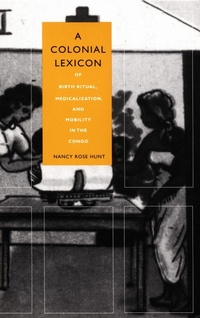
A Colonial Lexicon
Of Birth Ritual, Medicalization, and Mobility in the Congo
Published on 15. November 1999
Book
Hardback
496 pages
978-0-8223-2331-0 (ISBN)
Description
A Colonial Lexicon is the first historical investigation of how childbirth became medicalized in Africa. Rejecting the "colonial encounter" paradigm pervasive in current studies, Nancy Rose Hunt elegantly weaves together stories about autopsies and bicycles, obstetric surgery and male initiation, to reveal how concerns about strange new objects and procedures fashioned the hybrid social world of colonialism and its aftermath in Mobutu's Zaire.
Relying on archival research in England and Belgium, as well as fieldwork in the Congo, Hunt reconstructs an ethnographic history of a remote British Baptist mission struggling to survive under the successive regimes of King Leopold II's Congo Free State, the hyper-hygienic, pronatalist Belgian Congo, and Mobutu's Zaire. After exploring the roots of social reproduction in rituals of manhood, she shows how the arrival of the fast and modern ushered in novel productions of gender, seen equally in the forced labor of road construction and the medicalization of childbirth. Hunt focuses on a specifically interwar modernity, where the speed of airplanes and bicycles correlated with a new, mobile medicine aimed at curbing epidemics and enumerating colonial subjects. Fascinating stories about imperial masculinities, Christmas rituals, evangelical humor, colonial terror, and European cannibalism demonstrate that everyday life in the mission, on plantations, and under a strongly Catholic colonial state was never quite what it seemed. In a world where everyone was living in translation, privileged access to new objects and technologies allowed a class of "colonial middle figures"-particularly teachers, nurses, and midwives-to mediate the evolving hybridity of Congolese society. Successfully blurring conventional distinctions between precolonial, colonial, and postcolonial situations, Hunt moves on to discuss the unexpected presence of colonial fragments in the vibrant world of today's postcolonial Africa.
With its close attention to semiotics as well as sociology, A Colonial Lexiconwill interest specialists in anthropology, African history, obstetrics and gynecology, medical history, religion, and women's and cultural studies.
Relying on archival research in England and Belgium, as well as fieldwork in the Congo, Hunt reconstructs an ethnographic history of a remote British Baptist mission struggling to survive under the successive regimes of King Leopold II's Congo Free State, the hyper-hygienic, pronatalist Belgian Congo, and Mobutu's Zaire. After exploring the roots of social reproduction in rituals of manhood, she shows how the arrival of the fast and modern ushered in novel productions of gender, seen equally in the forced labor of road construction and the medicalization of childbirth. Hunt focuses on a specifically interwar modernity, where the speed of airplanes and bicycles correlated with a new, mobile medicine aimed at curbing epidemics and enumerating colonial subjects. Fascinating stories about imperial masculinities, Christmas rituals, evangelical humor, colonial terror, and European cannibalism demonstrate that everyday life in the mission, on plantations, and under a strongly Catholic colonial state was never quite what it seemed. In a world where everyone was living in translation, privileged access to new objects and technologies allowed a class of "colonial middle figures"-particularly teachers, nurses, and midwives-to mediate the evolving hybridity of Congolese society. Successfully blurring conventional distinctions between precolonial, colonial, and postcolonial situations, Hunt moves on to discuss the unexpected presence of colonial fragments in the vibrant world of today's postcolonial Africa.
With its close attention to semiotics as well as sociology, A Colonial Lexiconwill interest specialists in anthropology, African history, obstetrics and gynecology, medical history, religion, and women's and cultural studies.
Reviews / Votes
" 'Birth' is more than the begetting of children and Nancy Rose Hunt's 'colonial lexicon' is much more than a history of medicalized childbearing in the formerly Belgian Congo in colonial and post-colonial times. . . . With erudition and wit Hunt challenges conventional models-be they feminist, obstetric, colonial, missionary, or health-bureaucratic-about what it means to medicalize childbearing."-Barbara Duden, UniversitAEt Hannover "A highly original study. This book links medical work with maternity work in the context of arguments about gender relations and about feminist perspectives on writing history."-Gillian Feeley-Harnik, author of A Green Estate: Restoring Independence in MadagascarMore details
Series
Language
English
Place of publication
North Carolina
United States
Target group
Professional and scholarly
Product notice
Cloth over boards
Illustrations
47 b&w photographs, 8 maps
Dimensions
Height: 239 mm
Width: 157 mm
Thickness: 43 mm
Weight
1089 gr
ISBN-13
978-0-8223-2331-0 (9780822323310)
Copyright in bibliographic data and cover images is held by Nielsen Book Services Limited or by the publishers or by their respective licensors: all rights reserved.
Schweitzer Classification
Other editions
Additional editions
Nancy Rose Hunt | Arjun Appadurai | John L. Comaroff
A Colonial Lexicon
Of Birth Ritual, Medicalization, and Mobility in the Congo
E-Book
11/1999
1st Edition
De Gruyter
€228.99
Available for download
Person
Nancy Rose Hunt is Assistant Professor of History and Obstetrics/Gynecology at the University of Michigan, Ann Arbor. She is a coeditor of Gendered Colonialisms in African History.
Content
Illustrations
Abbreviations
Acknowledgments
Introduction
1 Crocodiles and Wealth
2 Doctors and Airplanes
3 Dining and Surgery
4 Nurses and Bicycles
5 Babies and Forceps
6 Colonial Maternities
7 Debris
Departures
Notes
Glossary
Bibliography
Index
Abbreviations
Acknowledgments
Introduction
1 Crocodiles and Wealth
2 Doctors and Airplanes
3 Dining and Surgery
4 Nurses and Bicycles
5 Babies and Forceps
6 Colonial Maternities
7 Debris
Departures
Notes
Glossary
Bibliography
Index