

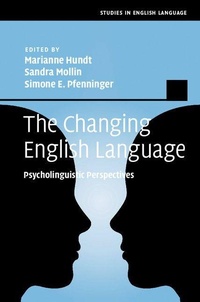
The Changing English Language
Psycholinguistic Perspectives
Published on 20. July 2017
Book
Hardback
428 pages
978-1-107-08686-9 (ISBN)
Description
Bringing together experts from both historical linguistics and psychology, this volume addresses core factors in language change from the perspectives of both fields. It explores the potential (and limitations) of such an interdisciplinary approach, covering the following factors: frequency, salience, chunking, priming, analogy, ambiguity and acquisition. Easily accessible, the book features chapters by psycholinguists presenting cutting edge research on core factors and processes and develops a model of how this may be involved in language change. Each chapter is complemented with one or several case study in the history of the English language in which the psycholinguistic factor in question may be argued to have played a decisive role. Thus, for the first time, a single volume provides a platform for an integrated exchange between psycholinguistics and historical linguistics on the question of how language changes over time.
Reviews / Votes
'This innovative collection sketches what a long overdue cooperation of psycholinguistics and language change could look like. By systematically investigating key psycholinguistic factors from both perspectives, it closes a striking gap in historical linguistics.' Lieselotte Anderwald, Christian-Albrechts-Universitaet zu Kiel 'This is an admirable example of how a sophisticated analysis of a narrowly defined and partly even invisible phenomenon can reveal deep insights into language acquisition, with wide-ranging consequences for syntactic theory. As such, it is also a demonstration of how acquisition research can inform grammatical theory. Beautifully written, this book is therefore highly recommended to a readership not only interested in language acquisition but also in syntactic theory.' Juergen Meisel, Universitaet Hamburg 'Each chapter in this book provides many research ideas for different scholars in any linguistics field like corpus linguistics, psycholinguistics, TESOL, etc. both theoretically and empirically. These research ideas can help flourish these two disciplines much better and establish a fully interdisciplinary field.' Pouya Vakili, LINGUIST ListMore details
Series
Language
English
Place of publication
Cambridge
United Kingdom
Target group
Professional and scholarly
Illustrations
24 Tables, black and white; 26 Line drawings, black and white
Dimensions
Height: 235 mm
Width: 157 mm
Thickness: 28 mm
Weight
773 gr
ISBN-13
978-1-107-08686-9 (9781107086869)
Copyright in bibliographic data and cover images is held by Nielsen Book Services Limited or by the publishers or by their respective licensors: all rights reserved.
Schweitzer Classification
Other editions
Additional editions
Marianne Hundt | Sandra Mollin | Simone E. Pfenninger
The Changing English Language
Psycholinguistic Perspectives
Book
04/2020
Cambridge University Press
€55.70
Shipment within 15-20 days
E-Book
07/2017
Cambridge University Press
€25.49
Available for download
Marianne Hundt | Sandra Mollin | Simone E. Pfenninger
The Changing English Language
Psycholinguistic Perspectives
E-Book
06/2017
Cambridge University Press
€118.99
Available for download
Persons
Marianne Hundt is Professor of English Linguistics at Universitaet Zuerich. Her research interests include grammatical variation and change in World Englishes. As a corpus-linguist, she has compiled and worked with corpora in World Englishes research and historical linguistics. She is the author of English Mediopassive Constructions (2007), co-author of Change in Contemporary English: A Grammatical Study (2009) and co-editor of English World-Wide. Sandra Mollin is senior lecturer in English Linguistics at the Universitaet Heidelberg. Her research focuses on phraseology, varieties of English and the combination of corpus linguistic and psycholinguistic methodology. She is the author of The (Ir)Reversibility of English Binomials (2014) and Euro-English: Assessing Variety Status (2006). Simone E. Pfenninger is Assistant Professor at Universitaet Salzburg. Her principal research areas are multilingualism, psycholinguistics and individual differences in second language acquisition, especially in regard to quantitative approaches and statistical methods and techniques for language application in education. She is the co-editor of the Second Language Acquisition book series for Multilingual Matters.
Content
1. Introduction: language history meets psychology Marianne Hundt, Sandra Mollin and Simone E. Pfenninger; Part I. Frequency: 2. The Ecclesiastes principle in language change Harald Baayen, Fabian Tomaschek, Susanne Gahl and Michael Ramscar; 3. Frequencies in diachronic corpora and knowledge of language Martin Hilpert; Part II. Salience: 4. Salience in language usage, learning, and change Nick C. Ellis; 5. Low salience as an enabling factor in morphosyntactic change Elizabeth C. Traugott; Part III. Chunking: 6. Chunking in language usage, learning, and change: I don't know Nick C. Ellis; 7. Chunking and changes in compositionality in context Joan L. Bybee and Carol Lynn Moder; Part IV. Priming: 8. Priming and language change Martin J. Pickering and Simon Garrod; 9. From priming and processing to frequency effects and grammaticalisation? Contracted semi-modals in present-day English Christian Mair; Part V. Analogy: 10. The role of analogy in language processing and acquisition Heike Behrens; 11. The role of analogy in language change: supporting constructions Hendrik de Smet and Olga Fischer; Part VI. Ambiguity: 12. Syntactic ambiguity in real-time language processing and diachronic change Claudia Felser; 13. Ambiguity and vagueness in historical change David Denison; Part VII. Acquisition and Transmission: 14. Developing language from usage: explaining errors Elena V. M. Lieven; 15. Transferring insights from child language acquisition to diachronic change (and vice versa) Maria Jose Lopez-Cous.