

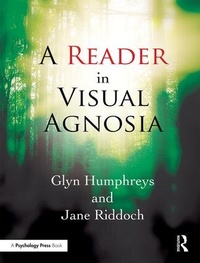
A Reader in Visual Agnosia
To See But Not To See
1st Edition
Published on 17. December 2015
Book
Hardback
408 pages
978-1-138-95100-6 (ISBN)
Description
The case study of John has provided a unique insight into the nature of visual agnosia and more broadly into the underlying processes which support human vision. After suffering a stroke, John had problems in recognizing common objects, faces, seeing colours, reading and finding his way around his environment. A Reader in Visual Agnosia brings together the primary scientific papers describing the detailed investigations for each visual problem which the authors carried out with John, known as patient HJA. This work was summarised initially in To See But Not To See (1987), and 26 years later in A Case Study in Visual Agnosia Revisited (2013).
The chapters are divided into 6 parts corresponding to the key areas of investigation:
Integrative visual agnosia
Perception of global form
Face perception
Colour perception
Word recognition
Changes over time
Each part contains a short introduction, written by the two leading researchers who worked with John, which highlights the relations between the papers and demonstrates the pathway of the case analysis. The book will be invaluable to students and researchers in visual cognition, cognitive neuropsychology and vision neuroscience.
The chapters are divided into 6 parts corresponding to the key areas of investigation:
Integrative visual agnosia
Perception of global form
Face perception
Colour perception
Word recognition
Changes over time
Each part contains a short introduction, written by the two leading researchers who worked with John, which highlights the relations between the papers and demonstrates the pathway of the case analysis. The book will be invaluable to students and researchers in visual cognition, cognitive neuropsychology and vision neuroscience.
More details
Language
English
Place of publication
London
United Kingdom
Publishing group
Taylor & Francis Ltd
Target group
College/higher education
Illustrations
52 s/w Tabellen
52 Tables, black and white
Dimensions
Height: 246 mm
Width: 189 mm
Weight
950 gr
ISBN-13
978-1-138-95100-6 (9781138951006)
Copyright in bibliographic data and cover images is held by Nielsen Book Services Limited or by the publishers or by their respective licensors: all rights reserved.
Schweitzer Classification
Other editions
Additional editions
Glyn Humphreys | Jane Riddoch
A Reader in Visual Agnosia
Book
02/2018
1st Edition
Routledge
€80.60
Shipment within 10-20 days
E-Book
01/2016
Routledge
€73.99
Available for download
E-Book
01/2016
Routledge
€73.99
Available for download
Persons
Glyn Humphreys is Watts Professor of Experimental Psychology at the University of Oxford, UK. His research covers the diagnosis and management of cognitive problems after brain injury, visual attention, perception, language and the control of action, and social cognition. He has published over 500 papers in international journals and 16 books.
Jane Riddoch is Professorial Research Fellow at the University of Oxford, UK. Her research covers visual disorders (agnosia, optic aphasia), disorders of attention (neglect, extinction), and action (apraxia, action disorganisation syndrome) and neuropsychological rehabilitation. She has published 150 papers in leading international journals and authored/edited five books.
Jane Riddoch is Professorial Research Fellow at the University of Oxford, UK. Her research covers visual disorders (agnosia, optic aphasia), disorders of attention (neglect, extinction), and action (apraxia, action disorganisation syndrome) and neuropsychological rehabilitation. She has published 150 papers in leading international journals and authored/edited five books.
Content
Part 1: Integrative visual agnosia 1. A case of integrative visual agnosia. (1987), Riddoch, M.J. & Humphreys, G.W. 2. The computation of occluded contours in visual agnosia: Evidence for early computation prior to shape binding and figure-ground coding. (2000), Giersch, A., Humphreys, G.W., Boucart, M. & Kovacs, I. 3. A two-stage account of computing and binding occluded and visible contours: Evidence from visual agnosia and effects of lorazepam. (2006), Giersch, A., Humphreys, G.W., Barthaud, J.C. & Landmanbn, C. 4. The necessary role of the dorsal visual route in the heterarchical coding of global visual pattern: Evidence from neuropsychological fMRI. (2014), Lestou, V., Kourtzi, Z., Humphreys, K.L., Lam, J. & Humphreys, G.W. 5. Parallel pattern processing in visual agnosia. (1992), Humphreys, G.W., Riddoch, M.J., Quinlan, P.T., Price, C.J. & Donnelly, N. Part 2: Seeing the whole 6. The computation of perceptual structure from collinearity and closure: Normality and pathology. (1992), Boucart, M. & Humphreys, G.W. 7. Ventral extra-striate cortical areas are required for optimal orientation averaging. (2007), Allen, H.A., Humphreys, G.W. & Bridge, H. 8. Interactive processes in perceptual organization: Evidence from visual agnosia. (1985), Humphreys, G.W., Riddoch, M.J. & Quinlan, P.T. 9. A tale of two agnosias: Distinctions between form and integrative agnosia. (2008), Riddoch, M.J., Humphreys, G.W., Akthar, N., Bracewell, R.M & Schofield, A.J. 10. The effects of view in depth on the identification of line drawings and silhouettes of familiar objects: Normality and pathology. (1999), Lawson, R. & Humphreys, G.W. 11. The real object advantage in agnosia: Evidence of a role for shading and depth in object recognition. (2001), Chainay, H. & Humphreys, G.W. Part 3: What's in a face? 12. Expression is computed separately from facial identity, and it is computed separately for moving and static faces: Neuropsychological evidence. (1993), Humphreys, G.W., Donnelly, N. & Riddoch, M.J. 13. Exploring the role of motion in prosopagnosia: Recognizing, learning and matching faces. (2004), Lander, K., Humphreys, G.W. & Bruce, V. 14. Recognition impairments and face imagery. (1994), Young, A.W., Humphreys, G.W., Riddoch, M.J., Hellalwell, D.J. & de Haan, E.H.F. Part 4: Colour, movement, action! 15. Human colour discrimination based on a non-parvocellular pathway. (1996), Troscianko, T., Davidoff, J., Humphreys, G.W., Landis, T., Fahle, M., Greenlee, M., Brugger, P. & Phillips, W. 16. The neural representation of objects in space: A dual coding account. (1998), Humphreys, G.W. 17. Visual and spatial short-term memory in visual agnosia. (2003), Riddoch, M.J., Humphreys, G.W., Hardy, E., Blott, W. & Smith, A. Part 5: The written word 18. The 'special effect' of case mixing on word identification: Neuropsychological and TMS studies dissociating case mixing from contrast reduction. (2006), Braet, W. & Humphreys, G.W. Part 6: Living with agnosia 19. Memories are made of this: The effects of time on stored visual knowledge in a case of visual agnosia. (1999), Riddoch, M.J., Humphreys, G.W., Gannon, T., Blott, W. & Jones, V.