

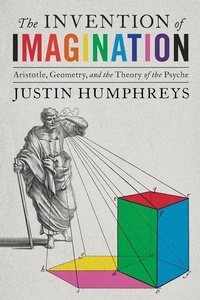
The Invention of Imagination
Aristotle and the Origins of the Representational Theory of Mind
Will be published approx. on 31. January 2024
Book
Hardback
176 pages
978-0-8229-4740-0 (ISBN)
Description
Aristotle was the first philosopher to divide the imagination-what he called phantasia-from other parts of the psyche, placing it between perception and intellect. A mathematician and philosopher of mathematical sciences, Aristotle was puzzled by the problem of geometrical cognition-which depends on the ability to "produce" and "see" a multitude of immaterial objects-and so he introduced the category of internal appearances produced by a new part of the psyche, the imagination. As Justin Humphreys argues, Aristotle developed his theory of imagination in part to explain certain functions of reason with a psychological rather than metaphysical framework. Investigating the background of this conceptual development, The Invention of Imagination reveals how imagery was introduced into systematic psychology in fifth-century Athens and ultimately made mathematical science possible. It offers new insights about major philosophers in the Greek tradition and significant events in the emergence of ancient mathematics while offering space for a critical reflection on how we understand ourselves as thinking beings.
Reviews / Votes
Humphreys's book stands as a comprehensive examination of the concept of phantasia across both its theoretical and its practical dimensions. This work is a notable contribution to the limited but growing body of literature on Aristotelian phantasia, offering valuable insights into its applications across the entire corpus of Aristotle's writings. * British Journal for the History of Science * A tightly argued study of Aristotle's De Anima and related writings. * Choice * Humphreys offers a radically new contribution to Aristotelian ontology and epistemology, which not only makes a real contribution to scholarship on Aristotle and on ancient Greek mathematics but stands a good chance to change the way people think about the way imagination was conceived in classical Greek thought and why that matters today. -- Michael Weinman, University of Virginia Elegantly written and subtly argued, this work presents a comprehensive and innovative view of imagination, acting as both genealogy and systematic analysis. Justin Humphreys shows that imagination emerges out of the necessity of providing philosophical justification for the solution of geometrical problems, which requires the construction and use of figures intermediate between the sensible and the thinkable. And yet, imagination in its capacity of producing images becomes indispensable for psychology. This book overturns our understanding of the ubiquitous yet enigmatic power of the soul. -- Dmitri Nikulin, The New School for Social ResearchMore details
Language
English
Place of publication
Pittsburgh PA
United States
Target group
Professional and scholarly
Product notice
sewn/stitched
Cloth over boards
Dimensions
Height: 230 mm
Width: 154 mm
Thickness: 22 mm
Weight
368 gr
ISBN-13
978-0-8229-4740-0 (9780822947400)
Copyright in bibliographic data and cover images is held by Nielsen Book Services Limited or by the publishers or by their respective licensors: all rights reserved.
Schweitzer Classification
Other editions
Additional editions
E-Book
10/2023
Princeton University Press
€53.99
Available for download
Person
Justin Humphreys is assistant professor of philosophy at Villanova University. He earned his PhD at The New School for Social Research and has taught philosophy at the University of Pittsburgh and the University of Pennsylvania.