

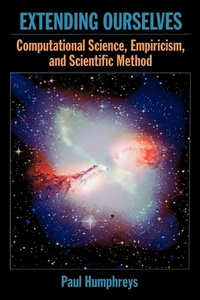
Extending Ourselves
Computational Science, Empiricism, and Scientific Method
Published on 5. April 2007
Book
Paperback/Softback
192 pages
978-0-19-531329-1 (ISBN)
Description
Computational methods such as computer simulations, Monte Carlo methods, and agent-based modeling have become the dominant techniques in many areas of science. Extending Ourselves contains the first systematic philosophical account of these new methods, and how they require a different approach to scientific method. Paul Humphreys draws a parallel between the ways in which such computational methods have enhanced our abilities to mathematically model the world, and the more familiar ways in which scientific instruments have expanded our access to the empirical world. This expansion forms the basis for a new kind of empiricism, better suited to the needs of science than the older anthropocentric forms of empiricism. Human abilities are no longer the ultimate standard of epistemological correctness.
Humphreys also includes arguments for the primacy of properties rather than objects, the need to consider technological constraints when appraising scientific methods, and a detailed account of how the path from computational template to scientific application is constructed. This last feature allows us to hold a form of selective realism in which anti-realist arguments based on formal reconstructions of theories can be avoided. One important consequence of the rise of computational methods is that the traditional organization of the sciences is being replaced by an organization founded on computational templates.
Extending Ourselves will be of interest to philosophers of science, epistemologists, and to anyone interested in the role played by computers in modern science.
Humphreys also includes arguments for the primacy of properties rather than objects, the need to consider technological constraints when appraising scientific methods, and a detailed account of how the path from computational template to scientific application is constructed. This last feature allows us to hold a form of selective realism in which anti-realist arguments based on formal reconstructions of theories can be avoided. One important consequence of the rise of computational methods is that the traditional organization of the sciences is being replaced by an organization founded on computational templates.
Extending Ourselves will be of interest to philosophers of science, epistemologists, and to anyone interested in the role played by computers in modern science.
Reviews / Votes
"... many of the issues raised here are important and deserving of the attention the author pays to them." --CHOICE "This book is an excellent philosophical appraisal of the roles played by computers in modern science...an excellent philosophical discussion of the role of computational models in physics."--Notre Dame Philosophical ReviewsMore details
Language
English
Place of publication
New York
United States
Dimensions
Height: 229 mm
Width: 152 mm
Thickness: 10 mm
Weight
276 gr
ISBN-13
978-0-19-531329-1 (9780195313291)
Copyright in bibliographic data and cover images is held by Nielsen Book Services Limited or by the publishers or by their respective licensors: all rights reserved.
Schweitzer Classification
Other editions
Additional editions
Book
08/2004
Oxford University Press Inc
€70.70
Shipment within 15-20 days
E-Book
07/2004
1st Edition
OUP eBook
€18.49
Available for download
Person
Paul Humphreys is chairman of the Department of Philosophy at the University of Virginia. A former editor of Synthese and a founding editor of Foundations of Science, his research interests include computer modeling, probability theory, strategic reasoning, emergence, causation, and explanation.