

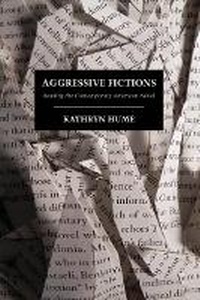
Aggressive Fictions
Reading the Contemporary American Novel
Published on 15. January 2012
Book
Hardback
216 pages
978-0-8014-5001-3 (ISBN)
Description
A frequent complaint against contemporary American fiction is that too often it puts off readers in ways they find difficult to fathom. Books such as Bret Easton Ellis's American Psycho, Katherine Dunn's Geek Love, and Don DeLillo's Underworld seem determined to upset, disgust, or annoy their readers-or to disorient them by shunning traditional plot patterns and character development. Kathryn Hume calls such works "aggressive fiction." Why would authors risk alienating their readers-and why should readers persevere? Looking beyond the theory-based justifications that critics often provide for such fiction, Hume offers a commonsense guide for the average reader who wants to better understand and appreciate books that might otherwise seem difficult to enjoy.
In her reliable and sympathetic guide, Hume considers roughly forty works of recent American fiction, including books by William Burroughs, Kathy Acker, Chuck Palahniuk, and Cormac McCarthy. Hume gathers "attacks" on the reader into categories based on narrative structure and content. Writers of some aggressive fictions may wish to frustrate easy interpretation or criticism. Others may try to induce certain responses in readers. Extreme content deployed as a tactic for distancing and alienating can actually produce a contradictory effect: for readers who learn to relax and go with the flow, the result may well be exhilaration rather than revulsion.
In her reliable and sympathetic guide, Hume considers roughly forty works of recent American fiction, including books by William Burroughs, Kathy Acker, Chuck Palahniuk, and Cormac McCarthy. Hume gathers "attacks" on the reader into categories based on narrative structure and content. Writers of some aggressive fictions may wish to frustrate easy interpretation or criticism. Others may try to induce certain responses in readers. Extreme content deployed as a tactic for distancing and alienating can actually produce a contradictory effect: for readers who learn to relax and go with the flow, the result may well be exhilaration rather than revulsion.
Reviews / Votes
[This]book deserves credit for both its transparent structure and its meticulous analysis and classification of the various narratological functions and effects.- Birgit Daewes (Amerikastudien / American Studies) The virtue of Hume's new book is that it covers a wide range of writers and integrates several not commonly associated... Fictionists who have been almost forgotten by scholars, such as Robert Coover, are given new life by comparisons with current favorites such as Chuck Palahniuk and Katherine Dunn.
- Jerome Klinkowitz (American Literary Scholarship) Using examples from more than forty works, Hume constructs a plausible discussion for what she terms average readers who may find some aspects of contemporary literature difficult to enjoy: she writes that 'aggressive fiction tramples reader sensibilities, offends and upsets willfully and deliberately.' The result is a brilliant view of important shifts in literature. Hume creates an exhilarating treatment for those interested in understanding the shifts in authorial motivation and content. She argues that subverting traditional plots and patterns, along with character development, creates a dissonance worthy of extended examination. Highly recommended.
(Choice)
More details
Language
English
Place of publication
Ithaca
United States
Product notice
Paper over boards
Dimensions
Height: 229 mm
Width: 152 mm
Thickness: 22 mm
Weight
454 gr
ISBN-13
978-0-8014-5001-3 (9780801450013)
Copyright in bibliographic data and cover images is held by Nielsen Book Services Limited or by the publishers or by their respective licensors: all rights reserved.
Schweitzer Classification
Other editions
Additional editions
E-Book
01/2012
Cornell University Press
€41.99
Available for download
Person
Kathryn Hume is Edwin Erle Sparks Professor of English at The Pennsylvania State University. She is the author of several books, including American Dream, American Nightmare: Fiction since 1960 and Surviving Your Academic Job Hunt: Advice for Humanities PhDs.
Content
Introduction: The Author-Reader ContractChapter 1. Narrative Speed in Contemporary Fiction
The Terrible Twos, The Terrible Threes, John's Wife, Bombardiers, Oreo, Microserfs, Negrophobia, The Ticket That Exploded, My Cousin, My GastroenterologistChapter 2. Modalities of Complaint
Portnoy's Complaint, Don Quixote, Pussy, King of the Pirates, Mercy, The Color Purple, Donald Duk, Doctor Rat, My Year of MeatsChapter 3. Conjugations of the Grotesque
Geek Love, Invisible Monsters, The Adventures of Lucky Pierre, Towing Jehovah, Elect Mr. Robinson for a Better World, Bearheart: The Heirship Chronicles, Blood Meridian, and several speculative fictionsChapter 4. Violence
Dark Property, The Road, American Psycho, Hogg, Frisk, Try, Blood and Guts in High School Chapter 5. Attacking the Reader's Ontological Assumptions
Lying Awake, Fight Club, Ubik, House of Leaves, Against the DayConclusion: Why Read Aggressive Fictions?Notes
Bibliography
Index
The Terrible Twos, The Terrible Threes, John's Wife, Bombardiers, Oreo, Microserfs, Negrophobia, The Ticket That Exploded, My Cousin, My GastroenterologistChapter 2. Modalities of Complaint
Portnoy's Complaint, Don Quixote, Pussy, King of the Pirates, Mercy, The Color Purple, Donald Duk, Doctor Rat, My Year of MeatsChapter 3. Conjugations of the Grotesque
Geek Love, Invisible Monsters, The Adventures of Lucky Pierre, Towing Jehovah, Elect Mr. Robinson for a Better World, Bearheart: The Heirship Chronicles, Blood Meridian, and several speculative fictionsChapter 4. Violence
Dark Property, The Road, American Psycho, Hogg, Frisk, Try, Blood and Guts in High School Chapter 5. Attacking the Reader's Ontological Assumptions
Lying Awake, Fight Club, Ubik, House of Leaves, Against the DayConclusion: Why Read Aggressive Fictions?Notes
Bibliography
Index