

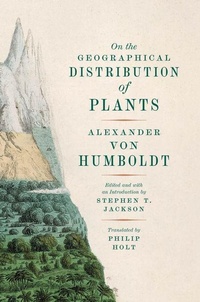
On the Geographical Distribution of Plants
Will be published approx. on 11. February 2027
Book
Hardback
160 pages
978-0-226-50252-6 (ISBN)
Description
The first English translation of an essay that is among Alexander von Humboldt's least known but most important scientific works.
In the nineteenth century, Alexander von Humboldt was arguably the world's most famous celebrity after Napoleon. What started in 1799 as a serendipitous trip to the New World tropics with his friend Aime Bonpland to collect plants and minerals expanded into a five-year exploration of Venezuela, Colombia, Ecuador, Peru, Mexico, and Cuba. The discoveries the two amassed were nothing short of staggering, and much of our knowledge of tropical botany, zoology, geography, and geology can be traced back to these journeys. The voyage, and the publication of Humboldt's travel narratives and scientific studies from these expeditions, which totaled dozens of books, elevated Humboldt to cult status.
In the last two decades, Humboldt's writings have been rediscovered in multiple fields, including biogeography; Earth and environmental sciences; American and Latin American studies; nineteenth-century art, poetry, and literature; and transatlantic cultural history. His ideas are profoundly relevant to twenty-first-century thought on the relationship between humans and nature, and the ecological framework in which he viewed the world remains essential two centuries after his travels.
Among his many interests and explorations, Humboldt invested considerable effort in explaining the underlying causes of the uneven distribution of plant species across the globe. His extended essay, On the Geographical Distribution of Plants, is among his least known but most important works, laying the foundations for the development of ecology, climatology, and evolutionary biology in the following decades. It was published originally in 1815 as an introduction to a seven-volume Latin botanical monograph, Nova Genera et Species Plantarum. The essay, republished in 1817 as a standalone volume, held great influence over nineteenth-century naturalists. It is his most comprehensive and detailed treatment of plant geography. In the essay, Humboldt applies botanical arithmetic to reveal ecological and biogeographic patterns of plants, applications that still ground modern macroecology, and provides frameworks to link vegetation patterns and climate, essential in modern Earth system science. Introduced and organized by ecologist Stephen T. Jackson and translated from Latin to English by Philip Holt, this book is essential for the libraries of scientists, historians, and all Humboldt admirers.
In the nineteenth century, Alexander von Humboldt was arguably the world's most famous celebrity after Napoleon. What started in 1799 as a serendipitous trip to the New World tropics with his friend Aime Bonpland to collect plants and minerals expanded into a five-year exploration of Venezuela, Colombia, Ecuador, Peru, Mexico, and Cuba. The discoveries the two amassed were nothing short of staggering, and much of our knowledge of tropical botany, zoology, geography, and geology can be traced back to these journeys. The voyage, and the publication of Humboldt's travel narratives and scientific studies from these expeditions, which totaled dozens of books, elevated Humboldt to cult status.
In the last two decades, Humboldt's writings have been rediscovered in multiple fields, including biogeography; Earth and environmental sciences; American and Latin American studies; nineteenth-century art, poetry, and literature; and transatlantic cultural history. His ideas are profoundly relevant to twenty-first-century thought on the relationship between humans and nature, and the ecological framework in which he viewed the world remains essential two centuries after his travels.
Among his many interests and explorations, Humboldt invested considerable effort in explaining the underlying causes of the uneven distribution of plant species across the globe. His extended essay, On the Geographical Distribution of Plants, is among his least known but most important works, laying the foundations for the development of ecology, climatology, and evolutionary biology in the following decades. It was published originally in 1815 as an introduction to a seven-volume Latin botanical monograph, Nova Genera et Species Plantarum. The essay, republished in 1817 as a standalone volume, held great influence over nineteenth-century naturalists. It is his most comprehensive and detailed treatment of plant geography. In the essay, Humboldt applies botanical arithmetic to reveal ecological and biogeographic patterns of plants, applications that still ground modern macroecology, and provides frameworks to link vegetation patterns and climate, essential in modern Earth system science. Introduced and organized by ecologist Stephen T. Jackson and translated from Latin to English by Philip Holt, this book is essential for the libraries of scientists, historians, and all Humboldt admirers.
More details
Language
English
Place of publication
Chicago
United States
Publishing group
The University of Chicago Press
Target group
Professional and scholarly
Illustrations
19 halftones, 22 tables
Dimensions
Height: 229 mm
Width: 152 mm
Weight
454 gr
ISBN-13
978-0-226-50252-6 (9780226502526)
Copyright in bibliographic data and cover images is held by Nielsen Book Services Limited or by the publishers or by their respective licensors: all rights reserved.
Schweitzer Classification
Persons
Alexander von Humboldt (1769-1859) was a Prussian polymath, geographer, naturalist, explorer, and influential proponent of Romantic philosophy and science. Stephen T. Jackson is professor emeritus of botany and ecology at the University of Wyoming and the editor of Humboldt's Essay on the Geography of Plants and Views of Nature, both also published by the University of Chicago Press. Philip Holt is professor emeritus in Latin, Greek, and classics at the University of Wyoming.
Content
Preface
Note to the Reader: Corrections and Units
Translator's Note, by Philip Holt
Acknowledgments
Introduction: Alexander von Humboldt's Plant Geography, by Stephen T. Jackson
Gallery: Plants, Profiles, and Climate Patterns
Bibliography
On the Geographical Distribution of Plants: Prolegomena, by Alexander von Humboldt
On the plan of the work
On the number of plants collected on the course of our journey in equinoctial America
On the multitude of plants which are still left to discover
On the total of plants either described or conserved in herbaria through the industry of botanists up to the present day
On the form and families of plants
On the principles and laws by which Phanerogamae and Agamae, monocotyledons and dicotyledons, annual and perennial plants are spread out through the different regions of the world
On the distribution of individual tribes in the equinoctial, temperate, and frigid zones, and on the principles of botanical arithmetic
On plants which grow in groups
On species of plants and animals common to both worlds
On the principles by which plants are distributed according to climate
On the climate of each continent in the Northern and Southern Hemispheres, and on isothermal lines which are parallel neither to the equator nor to each other
On the principles of the geography of plants which grow in low-lying places and in the mountainous region
Mountains of the torrid zone between 0 degrees and 10 degrees latitude and between 19 degrees and 21 degrees latitude
Mountains of the temperate zone
Caucasus
Pyrenees
Swiss Alps
Mountains of the frigid zone
On the families of plants which abound on mountaintops in each zone
On the decrease in heat, upon which the locations of plants on mountain slopes depend
On the temperature which cultivated plants require
On the force of heat and light, and on clear and bright skies
Supplement of observations on certain tribes of plants
Filices
Lycopodaceae, Equisetaceae, and Characeae
Piperaceae
Aroideae and Typhinae
Gramineae
Palmae
Orchideae
Plate: Outline of the Geography of Plants
Appendix: Text from the 1815 Prolegomena Deleted from the 1817 Prolegomena
Index of Plant Families, Tribes, Genera, and Species
Name Index
Place-Name Index
Subject Index
Note to the Reader: Corrections and Units
Translator's Note, by Philip Holt
Acknowledgments
Introduction: Alexander von Humboldt's Plant Geography, by Stephen T. Jackson
Gallery: Plants, Profiles, and Climate Patterns
Bibliography
On the Geographical Distribution of Plants: Prolegomena, by Alexander von Humboldt
On the plan of the work
On the number of plants collected on the course of our journey in equinoctial America
On the multitude of plants which are still left to discover
On the total of plants either described or conserved in herbaria through the industry of botanists up to the present day
On the form and families of plants
On the principles and laws by which Phanerogamae and Agamae, monocotyledons and dicotyledons, annual and perennial plants are spread out through the different regions of the world
On the distribution of individual tribes in the equinoctial, temperate, and frigid zones, and on the principles of botanical arithmetic
On plants which grow in groups
On species of plants and animals common to both worlds
On the principles by which plants are distributed according to climate
On the climate of each continent in the Northern and Southern Hemispheres, and on isothermal lines which are parallel neither to the equator nor to each other
On the principles of the geography of plants which grow in low-lying places and in the mountainous region
Mountains of the torrid zone between 0 degrees and 10 degrees latitude and between 19 degrees and 21 degrees latitude
Mountains of the temperate zone
Caucasus
Pyrenees
Swiss Alps
Mountains of the frigid zone
On the families of plants which abound on mountaintops in each zone
On the decrease in heat, upon which the locations of plants on mountain slopes depend
On the temperature which cultivated plants require
On the force of heat and light, and on clear and bright skies
Supplement of observations on certain tribes of plants
Filices
Lycopodaceae, Equisetaceae, and Characeae
Piperaceae
Aroideae and Typhinae
Gramineae
Palmae
Orchideae
Plate: Outline of the Geography of Plants
Appendix: Text from the 1815 Prolegomena Deleted from the 1817 Prolegomena
Index of Plant Families, Tribes, Genera, and Species
Name Index
Place-Name Index
Subject Index