

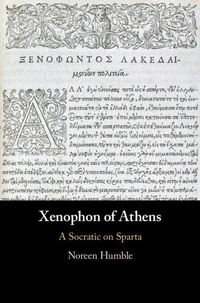
Xenophon of Athens
A Socratic on Sparta
Published on 16. December 2021
Book
Hardback
400 pages
978-1-108-47997-4 (ISBN)
Description
Xenophon of Athens (c. 430-354 BCE) has long been considered an uncritical admirer of Sparta who hero-worships the Spartan King Agesilaus and eulogises Spartan practices in his Lacedaimonion Politeia. By examining his own self-descriptions - especially where he portrays himself as conversing with Socrates and falling short in his appreciation of Socrates' advice - this book finds in Xenophon's overall writing project a Socratic response to his exile and situates his writings about Sparta within this framework. It presents a detailed reading of the Lacedaimonion Politeia as a critical and philosophical examination of Spartan socio-cultural practices. Evidence from his own Hellenica, Anabasis and Agesilaus is shown to confirm Xenophon's analysis of the weaknesses in the Spartan system, and that he is not enamoured of Agesilaus. Finally, a comparison with contemporary Athenian responses to Sparta, shows remarkable points of convergence with his fellow Socratic Plato, as well as connections with Isocrates too.
More details
Language
English
Place of publication
Cambridge
United Kingdom
Target group
Professional and scholarly
Illustrations
Worked examples or Exercises
Dimensions
Height: 235 mm
Width: 157 mm
Thickness: 26 mm
Weight
728 gr
ISBN-13
978-1-108-47997-4 (9781108479974)
Copyright in bibliographic data and cover images is held by Nielsen Book Services Limited or by the publishers or by their respective licensors: all rights reserved.
Schweitzer Classification
Other editions
Additional editions
Book
03/2023
Cambridge University Press
€44.20
Shipment within 15-20 days
E-Book
12/2021
Cambridge University Press
€95.49
Available for download
Person
Noreen Humble is a Professor in the Department of Classics at the University of Calgary. She has published numerous articles about Xenophon and the reception of Xenophon and Plutarch in Byzantium and the Renaissance, and is the editor of Plutarch's Lives: Parallelism and Purpose (2010), and co-editor (with P. Crowley and S. Ross) of Mediterranean Travels: Writing Self and Other (2011).
Content
Preface; List of Abbreviations; Note on Spelling Conventions; Introduction; Part I. 1. Xenophon and his Literary Project; 2. The Lacedaimonion Politeia: Theories, Problems, Assumptions; Part II. 3. Reading Lacedaimonion Politeia 1-4; 4. Reading Lacedaimonion Politeia 5-10; 5. Reading Lacedaimonion Politeia 11-15; Part III. 6. The Place of the Lacedaimonion Politeia within Xenophon's Literary Project; 7. Xenophon, Plato and Isocrates; Conclusion; Appendix: Text and Translation of the Lacedaimonion Politeia; Bibliography; Index locorum; General Index.