

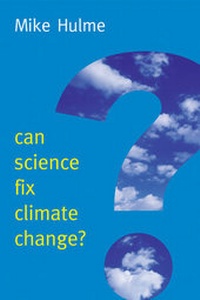
Can Science Fix Climate Change?
A Case Against Climate Engineering
Will be published approx. on 25. April 2014
Book
Paperback/Softback
144 pages
978-0-7456-8206-8 (ISBN)
Description
Climate change seems to be an insurmountable problem. Political solutions have so far had little impact. Some scientists are now advocating the so-called 'Plan B', a more direct way of reducing the rate of future warming by reflecting more sunlight back to space, creating a thermostat in the sky. In this book, Mike Hulme argues against this kind of hubristic techno-fix. Drawing upon a distinguished career studying the science, politics and ethics of climate change, he shows why using science to fix the global climate is undesirable, ungovernable and unattainable. Science and technology should instead serve the more pragmatic goals of increasing societal resilience to weather risks, improving regional air quality and driving forward an energy technology transition. Seeking to reset the planet's thermostat is not the answer. Climate change seems to be an insurmountable problem. Political solutions have so far had little impact. Some scientists are now advocating the so-called 'Plan B', a more direct way of reducing the rate of future warming by reflecting more sunlight back to space, creating a thermostat in the sky. In this book, Mike Hulme argues against this kind of hubristic techno-fix. Drawing upon a distinguished career studying the science, politics and ethics of climate change, he shows why using science to fix the global climate is undesirable, ungovernable and unattainable. Science and technology should instead serve the more pragmatic goals of increasing societal resilience to weather risks, improving regional air quality and driving forward an energy technology transition. Seeking to reset the planet's thermostat is not the answer.
Reviews / Votes
"A very clear read and a good introduction to an extremely important topic." Morning Star "Mike Hulme eloquently and rationally outlines the arguments against proposals to use stratospheric aerosols to cool the planet and questions the ethics of even researching them. Regardless of whether one agrees with his conclusions, there is no doubt that he definitively makes the case that must be answered by proponents." Steve Rayner, Oxford University "In this slim volume, Mike Hulme takes aim at the proposal to fix the climate problem with a single engineering solution. He calls for a science that is more attentive to human ends, that serves humanity rather than seeking to rule it. This plea for humility from a world expert on climate change deserves close reading by anyone concerned with the fate of the planet." Sheila Jasanoff, Harvard University "Few people talk as intelligently and compassionately about climate change as Mike Hulme. He is a rare voice of sanity and humility in an increasingly rancorous and megalomaniac debate." Fred Pearce, science writer and journalistMore details
Series
Edition
1. Auflage
Language
English
Place of publication
Oxford
United Kingdom
Publishing group
John Wiley and Sons Ltd
Target group
Professional and scholarly
Product notice
Paperback (trade)
Unsewn / adhesive bound
Dimensions
Height: 188 mm
Width: 123 mm
Thickness: 20 mm
Weight
188 gr
ISBN-13
978-0-7456-8206-8 (9780745682068)
Schweitzer Classification
Other editions
Additional editions
E-Book
06/2014
Polity Press
€17.99
Available for download
Book
04/2014
Polity Press
€65.50
Shipment within 15-20 days
Person
Mike Hulme is Professor of Climate and Culture in the Department of Geography at King's College London. His 2009 Why We Disagree about Climate Change won The Economist's 'Book of the Year Award'. He has contributed to public debates in the UK and US, writing for The Guardian and the Wall Street Journal. From 2000 to 2007 he was the Founding Director of the Tyndall Centre for Climate Change Research.
Content
Acknowledgements page vi
Acronyms page vii
Preface viii
1 Imagining an Engineered Climate 1
2 Designing a Global Thermostat 32
3 Governing the World's Temperature 57
4 Living in an Experimental World 89
5 Reframing the (Climate) Problem 114
Notes 141
Bibliography 144
Index 150