

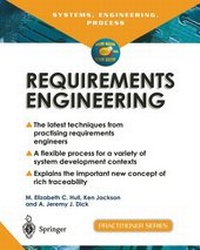
Requirements Engineering
A Structured Project Information Approach
Published on 9. August 2002
Book
Paperback/Softback
XXIII, 216 pages
978-1-85233-577-9 (ISBN)
Description
Written for those who want to develop their knowledge of requirements engineering process, whether practitioners or students. Using the latest research and driven by practical experience from industry, this book gives useful hints to practitioners on how to write and structure requirements.
- Explains the importance of Systems Engineering and the creation of effective solutions to problems
- Describes the underlying representations used in system modeling - data flow diagrams; statecharts; object-oriented approaches
- Covers a generic multi-layer requirements process
- Discusses the key elements of effective requirements management
- Includes a chapter written by one of the developers of rich traceability
- Introduces an overview of DOORS - a software tool which serves as an enabler of a requirements management process
Additional material and links are available at: http://www.requirementsengineering.info
"In recent years we have been finding ourselves with a shortage of engineers with good competence in requirements engineering. Perhaps this is in part because requirements management tool vendors have persuaded management that a glitzy tool will solve their requirements engineering problems. Of course, the tools only make it possible for engineers who understand requirements engineering to do a better job. This book goes a long way towards building a foundational set of skills in requirements engineering, so that today's powerful tools can be used sensibly. Of particular value is a recognition of the place software requirements have within the system context, and of ways for dealing with that sensitive connection. This is an important book. I think its particular value in industry will be to bring the requirements engineers and their internal customers to a practical common understanding of what can and should be achieved."
(Byron Purves, Technical Fellow, The Boeing Company)
- Explains the importance of Systems Engineering and the creation of effective solutions to problems
- Describes the underlying representations used in system modeling - data flow diagrams; statecharts; object-oriented approaches
- Covers a generic multi-layer requirements process
- Discusses the key elements of effective requirements management
- Includes a chapter written by one of the developers of rich traceability
- Introduces an overview of DOORS - a software tool which serves as an enabler of a requirements management process
Additional material and links are available at: http://www.requirementsengineering.info
"In recent years we have been finding ourselves with a shortage of engineers with good competence in requirements engineering. Perhaps this is in part because requirements management tool vendors have persuaded management that a glitzy tool will solve their requirements engineering problems. Of course, the tools only make it possible for engineers who understand requirements engineering to do a better job. This book goes a long way towards building a foundational set of skills in requirements engineering, so that today's powerful tools can be used sensibly. Of particular value is a recognition of the place software requirements have within the system context, and of ways for dealing with that sensitive connection. This is an important book. I think its particular value in industry will be to bring the requirements engineers and their internal customers to a practical common understanding of what can and should be achieved."
(Byron Purves, Technical Fellow, The Boeing Company)
More details
Series
Edition
1st Edition.
Language
English
Place of publication
London
United Kingdom
Target group
College/higher education
Professional and scholarly
Illustrations
177
177 s/w Abbildungen
Illustrations
Dimensions
Height: 25.4 cm
Width: 20.3 cm
Weight
480 gr
ISBN-13
978-1-85233-577-9 (9781852335779)
DOI
10.1007/978-1-4471-3730-6
Schweitzer Classification
Other editions
New editions
Jeremy Dick | Elizabeth Hull | Ken Jackson
Requirements Engineering
Book
09/2017
4th Edition
Springer
€80.24
Shipment within 10-15 days
Elizabeth Hull | Ken Jackson | Jeremy Dick
Requirements Engineering
Book
10/2004
2nd Edition
Springer
€64.15
Article exhausted; check for reprint
Additional editions
Elizabeth Hull | Ken Jackson | Jeremy Dick
Requirements Engineering
E-Book
04/2013
1st Edition
Springer
€85.59
Available for download
Content
Introduction: Introduction to requirements. Introduction to systems engineering. Requirements and quality. Requirements and the lifecycle. Requirements traceability. Requiring and modeling. Requirements and testing. Requirements in the problem and solution domains. How to read this book.-
A Generic Process for Requirements Engineering: Introduction. Developing systems. Generic process context. Generic process introduction. Generic process information model. Generic process details. Summary and conclusion.-
System Modelling for Requirements Engineering: Introduction. Representations for requirements engineering. Representations and information. Methods. Summary.-
Writing and Reviewing Requirements: Introduction. Requirements for requirements. Structuring requirements documents. Key requirements. Using attributes. Ensuring consistency across requirements. Value of a requirement. The language of requirements. Requirement boilerplates. Granularity of requirements. Criteria for writing requirements statements. Summary.-
Requirements Engineering in the Solution Domain: What is the solution domain? Engineering requirements from stakeholder requirements to system requirements. Engineering requirements from system requirements to subsystems. Other transformations using a design architecture.-
Advanced Traceability: Introduction. Elementary traceability. Satisfaction arguments. Requirements allocation. Reviewing traceability. The language of satisfaction arguments. Rich traceability analysis. Rich traceability for qualification. Implementing rich traceability. Metrics for traceability. Conclusion.- Management Aspects of Requirements Engineering: Introduction to management. Requirements management problems. Managing requirements in an acquisition organization. Supplier organizations. Product organizations. Summary.-
DOORS - A Tool to Manage Requirements: Introduction. The case for requirements management. DOORS architecture. Projects, modules and objects. History and version control. Attributes and views. Traceability. Import and export. Summary.
A Generic Process for Requirements Engineering: Introduction. Developing systems. Generic process context. Generic process introduction. Generic process information model. Generic process details. Summary and conclusion.-
System Modelling for Requirements Engineering: Introduction. Representations for requirements engineering. Representations and information. Methods. Summary.-
Writing and Reviewing Requirements: Introduction. Requirements for requirements. Structuring requirements documents. Key requirements. Using attributes. Ensuring consistency across requirements. Value of a requirement. The language of requirements. Requirement boilerplates. Granularity of requirements. Criteria for writing requirements statements. Summary.-
Requirements Engineering in the Solution Domain: What is the solution domain? Engineering requirements from stakeholder requirements to system requirements. Engineering requirements from system requirements to subsystems. Other transformations using a design architecture.-
Advanced Traceability: Introduction. Elementary traceability. Satisfaction arguments. Requirements allocation. Reviewing traceability. The language of satisfaction arguments. Rich traceability analysis. Rich traceability for qualification. Implementing rich traceability. Metrics for traceability. Conclusion.- Management Aspects of Requirements Engineering: Introduction to management. Requirements management problems. Managing requirements in an acquisition organization. Supplier organizations. Product organizations. Summary.-
DOORS - A Tool to Manage Requirements: Introduction. The case for requirements management. DOORS architecture. Projects, modules and objects. History and version control. Attributes and views. Traceability. Import and export. Summary.