

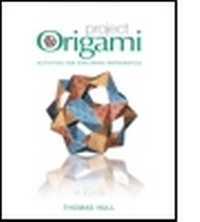
Project Origami
Activities for Exploring Mathematics
1st Edition
Published on 16. March 2006
Book
Paperback/Softback
272 pages
978-1-56881-258-8 (ISBN)
Description
When it comes to mathematics, paper isn't just for pen and pencil any more! Origami, the art and science of paper folding, can be used to explain concepts and solve problems in mathematics-and not just in the field of geometry. The origami activities collected here also relate to topics in calculus, abstract algebra, discrete mathematics, topology, and more. Using origami, learn about: - Solving Cubic Equations - Bucky Balls and PHiZZ units - Matrix models for folds - Gaussian Curvature and much more! These activities, which can enhance the classroom experience, also make great independent student projects and are perfect for math clubs or math circles. To provide readers of Project Origami with as much flexibility as possible, we have made all of the handouts in the book available online.
Reviews / Votes
For anyone who wants to enliven their class activities, this book gives wonderfully clear instructions for hands-on pager-folding activities, and specific suggestions as how to encourage students to ask questions, and to answer them, in the spirit of really `doing mathematics' ... I will use it next time I teach the Polya Enumeration Theorem.-Mathematical Reviews, February 2008
Is it possible to use origami in the higher level mathematics classroom? An affirmative answer is given by Thomas Hull's book Project Origami: Activities for Exploring Mathematics. Based on Hull's extensive experience of combining origami and mathematics teaching over the last fifteen years, it aims to help the teacher bring origami into the mathematics classroom, at the high school, college, and university level.
-Helena Verrill, AMS Notices, May 2007
Thomas Hull ... is one of the country's foremost researchers in origami mathematics-a subject making the slow transition from the ghetto of recreational math, where Sudoku and Rubik's Cube dwell, to the rarified air of legitimate research topic ... The fun part is watching the mash-up of intellectual analysis and paper creativity ... but what really drives him, he says, is understanding what's happening underneath each figure.
-David Brooks, Nashuatelegraph.com, May 2007
In his efforts to collect everything that he could find linking origami and math (and in his own research efforts), Hull has discovered not only the obvious links between origami and geometry but also intriguing intersections of origami with other fields of mathematics, such as algebra, number theory, and combinatorics.
-Ivars Peterson, Science News, June 2006
Overall, this book is an excellent resource for mathematics educators who would like to include some hands-on experimentation in their teaching.
-Steven Frankel, MAA Reviews, July 2006
This is probably the most comprehensive study of mathematical paperfolding produced in book form to date. ... Along with theorems and formulas, there are copious notes for instructors, making the book more a teachers' manual than a recreational pursuit. Even so it will reward a study even by those wishing solely to produce decorative forms.
-John Cunliffe, ELFA and British Origami Society
This book shows you how and explains how! ... The book is neatly presented and is designed to work as a sourcebook for teachers wishing to use origami in the classroom, but is easily accessible to anyone.
-Dennis Walker, British Origami Society
Thomas Hull has written a truly wonderful book ... Project Origami is full of surprises and depth. Hull is passionate about his work and it shines through in this text ... Concrete connections to curriculum (upper high-school levels, undergraduate levels) are made clear, highlighting the relevance and importance of this material to mathematics education. Every teacher should take a hold of this book ... Hull shares the joy of doing and exploring real mathematics and provides a route that all can pursue.
-James Tanton
More details
Language
English
Place of publication
Natick
United States
Publishing group
Taylor & Francis Inc
Target group
College/higher education
Professional and scholarly
Dimensions
Height: 254 mm
Width: 203 mm
Weight
658 gr
ISBN-13
978-1-56881-258-8 (9781568812588)
Copyright in bibliographic data and cover images is held by Nielsen Book Services Limited or by the publishers or by their respective licensors: all rights reserved.
Schweitzer Classification
Other editions
New editions
Book
12/2012
2nd Edition
A K Peters
€84.40
Shipment within 15-20 days
Person
Thomas Hull earned his PhD in Mathematics from the University of Rhode Island in 1977. He is currently an associate professor in the Department of Mathematics at Merrimack College in North Andover, MA. Recently, he was awarded the Murray Fellowship offered to educators who promote science and engineering research that will lead to enhanced effectiveness in classroom teaching.