

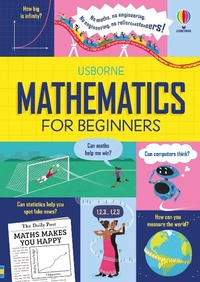
Mathematics for Beginners
Published on 1. September 2022
Book
Hardback
128 pages
978-1-4749-9854-3 (ISBN)
Description
This book WON'T test your mental maths or teach you countless ways to find x. It WILL show you just how fascinating maths can be.
Can maths make people rich? Can formulas predict which sports teams will win more games? Can equations explain the mysteries of the universe? The short answer to all these is YES. This book explores and explains the ways that the tools of mathematics help people make sense of the world around them, predict the future and, just maybe, how to make life itself better.
Chapters in this book include:
- What is maths?
- What is maths for?
- How do you do maths?
The beginning of maths
What did the first numbers look like, and what did people use them for?
Numbers
Number shapes, number patterns, prime numbers and numbers that go on and on and on...to infinity.
Shapes and measuring
How and why people use the tools of mathematics to describe the shapes of everything, from everyday objects to the entire universe.
How maths is shown
Making graphs, drawing diagrams and using pictures to explain the world better, and to help solve problems.
Prove it
In mathematics, you can find an answer to a problem and know for certain that it is correct. But how? With a PROOF.
Probability and statistics
Maths can tell you the truth and predict the future - up to a point. How does it do this, and how can you spot when people are (mis)using maths to lie?
Maths, computers and the future
No mathematics, no computers. But what kind of maths do people use to make computers works?
Mathematical models
Describing real-world problems with maths to give insights into future weather, profits, and even human behavior.
What's next?
Jobs in maths
Can maths make people rich? Can formulas predict which sports teams will win more games? Can equations explain the mysteries of the universe? The short answer to all these is YES. This book explores and explains the ways that the tools of mathematics help people make sense of the world around them, predict the future and, just maybe, how to make life itself better.
Chapters in this book include:
- What is maths?
- What is maths for?
- How do you do maths?
The beginning of maths
What did the first numbers look like, and what did people use them for?
Numbers
Number shapes, number patterns, prime numbers and numbers that go on and on and on...to infinity.
Shapes and measuring
How and why people use the tools of mathematics to describe the shapes of everything, from everyday objects to the entire universe.
How maths is shown
Making graphs, drawing diagrams and using pictures to explain the world better, and to help solve problems.
Prove it
In mathematics, you can find an answer to a problem and know for certain that it is correct. But how? With a PROOF.
Probability and statistics
Maths can tell you the truth and predict the future - up to a point. How does it do this, and how can you spot when people are (mis)using maths to lie?
Maths, computers and the future
No mathematics, no computers. But what kind of maths do people use to make computers works?
Mathematical models
Describing real-world problems with maths to give insights into future weather, profits, and even human behavior.
What's next?
Jobs in maths
More details
Series
Language
English
Place of publication
London
United Kingdom
Target group
Children/juvenile
Interest Age: From 10 to 16 years
Dimensions
Height: 242 mm
Width: 175 mm
Thickness: 17 mm
Weight
514 gr
ISBN-13
978-1-4749-9854-3 (9781474998543)
Copyright in bibliographic data and cover images is held by Nielsen Book Services Limited or by the publishers or by their respective licensors: all rights reserved.
Schweitzer Classification
Persons
Sarah Hull (Author)
Sarah grew up in London, then studied German and Fine Art in Oxford and Hamburg. She joined Usborne after working at Profile Books and Thames & Hudson, and now spends her time writing about art, investigating germs and devising ways to stave off boredom - all the important things, basically.
Tom Mumbray (Author)
Tom studied History at university before joining Usborne in 2018. Since then he's worked on books about Planet Earth, technology, maths and inventions (and learned lots of amazing facts about everything from paleoburrows to fireworks along the way).
Sarah grew up in London, then studied German and Fine Art in Oxford and Hamburg. She joined Usborne after working at Profile Books and Thames & Hudson, and now spends her time writing about art, investigating germs and devising ways to stave off boredom - all the important things, basically.
Tom Mumbray (Author)
Tom studied History at university before joining Usborne in 2018. Since then he's worked on books about Planet Earth, technology, maths and inventions (and learned lots of amazing facts about everything from paleoburrows to fireworks along the way).
Content
Chapters in this book include:
- What is maths?
- What is maths for?
- How do you do maths?
The beginning of maths
What did the first numbers look like, and what did people use them for?
Numbers
Number shapes, number patterns, prime numbers and numbers that go on and on and on...to infinity.
Shapes and measuring
How and why people use the tools of mathematics to describe the shapes of everything, from everyday objects to the entire universe.
How maths is shown
Making graphs, drawing diagrams and using pictures to explain the world better, and to help solve problems.
Prove it
In mathematics, you can find an answer to a problem and know for certain that it is correct. But how? With a PROOF.
Probability and statistics
Maths can tell you the truth and predict the future - up to a point. How does it do this, and how can you spot when people are (mis)using maths to lie?
Maths, computers and the future
No mathematics, no computers. But what kind of maths do people use to make computers works?
Mathematical models
Describing real-world problems with maths to give insights into future weather, profits, and even human behavior.
What's next?
Jobs in maths
- What is maths?
- What is maths for?
- How do you do maths?
The beginning of maths
What did the first numbers look like, and what did people use them for?
Numbers
Number shapes, number patterns, prime numbers and numbers that go on and on and on...to infinity.
Shapes and measuring
How and why people use the tools of mathematics to describe the shapes of everything, from everyday objects to the entire universe.
How maths is shown
Making graphs, drawing diagrams and using pictures to explain the world better, and to help solve problems.
Prove it
In mathematics, you can find an answer to a problem and know for certain that it is correct. But how? With a PROOF.
Probability and statistics
Maths can tell you the truth and predict the future - up to a point. How does it do this, and how can you spot when people are (mis)using maths to lie?
Maths, computers and the future
No mathematics, no computers. But what kind of maths do people use to make computers works?
Mathematical models
Describing real-world problems with maths to give insights into future weather, profits, and even human behavior.
What's next?
Jobs in maths