

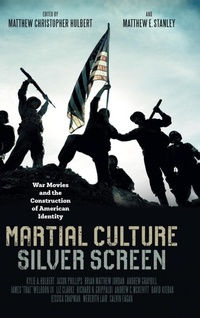
Martial Culture, Silver Screen
War Movies and the Construction of American Identity
Published on 30. November 2020
Book
Hardback
312 pages
978-0-8071-7134-9 (ISBN)
Description
Martial Culture, Silver Screen analyzes war movies, one of the most popular genres in American cinema, for what they reveal about the narratives and ideologies that shape U.S. national identity.
Edited by Matthew Christopher Hulbert and Matthew E. Stanley, this volume explores the extent to which the motion picture industry, particularly Hollywood, has played an outsized role in the construction and evolution of American self-definition.
Moving chronologically, eleven essays highlight cinematic versions of military and cultural conflicts spanning from the American Revolution to the War on Terror. Each focuses on a selection of films about a specific war or historical period, often foregrounding recent productions that remain understudied in the critical literature on cinema, history, and cultural memory. Scrutinizing cinema through the lens of nationalism and its "invention of tradition", Martial Culture, Silver Screen considers how movies possess the power to frame ideologies, provide social coherence, betray collective neuroses and fears, construct narratives of victimhood or heroism, forge communities of remembrance, and cement tradition and convention. Hollywood war films routinely present broad, identifiable narratives such as that of the rugged pioneer or the "good war" through which filmmakers invent representations of the past, establishing narratives that advance discrete social and political functions in the present. As a result, cinematic versions of wartime conflicts condition and reinforce popular understandings of American national character as it relates to violence, individualism, democracy, militarism, capitalism, masculinity, race, class, and empire.
Approaching war movies as identity-forging apparatuses and tools of social power, Martial Culture, Silver Screen lays bare how cinematic versions of warfare have helped define for audiences what it means to be American.
Edited by Matthew Christopher Hulbert and Matthew E. Stanley, this volume explores the extent to which the motion picture industry, particularly Hollywood, has played an outsized role in the construction and evolution of American self-definition.
Moving chronologically, eleven essays highlight cinematic versions of military and cultural conflicts spanning from the American Revolution to the War on Terror. Each focuses on a selection of films about a specific war or historical period, often foregrounding recent productions that remain understudied in the critical literature on cinema, history, and cultural memory. Scrutinizing cinema through the lens of nationalism and its "invention of tradition", Martial Culture, Silver Screen considers how movies possess the power to frame ideologies, provide social coherence, betray collective neuroses and fears, construct narratives of victimhood or heroism, forge communities of remembrance, and cement tradition and convention. Hollywood war films routinely present broad, identifiable narratives such as that of the rugged pioneer or the "good war" through which filmmakers invent representations of the past, establishing narratives that advance discrete social and political functions in the present. As a result, cinematic versions of wartime conflicts condition and reinforce popular understandings of American national character as it relates to violence, individualism, democracy, militarism, capitalism, masculinity, race, class, and empire.
Approaching war movies as identity-forging apparatuses and tools of social power, Martial Culture, Silver Screen lays bare how cinematic versions of warfare have helped define for audiences what it means to be American.
More details
Language
English
Place of publication
Baton Rouge
United States
Target group
Professional and scholarly
Dimensions
Height: 235 mm
Width: 157 mm
Thickness: 23 mm
Weight
659 gr
ISBN-13
978-0-8071-7134-9 (9780807171349)
Copyright in bibliographic data and cover images is held by Nielsen Book Services Limited or by the publishers or by their respective licensors: all rights reserved.
Schweitzer Classification
Persons
Matthew Christopher Hulbert is a cultural and military historian of nineteenth-century America. He teaches at Hampden-Sydney College in Virginia and is the author of The Ghosts of Guerrilla Memory: How Civil War Bushwhackers Became Gunslingers in the American West, winner of the Wiley-Silver Prize.
Matthew E. Stanley is assistant professor of history at Albany State University and the author of The Loyal West: Civil War and Reunion in Middle America.
Matthew E. Stanley is assistant professor of history at Albany State University and the author of The Loyal West: Civil War and Reunion in Middle America.