

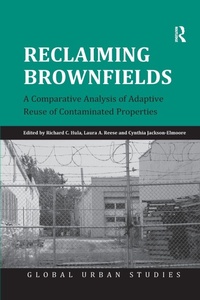
Reclaiming Brownfields
A Comparative Analysis of Adaptive Reuse of Contaminated Properties
1st Edition
Published on 15. November 2016
Book
Paperback/Softback
408 pages
978-1-138-26706-0 (ISBN)
Description
The environmental legacy of past industrial and agricultural development can simultaneously pose serious threats to human health and impede reuse of contaminated land. The urban landscape around the world is littered with sites contaminated with a variety of toxins produced by past use. Both public and private sector actors are often reluctant to make significant investments in properties that simultaneously pose significant potential human health issues, and may demand complex and very expensive cleanups. The chapters in this volume recognize that land and water contamination are now almost universally acknowledged to be key social, economic, and political issues. How multiple societies have attempted to craft and implement public policy to deal with these issues provides the central focus of the book. The volume is unique in that it provides a global comparative perspective on brownfield policy and examples of its use in a variety of countries.
Reviews / Votes
This volume on brownfields reclamation is a much welcomed scholarly endeavor and an impressive achievement. While much research involving brownfields and urban environmental problems function with imposed definitions and disparate analyses, this research provides a much needed holistic and integrated approach to brownfields specifically, but also the larger urban environmental policy arena in general. Though focused, the major achievement of this exceptional effort is its treatment and placement of urban environmental challenges within a larger context that recognizes and evaluates pollution, people, and place in a comparative and adaptive manner never before done. Such an approach is a major theoretical and practical breakthrough for both scholars and practitioners seeking to assess, evaluate, and resolve urban environmental policy issues. Yet, the greatest triumph of this research is the comparative approach that further underscores the contemporary nature of urban environmental challenges by recognizing that these issues are in fact common across urban areas across the globe. While the international community has recognized our shrinking world across financial, political, and social sectors, this research injects urban environmental policy issue into that global community conversation-a long overdue advance. Hunter Bacot, University of Arkansas at Little Rock, USAMore details
Language
English
Place of publication
London
United Kingdom
Publishing group
Taylor & Francis Ltd
Target group
College/higher education
Dimensions
Height: 234 mm
Width: 156 mm
Thickness: 22 mm
Weight
617 gr
ISBN-13
978-1-138-26706-0 (9781138267060)
Copyright in bibliographic data and cover images is held by Nielsen Book Services Limited or by the publishers or by their respective licensors: all rights reserved.
Schweitzer Classification
Other editions
Additional editions
Richard C. Hula | Laura A. Reese
Reclaiming Brownfields
A Comparative Analysis of Adaptive Reuse of Contaminated Properties
E-Book
03/2016
Routledge
€77.99
Available for download
Richard C. Hula | Laura A. Reese
Reclaiming Brownfields
A Comparative Analysis of Adaptive Reuse of Contaminated Properties
E-Book
03/2016
Routledge
€77.99
Available for download
Richard C. Hula | Laura A. Reese
Reclaiming Brownfields
A Comparative Analysis of Adaptive Reuse of Contaminated Properties
Book
09/2012
1st Edition
Routledge
€232.90
Shipment within 10-20 days
Persons
Richard C. Hula is professor and chair of the Department of Political Science, Laura A. Reese is Professor of Political Science and Director of the Global Urban Studies Program (GUSP) and Cynthia Jackson-Elmoore is Dean of the Honors College, a Professor with faculty appointments in Social Work and Political Science and an affiliation with the Global Urban Studies Program, all at Michigan State University, USA.
Content
I: Policy; 1: Incentives for Collaboration; 2: Changing Agendas in State Environmental Policy; 3: Revitalizing Contaminated Land in Italy, the United Kingdom and the United States; 4: Redevelopment Strategy of Brownfield Sites in the Czech Republic; II: Implementation and Evaluation; 5: Exploring the Potential for Integrating Community Benefits Agreements into Brownfield Redevelopment Projects; 6: The Quantitative and Qualitative Impacts of Brownfield Policies in England; 7: New Urban Communities; 8: The Inertia of Environmental Regulatory Enforcement in China; 9: Strategic Land Management in Germany; III: Brownfield Case Studies; 10: Fostering Brownfields Development in Rust Belt Cities; 11: Institutional Network Management in Brownfield Cleanup and Redevelopment; 12: From Blighted Brownfields to Healthy and Sustainable Communities; 13: Michigan Brownfield Redevelopment Innovation