

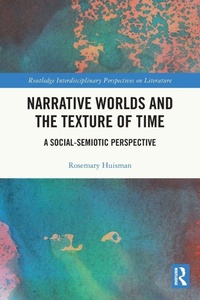
Narrative Worlds and the Texture of Time
A Social-Semiotic Perspective
1st Edition
Published on 27. May 2024
Book
Paperback/Softback
188 pages
978-1-032-34941-1 (ISBN)
Description
This book brings together a model of time and a model of language to generate a new model of narrative, where different stories with different temporalities and non-chronological modes of sequence can tell of different worlds of human - and non-human - experience, woven together (the 'texture of time') in the one narrative. The work of Gerald Edelman on consciousness, J.T. Fraser on time, and M.A.K. Halliday on language is introduced; the categories of systemic functional linguistics are used for detailed analysis of English narrative texts from different literary periods. A summary chapter gives an overview of previous narrative studies and theories, with extensive references. Chapters on 'temporalization' and 'spatialization' of language contrast the importance of time in narrative texts with the effect of 'grammatical metaphor', as described by M.A.K. Halliday, for scientific discourse. Chapters on prose fiction, poetry and the texts of digital culture chart changes in the 'texture of time' with changes in the social context: 'narrative as social semiotic'.
Reviews / Votes
"Rosemary Huisman's absorbingstudy draws on a wide and eclectic range of thinkers, to construct her own account of how people and their narratives experience or negotiate time: its texture, its passing, its inexorable force. Her commentary is in fruitful dialogue with the likes of Whorf, Edelman, William James, and the systemic functional linguistics of M.A.K. Halliday. Central to the discussion is J. T. Fraser's thesis that 'time felt' and 'time understood' are profoundly distinct but interacting phenomena. Along the narrative arc of this study, we meet interesting commentaries on the temporal texture of some great narrative literature, including Middlemarch and 'Frost at Midnight', and contemporary poems by Louis Armand and Antigone Kefala."-Prof. Michael Toolan, Emeritus Professor of English Language, University of Birmingham, UK
Rosemary Huisman's Narrative Worlds and the Texture of Time, a social-semiotic perspective is a very timely gift to social-semiotic scholarship - a brilliant, erudite transdisciplinary investigation of how we construe our experience of time by modelling it as meaning - including its manifestation as the texture of time in stories. This investigation is grounded in insights into the theoretical conceptions of different modes of time in an ordered typology of systems operating in different phenomenal realms, with reference to the pioneering work by J.T. Fraser on different orders of time but also to studies by other leading scholars from different disciplines concerned with aspects of temporality, including M.A.K. Halliday, B.L. Whorf., Vladimir Propp, Mikhail Bakhtin, Gerald Edelman.
-Prof. Christian M.I.M. Matthiessen, Distinguished Professor, School of Foreign Languages, Hunan University
More details
Series
Language
English
Place of publication
London
United Kingdom
Publishing group
Taylor & Francis Ltd
Target group
College/higher education
Postgraduate
Illustrations
15 s/w Tabellen, 4 s/w Zeichnungen, 4 s/w Abbildungen
15 Tables, black and white; 4 Line drawings, black and white; 4 Illustrations, black and white
Dimensions
Height: 229 mm
Width: 152 mm
Thickness: 12 mm
Weight
312 gr
ISBN-13
978-1-032-34941-1 (9781032349411)
Copyright in bibliographic data and cover images is held by Nielsen Book Services Limited or by the publishers or by their respective licensors: all rights reserved.
Schweitzer Classification
Other editions
Additional editions
E-Book
09/2022
1st Edition
Routledge
€55.49
Available for download
Book
09/2022
1st Edition
Routledge
€206.20
Shipment within 10-20 days
E-Book
09/2022
1st Edition
Routledge
€55.49
Available for download
Person
Rosemary Huisman is Honorary Associate Professor in English at The University of Sydney. She is the author of The Written Poem, Semiotic Conventions from Old to Modern English, six chapters in Narrative and Media, and numerous articles on literary and legal language; she is also a published poet.
Content
List of figures
List of tables
Acknowledgements
Preface
1 Human consciousness and the dual experience of time felt and time understood
2 'Spatialization' and scientific discourse, taking time out of language: Benjamin Whorf's 'configuration of experience' and M.A.K. Halliday's 'grammatical metaphor'
3 Levels of nature and worlds of time: J.T. Fraser's model of five levels of natural complexity associated with six worlds of different temporalities in the extended human umwelt
4 Narrative studies and time: a summary history of 'scientific' and 'philosophical' understandings of temporal meaning in narrative theory and narratology
5 Language and worlds of experience: the basic concepts of M.A.K Halliday's model of functional grammar, and its system of transitivity relating meaning to worlds of experience
6 'Temporalization' and narrative texts, keeping time in language: projection and narrative voice, expansion and narrative particularity
7 Narrative worlds and their temporalities: weaving the temporalities of different worlds with different modes of coherence in the texture of one narrative; dominant worlds in English literary texts, pre-printing to postmodern
8 The meaning of 'story': the mode of coherence of each thread/theory telling the temporality of one narrative world, with examples from different historical periods
9 Prose fiction and the texture of time: detailed study and comparison of extracts from three 'canonical' novels of classic realism, modernism and postmodernism
10 Poetry and the texture of time: extending the model of temporalities to the traditional, modernist and postmodern poem, and the complex poetic 'weaving' of temporal meanings
11 Digital culture and the texture of time, post postmodernism or ...
Index
List of tables
Acknowledgements
Preface
1 Human consciousness and the dual experience of time felt and time understood
2 'Spatialization' and scientific discourse, taking time out of language: Benjamin Whorf's 'configuration of experience' and M.A.K. Halliday's 'grammatical metaphor'
3 Levels of nature and worlds of time: J.T. Fraser's model of five levels of natural complexity associated with six worlds of different temporalities in the extended human umwelt
4 Narrative studies and time: a summary history of 'scientific' and 'philosophical' understandings of temporal meaning in narrative theory and narratology
5 Language and worlds of experience: the basic concepts of M.A.K Halliday's model of functional grammar, and its system of transitivity relating meaning to worlds of experience
6 'Temporalization' and narrative texts, keeping time in language: projection and narrative voice, expansion and narrative particularity
7 Narrative worlds and their temporalities: weaving the temporalities of different worlds with different modes of coherence in the texture of one narrative; dominant worlds in English literary texts, pre-printing to postmodern
8 The meaning of 'story': the mode of coherence of each thread/theory telling the temporality of one narrative world, with examples from different historical periods
9 Prose fiction and the texture of time: detailed study and comparison of extracts from three 'canonical' novels of classic realism, modernism and postmodernism
10 Poetry and the texture of time: extending the model of temporalities to the traditional, modernist and postmodern poem, and the complex poetic 'weaving' of temporal meanings
11 Digital culture and the texture of time, post postmodernism or ...
Index