

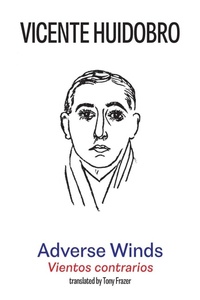
Adverse Winds
Vientos contrarios
Published on 1. September 2023
Book
Paperback/Softback
212 pages
978-1-84861-854-1 (ISBN)
Description
Adverse Winds (Vientos contrarios) is a collection of essays, aphorisms, and observations, published by Huidobro in Santiago in 1926, after many years in Europe.
At this remove it is perhaps difficult to grasp that in 1926, Vicente Huidobro (1893-1948), who had cut something of a swathe through literary Paris - albeit not quite as thorough a swathe as he would sometimes have us believe - was almost unknown back home in Santiago. He had published nothing there apart from self-financed volumes of juvenilia before his departure for Paris in 1916, and his new avant-garde work from the Paris period was mostly unknown and mostly not very welcome in backward Santiago.
Needing to attract some attention upon his return, Huidobro assembled this collection of statements, aphorisms and cod-memoirs as an introduction to the serious new self that he wished to present to those who might have heard a few rumours of his successes abroad, but would be puzzled by having seen nothing of his writing. The soon-to-be broken marriage and the surrounding scandal were to ruin his attempts in this direction, and caused his flight back to Europe, this time alone and pursued by death-threats from irate relatives of his new paramour. Looked at objectively, the book is a grab-bag, including some fascinating and notorious statements (the poet is a little god; I will be the premier poet of my time, etc.), alongside a number of interesting sideswipes at writers he wished to denigrate. His excursions - daring for their time - into matters of love, sex and infidelity in the book must have struck many after his hurried departure as being, at the very least, misguided. The heartfelt tribute to Teresa Wilms, a great beauty, and a talented prose-writer, dead by her own hand at 28, is undermined somewhat by that fact Vicente had had an affair with her in 1916 and that just about everyone in the tight-knit aristocratic circles in which he moved would have known this. One imagines that his now-estranged wife would have been doubly unamused.
The book should be seen as an adjunct to the previous year's collection of Manifestos (also available in this series), and as another staging post on the poet's path towards a position of mastery.
At this remove it is perhaps difficult to grasp that in 1926, Vicente Huidobro (1893-1948), who had cut something of a swathe through literary Paris - albeit not quite as thorough a swathe as he would sometimes have us believe - was almost unknown back home in Santiago. He had published nothing there apart from self-financed volumes of juvenilia before his departure for Paris in 1916, and his new avant-garde work from the Paris period was mostly unknown and mostly not very welcome in backward Santiago.
Needing to attract some attention upon his return, Huidobro assembled this collection of statements, aphorisms and cod-memoirs as an introduction to the serious new self that he wished to present to those who might have heard a few rumours of his successes abroad, but would be puzzled by having seen nothing of his writing. The soon-to-be broken marriage and the surrounding scandal were to ruin his attempts in this direction, and caused his flight back to Europe, this time alone and pursued by death-threats from irate relatives of his new paramour. Looked at objectively, the book is a grab-bag, including some fascinating and notorious statements (the poet is a little god; I will be the premier poet of my time, etc.), alongside a number of interesting sideswipes at writers he wished to denigrate. His excursions - daring for their time - into matters of love, sex and infidelity in the book must have struck many after his hurried departure as being, at the very least, misguided. The heartfelt tribute to Teresa Wilms, a great beauty, and a talented prose-writer, dead by her own hand at 28, is undermined somewhat by that fact Vicente had had an affair with her in 1916 and that just about everyone in the tight-knit aristocratic circles in which he moved would have known this. One imagines that his now-estranged wife would have been doubly unamused.
The book should be seen as an adjunct to the previous year's collection of Manifestos (also available in this series), and as another staging post on the poet's path towards a position of mastery.
More details
Language
English
Spanish
Place of publication
Exeter
United Kingdom
Dimensions
Height: 229 mm
Width: 152 mm
Thickness: 13 mm
Weight
352 gr
ISBN-13
978-1-84861-854-1 (9781848618541)
Copyright in bibliographic data and cover images is held by Nielsen Book Services Limited or by the publishers or by their respective licensors: all rights reserved.
Schweitzer Classification
Persons
The Chilean poet Vicente Huidobro (1893-1948) is one of the most important figures in 20th-century Hispanic poetry and a pioneering avant-gardist in Spanish. After an early phase writing in a quasi-Symbolist style in his native Santiago, he moved to Paris and threw himself into the local artistic milieu with a passion, quickly becoming a notable figure in avant-garde circles, and publishing a dozen books and chapbooks in the period 1917-1925. He was to reach his artistic maturity in 1931 with the publication of 'Altazor' and 'Temblor de cielo' (Skyquake). While he is mainly remembered today for his poetry, his fiction and other writings are also still worth the reader's attention.