

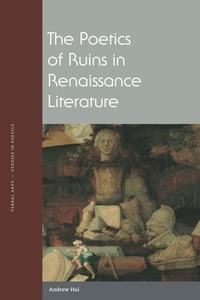
The Poetics of Ruins in Renaissance Literature
Published on 2. January 2017
Book
Hardback
296 pages
978-0-8232-7335-5 (ISBN)
Description
The Renaissance was the Ruin-naissance, the birth of the ruin as a distinct category of cultural discourse, one that inspired voluminous poetic production. For humanists, the ruin became the material sign that marked the rupture between themselves and classical antiquity. In the first full-length book to document this cultural phenomenon, Andrew Hui explains how the invention of the ruin propelled poets into creating works that were self-aware of their absorption of the past as well as their own survival in the future.
Reviews / Votes
"Written with a lucid, elegant sensibility and profound erudition, this study interprets anew the shifts in meaning and value of ruins from classical Latin, to the Romance languages, to English lyrics. At the heart of his analysis Hui uncovers and probes the central problems raised by thinkers on the archeology of ruins: the inner relation between literature and ruins, the ethics of finitude they embody, their future, and the place of ruins at the new beginnings of history. My mind expands as I read it, and I can easily predict others will respond the same way." -- -Giuseppe Mazzotta Sterling Professor in the Humanities for Italian, Yale UniversityMore details
Series
Language
English
Place of publication
New York
United States
Target group
Professional and scholarly
Product notice
Cloth over boards
Dimensions
Height: 235 mm
Width: 157 mm
Thickness: 21 mm
Weight
594 gr
ISBN-13
978-0-8232-7335-5 (9780823273355)
Copyright in bibliographic data and cover images is held by Nielsen Book Services Limited or by the publishers or by their respective licensors: all rights reserved.
Schweitzer Classification
Other editions
Additional editions
E-Book
01/2017
1st Edition
Fordham University Press
€32.99
Available for download
Person
Andrew Hui is Assistant Professor of Humanities at Yale-NUS College, Singapore.
Content
List of Figures and Color Plates Introduction: A Japanese Friend Part I 1. The Rebirth of Poetics 2. The Rebirth of Ruins Part II 3. Petrarch's Vestigia and the Presence of Absence 4. Hypnerotomachia Poliphili and the Erotics of Fragments 5. Du Bellay's Cendre and the Formless Signifier 6. Spenser's Moniments and the Allegory of Ruins Epilogue: Fallen Castles and Summer Grass Acknowledgments Notes Index