

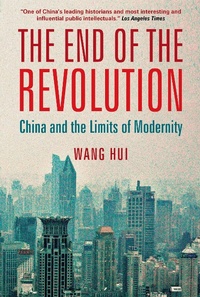
The End of the Revolution
China and the Limits of Modernity
Published on 1. August 2011
Book
Paperback/Softback
272 pages
978-1-84467-379-7 (ISBN)
Description
Challenging both the bureaucratic one-party regime and the Western neoliberal paradigm, China's leading critic shatters the myth of progress and reflects upon the inheritance of a revolutionary past. In this original and wide-ranging study, Wang Hui examines the roots of China's social and political problems, and traces the reforms and struggles that have led to the current state of mass depoliticization.
Arguing that China's revolutionary history and its current liberalization are part of the same discourse of modernity, Wang Hui calls for alternatives to both its capitalist trajectory and its authoritarian past.
From the May Fourth Movement to Tiananmen Square, The End of the Revolution offers a broad discussion of Chinese intellectual history and society, in the hope of forging a new path for China's future.
Arguing that China's revolutionary history and its current liberalization are part of the same discourse of modernity, Wang Hui calls for alternatives to both its capitalist trajectory and its authoritarian past.
From the May Fourth Movement to Tiananmen Square, The End of the Revolution offers a broad discussion of Chinese intellectual history and society, in the hope of forging a new path for China's future.
Reviews / Votes
A central figure among a group of writers and academics known collectively as the New Left. * The New York Times Magazine * One of China's leading historians and most interesting and influential public intellectuals. -- Jeffrey Wasserstrom * Los Angeles Times * Wang Hui brings a distinctive Chinese voice to the discussion of globalization and neoliberalism. * Chinese Development Brief * Our focus on the country's future has led to a de facto collusion with the Chinese government in ignoring its past ... In The End of the Revolution, the leading Chinese critic Wang Hui offers an alternative: an undivided narrative of modern Chinese history which makes better sense. -- John Gittings * The Guardian * Immensely valuable. * Choice * Wang Hui [is] one of the strongest critics of contemporary inequality and the marketization of society and politics in China. [This] nuanced and highly theorized investigation into the relationship between revolutionary traditions and the rise of neoliberal capitalism ... has implications beyond the field of China studies. -- Alexander Day * Criticism * The best book regarding Western misconceptions of contemporary China. * Artforum *More details
Language
English
Place of publication
London
United Kingdom
Target group
College/higher education
Professional and scholarly
Product notice
Paperback (trade)
Unsewn / adhesive bound
Dimensions
Height: 212 mm
Width: 141 mm
Thickness: 24 mm
Weight
353 gr
ISBN-13
978-1-84467-379-7 (9781844673797)
Copyright in bibliographic data and cover images is held by Nielsen Book Services Limited or by the publishers or by their respective licensors: all rights reserved.
Schweitzer Classification
Other editions
Additional editions
E-Book
08/2011
Verso Books
from
€34.79
Available for download
Previous edition
Book
02/2010
Verso Books
€38.59
Article exhausted; check for reprint
Persons
WANG HUI is a Professor in the Department of Chinese Language and Literature at Tsinghua University in Beijing, where he currently lives. He studied at Yangzhou University, Nanjing University, and the Chinese Academy of Social Sciences. He has also been a visiting professor at NYU and other universities in the US. In 1989, he participated in the Tiananmen Square protests and was subsequently sent to a poor inland province for compulsory "reeducation" as punishment for his participation. He developed a leftist critique of government policy and came to be one of the leading proponents of the Chinese New Left in the 1990s, though Wang Hui did not choose this term. Wang was named as one of the top 100 public intellectuals in the world in 2008 by Foreign Policy.