


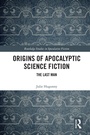
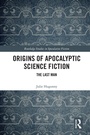
Origins of Apocalyptic Science Fiction
The Last Man
1st Edition
Will be published approx. on 3. July 2026
Book
Hardback
198 pages
978-1-032-74914-3 (ISBN)
Description
Origins of Apocalyptic Science Fiction: The Last Man argues that apocalyptic science fiction found its origins in the early 19th century, in works of literature centred on the figure of the Last Man on Earth. This character, inexistent before then, inspired authors and readers alike, grew in popularity, and quickly became an archetype.
This obsessive retelling of the same story was a response to unprecedented social, political, and scientific upheavals and acted as a means to process those changes through the practice of fiction. By imagining the end of the human worldview through the figure of the Last Man on Earth, a new archetype of resilience and solitude, they expressed indirectly the trauma of those changing times and created a blueprint to read both past and future human history. This book traces the figure of the Last Man and its significance through eight major works of fiction, charting the evolution of humanity's most persistent nightmare and its transformation into our most enduring literary obsession.
This obsessive retelling of the same story was a response to unprecedented social, political, and scientific upheavals and acted as a means to process those changes through the practice of fiction. By imagining the end of the human worldview through the figure of the Last Man on Earth, a new archetype of resilience and solitude, they expressed indirectly the trauma of those changing times and created a blueprint to read both past and future human history. This book traces the figure of the Last Man and its significance through eight major works of fiction, charting the evolution of humanity's most persistent nightmare and its transformation into our most enduring literary obsession.
More details
Series
Language
English
Place of publication
London
United Kingdom
Publishing group
Taylor & Francis Ltd
Target group
College/higher education
Postgraduate
Dimensions
Height: 229 mm
Width: 152 mm
ISBN-13
978-1-032-74914-3 (9781032749143)
Copyright in bibliographic data and cover images is held by Nielsen Book Services Limited or by the publishers or by their respective licensors: all rights reserved.
Schweitzer Classification
Other editions
Additional editions
E-Book
approx. 07/2026
Routledge
€60.49
Available for download
E-Book
approx. 07/2026
Routledge
€60.49
Available for download
Person
Julie Hugonny earned a PhD in French literature from New York University. Her research interests include 19th-century literature, science fiction in literature and cinema, depictions of monsters in popular culture, as well as disasters, epidemics, devolution, and the end of the world. Her articles have been published in Supernatural Studies, Modern Language Studies, as well as French Forum.
Content
Introduction; Chapter 1 - "It was a beautiful day for the world's decadence."; The Last Man, by Jean-Baptiste de Grainville, a poetic apocalypse; Chapter 2 - "One day all extinct, save myself, should I walk the earth alone"; The Cathartic Word in Mary Shelley's The Last Man; Chapter 3 - "Another universe began, whose genesis some future Moses and Laplace would tell."; The unlimited possibilities of death and life in Camille Flammarion's Omega; Chapter 4 - "After the battle comes Quiet"; The Consequences of Evolution in H.G. Wells' The Time Machine; Chapter 5 - "It was not a good race which called itself Man [...] Never through me shall it spring and fester again."; M. P. Shiel's The Purple Cloud - The Reluctant Adam of a New Humanity; Chapter 6 - "Children with sharp teeth [and] an insatiable belly."; Figures of eternal return in Jules & Michel Verne's The Eternal Adam; Chapter 7 - "What is education? - Calling red scarlet"; Figures of regression in Jack London's The Scarlet Plague; Chapter 8 - "The Death of the Earth for our Kingdom"; Human and Posthuman in J.-H. Rosny Aine's The Death of the Earth.; Conclusion