

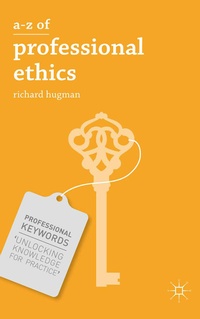
A-Z of Professional Ethics
Essential Ideas for the Caring Professions
Published on 28. November 2013
Book
Paperback/Softback
224 pages
978-0-230-33722-0 (ISBN)
Description
If you are looking for an accessible introduction to the essential concepts that define the field of professional ethics, then this is the book for you.
Richard Hugman's A-Z of Professional Ethics offers a winning combination of breadth and concision, expertly organised to make usage intuitive and easy. Its simple A-Z structure will help you appreciate the architecture of ethics and give you a vocabulary for ethical debate. Clever cross-referencing allows you to find your own routes through the material as well as signposting interesting connections between different ideas.
Unique to this book are its sensitivity to cross-cultural influences and its careful integration of different professional perspectives. These give it outstanding balance and coverage. A rich source of further references, it offers readers an invaluable guide to an increasingly extensive literature.
Whatever your field of study or practice (social work, health care, or therapy), this book will prove an enduring source of clarity, insight and reflection.
Richard Hugman's A-Z of Professional Ethics offers a winning combination of breadth and concision, expertly organised to make usage intuitive and easy. Its simple A-Z structure will help you appreciate the architecture of ethics and give you a vocabulary for ethical debate. Clever cross-referencing allows you to find your own routes through the material as well as signposting interesting connections between different ideas.
Unique to this book are its sensitivity to cross-cultural influences and its careful integration of different professional perspectives. These give it outstanding balance and coverage. A rich source of further references, it offers readers an invaluable guide to an increasingly extensive literature.
Whatever your field of study or practice (social work, health care, or therapy), this book will prove an enduring source of clarity, insight and reflection.
Reviews / Votes
'The structure of the book is a real strength. It offers the reader an introduction to the major themes in ethics, with references and signposts to further reading for the student to deepen their knowledge.' - Dr Janet Holt, Senior Lecturer, School of Healthcare, University of Leeds 'I am impressed with the book's comprehensiveness and clarity. Hugman provides readers with clear explications of core and essential ethics concepts.' - Professor Frederic Reamer, School of Social Work, Rhode Island CollegeMore details
Series
Edition
2013
Language
English
Place of publication
London
United Kingdom
Publishing group
Bloomsbury Publishing PLC
Target group
College/higher education
Professional and scholarly
Dimensions
Height: 203 mm
Width: 127 mm
Thickness: 12 mm
Weight
246 gr
ISBN-13
978-0-230-33722-0 (9780230337220)
DOI
10.1007/978-1-137-31669-1
Schweitzer Classification
Other editions
Additional editions
E-Book
11/2013
1st Edition
Bloomsbury Academic
€27.49
Available for download
Person
Richard Hugman is Professor of Social Work at the University of New South Wales, Australia. He has published extensively in the last 20 years and his recent work in this area includes New Approaches in Ethics for the Caring Professions (2005, Palgrave-Macmillan) as well as several journal articles. He also currently serves as the chair of the ethics committee for the International Federation of Social Workers.
Content
Contents.- List of figures.- Introduction.- 1. African/Black Ethics.- 2. Altruism.- 3. Autonomy.- 4. Beneficence.- 5. Benevolence.- 6. Care (Duty of).- 7. Care (Ethics of).- 8. Codes of Ethics.- 9. Community.- 10. Compassion.- 11. Competence.- 12. Confidentiality.- 13. Confucian Ethics (Includes Filial Piety).- 14. Consent.- 15. Consequentialism.- 16. Courage.- 17. Deontology (Ethics of Duty).- 18. Dignity.- 19. Discourse Ethics.- 20. Emotion and Moral Sentiment.- 21. Equality.- 22. Ethical Egoism.- 23. Evil.- 24. Existential Ethics.- 25. Fairness.- 26. Feminist Ethics.- 27. Fidelity.- 28. Freedom.- 29. Futility.- 30. Harmony.- 31. Honesty.- 32. Honour.- 33. Human Agency (Includes Self-Determination).- 34. Human Rights.- 35. Indigenous (First Nations) Ethics.- 36. Informed Consent.- 37. Integrity.- 38. Justice (Includes Distributive Justice, Retributive Justice, Restorative Justice).- 39. Liberalism.- 40. Loyalty.- 41. Ma'at.- 42. 'Moral Fluency'.- 43. Non-Maleficence (Non-Malfeasance).- 44. Oppression (Includes Anti-Oppressive Values and Action).- 45. Over Servicing.- 46. Partiality and Impartiality.- 47. Paternalism.- 48. Phronesis (Prudence, Practical Wisdom).- 49. Pluralism (Includes 'Common Morality').- 50. Politics.- 51. Postmodern Ethics.- 52. Power (Includes Empowerment).- 53. Principles (Including 'Principilism').- 54. Relativism (Cultural; Ethical).- 55. Religion and Spirituality.- 56. Respect.- 57. Responsibility.- 58. Service.- 59. Social Justice.- 60. Subjectivism.- 61. Supererogatory (Action).- 62. Sustainability.- 63. Trust.- 64. Truth.- 65. 'Ubuntu'.- 66. Universalism.- 67. Utilitarianism.- (Includes: Rule Utilitarianism, Act Utilitarianism, Ideal Utilitarianism, Preference Utilitarianism).- 68. Values.- 69. Virtue.- 70. Welfare.- 71. Whistle-Blowing.- 72. Wisdom.- Further Reading.- References.