

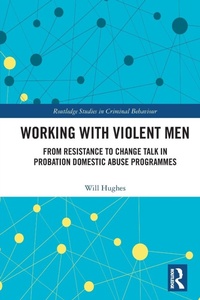
Working with Violent Men
From Resistance to Change Talk in Probation Domestic Abuse Programmes
1st Edition
Published on 6. May 2025
Book
Paperback/Softback
148 pages
978-1-032-15168-7 (ISBN)
Description
Working with Violent Men gives a detailed insight into working with men who have been violent towards intimate partners. As such this monograph aims to contribute to a gap in knowledge and understanding within an important social and criminal justice topic.
The book is underpinned by research based on participant observation at domestic abuse groups, allowing for direct observation of behaviours and interactions, including gestures and emotional responses, as well as semi-structured interviews with group facilitators and participants. It also draws on the author's experience of working with domestically abusive men, as a probation officer and facilitator of domestic abuse programmes. He argues that groups involve a micro social order, involving rules and rituals. These are continuously constructed and negotiated by participants, against a backdrop of ideas about masculinity, and involve the performance of gendered roles. Understanding the perspectives of these men, as well the interactional rules, rituals, and dynamics of programmes, enables facilitators to navigate the hostility that men display and engage them in a process of change. Attention to these considerations has implications for the effectiveness of group-based interventions in reducing violence against intimate partners and the training of those who deliver programmes. More general extrapolations are also drawn, about contemporary understandings of gender, masculinity, identity, and effective communication within groups.
This book will be of value to undergraduate and postgraduate students with interests in domestic violence, gender, probation, and the rituals of social interactions. It will also be useful to academics, researchers, and policymakers wishing to explore and develop approaches to work with domestically violent men.
The book is underpinned by research based on participant observation at domestic abuse groups, allowing for direct observation of behaviours and interactions, including gestures and emotional responses, as well as semi-structured interviews with group facilitators and participants. It also draws on the author's experience of working with domestically abusive men, as a probation officer and facilitator of domestic abuse programmes. He argues that groups involve a micro social order, involving rules and rituals. These are continuously constructed and negotiated by participants, against a backdrop of ideas about masculinity, and involve the performance of gendered roles. Understanding the perspectives of these men, as well the interactional rules, rituals, and dynamics of programmes, enables facilitators to navigate the hostility that men display and engage them in a process of change. Attention to these considerations has implications for the effectiveness of group-based interventions in reducing violence against intimate partners and the training of those who deliver programmes. More general extrapolations are also drawn, about contemporary understandings of gender, masculinity, identity, and effective communication within groups.
This book will be of value to undergraduate and postgraduate students with interests in domestic violence, gender, probation, and the rituals of social interactions. It will also be useful to academics, researchers, and policymakers wishing to explore and develop approaches to work with domestically violent men.
More details
Series
Language
English
Place of publication
London
United Kingdom
Publishing group
Taylor & Francis Ltd
Target group
College/higher education
Professional and scholarly
Postgraduate, Professional, and Undergraduate Advanced
Dimensions
Height: 234 mm
Width: 156 mm
Thickness: 9 mm
Weight
248 gr
ISBN-13
978-1-032-15168-7 (9781032151687)
Copyright in bibliographic data and cover images is held by Nielsen Book Services Limited or by the publishers or by their respective licensors: all rights reserved.
Schweitzer Classification
Other editions
Additional editions
Will Hughes
Working with Violent Men
From Resistance to Change Talk in Probation Domestic Abuse Programmes
Book
12/2023
1st Edition
Routledge
€205.80
Shipment within 10-20 days
Will Hughes
Working with Violent Men
From Resistance to Change Talk in Probation Domestic Abuse Programmes
E-Book
12/2023
1st Edition
Taylor & Francis
€60.49
Available for download
Will Hughes
Working with Violent Men
From Resistance to Change Talk in Probation Domestic Abuse Programmes
E-Book
12/2023
1st Edition
Taylor & Francis
€60.49
Available for download
Person
Will Hughes is a senior lecturer in criminology at London Metropolitan University. He was previously a probation officer and specialised in staff development and work with men who have histories of domestic violence. During the last 20 years, he has worked as a group facilitator for various probation programmes and community programmes, including Caring Dad's, the Integrated Domestic Abuse Programme, and the Building Better relationships programme.
Content
Chapter 1: Introduction and Overview
Chapter 2: Working with Men who Abuse their Partners: Context, History and Challenges
Chapter 3: Thinking Differently about Programmes for Men who have been Abusive
Chapter 4: 'I am not one of those wife beaters': Working with Resistance and Hostility
Chapter 5: 'These are a good bunch of Guys': From Resistance to Masculine Bonds and Engagement
Chapter 6: Finding Common Ground: Facilitator Perceptions and Perceptions of Facilitators
Chapter 7: But do these Programmes Actually Work?
Chapter 8: Conclusion and Final Reflections
Chapter 2: Working with Men who Abuse their Partners: Context, History and Challenges
Chapter 3: Thinking Differently about Programmes for Men who have been Abusive
Chapter 4: 'I am not one of those wife beaters': Working with Resistance and Hostility
Chapter 5: 'These are a good bunch of Guys': From Resistance to Masculine Bonds and Engagement
Chapter 6: Finding Common Ground: Facilitator Perceptions and Perceptions of Facilitators
Chapter 7: But do these Programmes Actually Work?
Chapter 8: Conclusion and Final Reflections