

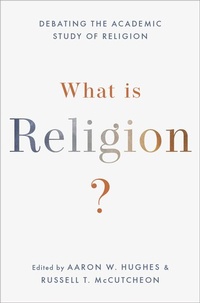
What Is Religion?
Debating the Academic Study of Religion
Published on 2. February 2022
Book
Hardback
378 pages
978-0-19-006497-6 (ISBN)
Description
Controversies over how to define the word "religion" have persisted for decades. It is a term of art and of academic study, but also one of governance, technologies, and of networks; it is a concept whose diversity is often its own worst enemy. "Religion" is as much a fuzzy set of conceptualizations and generalizations about a range of human activities as it is an authorizing system of persons, ideas, and practices.
What is Religion?: Debating the Academic Study of Religion invites readers to eavesdrop on scholarly debates over the limits of, and uses for, a word commonly used but infrequently defined in a precise manner. This volume takes the temperature of the modern field of Religious Studies by inviting a diverse group of scholars to offer their own substantive contribution that builds on the shared opening prompt, "Religion is...". Their essays document the current state of the field and its various sub-fields, assess the progress that has been made over the past generation, and propose new directions for future work. Seventeen of the international field's leading scholars show how they work with each other's definition, or, sometimes, the lack of a definition. Of interest to students, scholars, and general readers alike, What is Religion? will provoke debate and provide insights into the state of the field.
What is Religion?: Debating the Academic Study of Religion invites readers to eavesdrop on scholarly debates over the limits of, and uses for, a word commonly used but infrequently defined in a precise manner. This volume takes the temperature of the modern field of Religious Studies by inviting a diverse group of scholars to offer their own substantive contribution that builds on the shared opening prompt, "Religion is...". Their essays document the current state of the field and its various sub-fields, assess the progress that has been made over the past generation, and propose new directions for future work. Seventeen of the international field's leading scholars show how they work with each other's definition, or, sometimes, the lack of a definition. Of interest to students, scholars, and general readers alike, What is Religion? will provoke debate and provide insights into the state of the field.
Reviews / Votes
The book presents the reader with an original and innovative account of current approaches to, and controversies within, religious studies, gathering and interlinking multifaceted voices. * Hannah Griese, Reading Religion *More details
Language
English
Place of publication
New York
United States
Target group
Professional and scholarly
Dimensions
Height: 241 mm
Width: 159 mm
Thickness: 25 mm
Weight
454 gr
ISBN-13
978-0-19-006497-6 (9780190064976)
Copyright in bibliographic data and cover images is held by Nielsen Book Services Limited or by the publishers or by their respective licensors: all rights reserved.
Schweitzer Classification
Other editions
Additional editions
Book
02/2022
Oxford University Press Inc
€43.50
Shipment within 15-20 days
E-Book
10/2021
OUP eBook
€19.99
Available for download
E-Book
10/2021
OUP eBook
€19.99
Available for download
Persons
Aaron W. Hughes is the Philip S. Bernstein Professor in the Department of Religion and Classics at the University of Rochester. He is the author of sixteen books, twelve edited volumes, and over eighty articles and book chapters. Book titles include Abrahamic Religions: On the Uses and Abuses of History; Shared Identities: Medieval and Modern Imaginings of Judeo-Islam; and From Seminary to University: An Institutional History of the Study of Religion in Canada.
Russell T. McCutcheon is University Research Professor and long-time Chair of the Department of Religious Studies at the University of Alabama. He writes widely on the history of the field and the practical implications of classification systems. He is the author of such books as Manufacturing Religion, Studying Religion: An Introduction, and On Making a Shift in the Study of Religion and Other Essays.
Russell T. McCutcheon is University Research Professor and long-time Chair of the Department of Religious Studies at the University of Alabama. He writes widely on the history of the field and the practical implications of classification systems. He is the author of such books as Manufacturing Religion, Studying Religion: An Introduction, and On Making a Shift in the Study of Religion and Other Essays.
Editor
Philip S. Bernstein Professor, Department of Religion and ClassicsPhilip S. Bernstein Professor, Department of Religion and Classics, University of Rochester
University Research Professor and Chair of the Department of Religious StudiesUniversity Research Professor and Chair of the Department of Religious Studies, University of Alabama
Content
Preface
Introduction
The "Religion is..." Statements
1. Definition and the Politics of Semantic Drift: A Reply to Susan Henking
I Agree, And Yes, I Do Not: A Response to Craig Martin
2. Complicating Classification: Cognitive Sciences Comes to Religion: A Reply to Jeppe Sinding Jensen
Religion in Mind? But Where: In Here-or Our There?
3. Negotiating Critical and Constructive Scholarship in the Study of Religion: A Reply to Martin Kavka
On Truth and Lie in a Religious-Studies Sense: A Response to Kurtis R. Schaeffer
4. Defining Temptation: A Reply to Anne Koch
Religion-ing/religion*: Tempting Since Aesthetically Irresistible: A Response to Susan Henking
5. Is Judaism a Religion and Why Should We Care?: A Reply to Nicola Denzey Lewis
Are World Religions "Religions"? What about Ancient "Religions"? A Response to Shaul Magid
6. Minding Our Manners in World Without the Gods: A Reply to Kathryn Lofton
What I Think About: A Response to S. Brent Plate
7. The Circularity in Defining Religion: A Reply to Shaul Magid
Colonialism, Monotheism, and Spirituality: A Response to Kocku von Stuckrad
8. The Semantic Subject: Religion and the Limits of Language: A Reply to Craig Martin
Religion Is..., Not Like Science
9. Agreed: Religion Is Not a Thing-But Is It an Agent? A Reply to Malory Nye
Religion, Capital, and Other 'Things' Which are Not Things: A Response to Nicola Denzey Lewis
10. Is (What Gets Called) Religion an Argument, Discourse, or Ideology: A Reply to Laurie L. Patton
Now What? A Response to Malory Nye
11. Religion is..., What it Does: A Reply to Anthony B. Pinn
Optics Matter: A Response to Jeppe Sinding Jensen
12. Religion is an Ever-Adapting Ecosystem of Objects: A Reply to S. Brent Plate
Evolution, Technology, Art: A Reply to Anne Taves
13. Scripturalization as Management of Difference: A Reply to Kurtis R. Schaeffer
Inside/Outside, Then/Now: A Response to Vincent L. Wimbush
14. Critical Voices, Public Debates: A Reply to Kocku von Struckrad
The Accountability of Embedded Scholarship: A Response to Laurie L. Patto
15. Let's Talk About Reading: A Reply to Ann Taves
A Reader's Guide to Worldviews and Ways of Life: A Response to Martin Kavka
16. Arguments Against the Textualization Regime: A Reply to Vincent L. Wimbush
Refracting the Scriptural: A Response to Anne Koch
17. Mapping Religion-religion: A Reply to Laurie Zoloth
What Do We Mean When We Say We Teach "Religion?": A Response to Anthony B. Pinn
Appendix
Definitions of Religion and Critical Comments
Introduction
The "Religion is..." Statements
1. Definition and the Politics of Semantic Drift: A Reply to Susan Henking
I Agree, And Yes, I Do Not: A Response to Craig Martin
2. Complicating Classification: Cognitive Sciences Comes to Religion: A Reply to Jeppe Sinding Jensen
Religion in Mind? But Where: In Here-or Our There?
3. Negotiating Critical and Constructive Scholarship in the Study of Religion: A Reply to Martin Kavka
On Truth and Lie in a Religious-Studies Sense: A Response to Kurtis R. Schaeffer
4. Defining Temptation: A Reply to Anne Koch
Religion-ing/religion*: Tempting Since Aesthetically Irresistible: A Response to Susan Henking
5. Is Judaism a Religion and Why Should We Care?: A Reply to Nicola Denzey Lewis
Are World Religions "Religions"? What about Ancient "Religions"? A Response to Shaul Magid
6. Minding Our Manners in World Without the Gods: A Reply to Kathryn Lofton
What I Think About: A Response to S. Brent Plate
7. The Circularity in Defining Religion: A Reply to Shaul Magid
Colonialism, Monotheism, and Spirituality: A Response to Kocku von Stuckrad
8. The Semantic Subject: Religion and the Limits of Language: A Reply to Craig Martin
Religion Is..., Not Like Science
9. Agreed: Religion Is Not a Thing-But Is It an Agent? A Reply to Malory Nye
Religion, Capital, and Other 'Things' Which are Not Things: A Response to Nicola Denzey Lewis
10. Is (What Gets Called) Religion an Argument, Discourse, or Ideology: A Reply to Laurie L. Patton
Now What? A Response to Malory Nye
11. Religion is..., What it Does: A Reply to Anthony B. Pinn
Optics Matter: A Response to Jeppe Sinding Jensen
12. Religion is an Ever-Adapting Ecosystem of Objects: A Reply to S. Brent Plate
Evolution, Technology, Art: A Reply to Anne Taves
13. Scripturalization as Management of Difference: A Reply to Kurtis R. Schaeffer
Inside/Outside, Then/Now: A Response to Vincent L. Wimbush
14. Critical Voices, Public Debates: A Reply to Kocku von Struckrad
The Accountability of Embedded Scholarship: A Response to Laurie L. Patto
15. Let's Talk About Reading: A Reply to Ann Taves
A Reader's Guide to Worldviews and Ways of Life: A Response to Martin Kavka
16. Arguments Against the Textualization Regime: A Reply to Vincent L. Wimbush
Refracting the Scriptural: A Response to Anne Koch
17. Mapping Religion-religion: A Reply to Laurie Zoloth
What Do We Mean When We Say We Teach "Religion?": A Response to Anthony B. Pinn
Appendix
Definitions of Religion and Critical Comments