


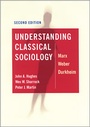
Understanding Classical Sociology
Marx, Weber, Durkheim
2nd Edition
Published on 10. April 2003
Book
Hardback
246 pages
978-0-7619-5466-8 (ISBN)
Description
Praise for the First Edition:
`Totally reliable... the authors have produced a book urgently needed by all those charged with introducing students to the classics... quite indispensable' - Times Higher Education Supplement
This is a fully updated and expanded new edition of the successful undergraduate text. Providing a lucid examination of the pivotal theories of Marx, Durkheim and Weber, the authors submit that these figures have decisively shaped the discipline. They show how the classical apparatus is in use, even though it is being directed in new ways in response to the changing character of society.
Written with the needs of undergraduates in mind, the text is essential reading for students in sociology and social theory.
`Totally reliable... the authors have produced a book urgently needed by all those charged with introducing students to the classics... quite indispensable' - Times Higher Education Supplement
This is a fully updated and expanded new edition of the successful undergraduate text. Providing a lucid examination of the pivotal theories of Marx, Durkheim and Weber, the authors submit that these figures have decisively shaped the discipline. They show how the classical apparatus is in use, even though it is being directed in new ways in response to the changing character of society.
Written with the needs of undergraduates in mind, the text is essential reading for students in sociology and social theory.
More details
Edition
2nd Revised edition
Language
English
Place of publication
Thousand Oaks
United States
Target group
College/higher education
Edition type
Revised edition
Product notice
Cloth over boards
Dimensions
Height: 250 mm
Width: 175 mm
Thickness: 18 mm
Weight
627 gr
ISBN-13
978-0-7619-5466-8 (9780761954668)
Copyright in bibliographic data and cover images is held by Nielsen Book Services Limited or by the publishers or by their respective licensors: all rights reserved.
Schweitzer Classification
Other editions
Additional editions

Book
03/2003
2nd Edition
SAGE Publications Inc
€111.50
Shipment within 15-20 days

E-Book
03/2003
2nd Edition
SAGE Publications Ltd
from
€80.59
Available for download
E-Book
03/2003
2nd Edition
SAGE Publications Ltd
from
€80.59
Available for download
Previous edition

Book
05/1995
1st Edition
SAGE Publications Ltd
€79.41
Article exhausted; check for reprint
Persons
Wes Sharrock has spent his entire career since 1965 in sociology until his retirement in 2017 at the University of Manchester. His main interests have been in the philosophy of social science and in ethnomethodology, and he has published widely on issues of sociological principle and empirical research in these areas.
Wes has explored two central themes-the relevance of fieldwork and an understanding of ordinary language for an understanding of social practice and the respecification of social theory-pursuing them across a huge variety of settings, from ordinary scenes of everyday social life through to complex domains of practical action and reasoning in various academic and industrial work situations. An ethnomethodologist of international reputation, alongside his other contributions, Wes coedited with Mike Lynch the four-volume 2003 Sage collection Harold Garfinkel.
Wes has explored two central themes-the relevance of fieldwork and an understanding of ordinary language for an understanding of social practice and the respecification of social theory-pursuing them across a huge variety of settings, from ordinary scenes of everyday social life through to complex domains of practical action and reasoning in various academic and industrial work situations. An ethnomethodologist of international reputation, alongside his other contributions, Wes coedited with Mike Lynch the four-volume 2003 Sage collection Harold Garfinkel.
Content
Introduction
Sociology's Intellectual Character
Conclusion
Select Bibliography and Further Reading
Karl Marx
Biography and Social Background
Early Years: The Critique of Hegel's Idealism
Turning Hegel the Right Way Up
The Critique of Political Economy
The Partnership with Engels
The Materialist Conception of History
The Priority of Society
The Material Basis of Social Organisation
Economic Production and Social Organisation
The Shaping of Consciousness
The Sources of Social Change
The Nature of Social Change
Social Revolution
The Economic Sources of Social Change
Issues of Interpretation
Changes in the Nature of Capitalism
Conclusion: Marx's Legacy
Select Bibliography and Further Reading
Max Weber
The Early Career
Weber and Modern Capitalism
The Organisation of Society
Capitalism, Rationality and Social Change
The Methodological Weber
The Legacy
Select Bibliography and Further Reading
Emile Durkheim
The Study of Social Action
The Reality of Society
The Unity of Society
Autonomy and Constraint
The Solidarity of Society
Thought and Society
The Diagnosis of Society
The Aftermath
Select Bibliography and Further Reading
Conclusion
Towards a Postmodern Marx?
The Durkheimian Legacy
Which Weber?
Concluding Remarks
Sociology's Intellectual Character
Conclusion
Select Bibliography and Further Reading
Karl Marx
Biography and Social Background
Early Years: The Critique of Hegel's Idealism
Turning Hegel the Right Way Up
The Critique of Political Economy
The Partnership with Engels
The Materialist Conception of History
The Priority of Society
The Material Basis of Social Organisation
Economic Production and Social Organisation
The Shaping of Consciousness
The Sources of Social Change
The Nature of Social Change
Social Revolution
The Economic Sources of Social Change
Issues of Interpretation
Changes in the Nature of Capitalism
Conclusion: Marx's Legacy
Select Bibliography and Further Reading
Max Weber
The Early Career
Weber and Modern Capitalism
The Organisation of Society
Capitalism, Rationality and Social Change
The Methodological Weber
The Legacy
Select Bibliography and Further Reading
Emile Durkheim
The Study of Social Action
The Reality of Society
The Unity of Society
Autonomy and Constraint
The Solidarity of Society
Thought and Society
The Diagnosis of Society
The Aftermath
Select Bibliography and Further Reading
Conclusion
Towards a Postmodern Marx?
The Durkheimian Legacy
Which Weber?
Concluding Remarks