

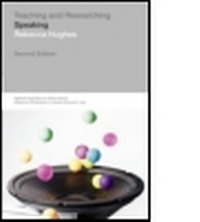
Teaching and Researching: Speaking
2nd Edition
Published on 25. November 2010
Book
Paperback/Softback
248 pages
978-1-4082-0504-4 (ISBN)
Description
Speaking is a dynamic, interpersonal process and one that strongly influences how we are perceived by others in a range of formal and everyday contexts. Despite this, speaking is often researched and taught as if it is simply writing delivered in a different mode. In Teaching and Researching Speaking, Rebecca Hughes suggests that we have less understanding than we might of important meaning-making aspects of speech such as prosody, gaze, affect, and the ways speakers collaborate and negotiate with one another in interaction.
This thoroughly revised and updated second edition looks to the future of the field, offering:
- A new chapter on assessment, discussing 'high stakes' oral language testing contexts such as immigration
- New material considering access to spoken data via the worldwide web and new technologies that allow neurolinguistic insights formerly hidden from view
- Summaries and case studies to help the reader understand how to approach researching speaking and encourages practitioners to question the models of speaking that they are using in their classrooms.
Reviewing materials and assessment practices in the light of current knowledge about spoken language, and highlighting areas for new work and collaboration between researchers and practitioners, this book will be a valuable resource for anyone involved in language teaching.
This thoroughly revised and updated second edition looks to the future of the field, offering:
- A new chapter on assessment, discussing 'high stakes' oral language testing contexts such as immigration
- New material considering access to spoken data via the worldwide web and new technologies that allow neurolinguistic insights formerly hidden from view
- Summaries and case studies to help the reader understand how to approach researching speaking and encourages practitioners to question the models of speaking that they are using in their classrooms.
Reviewing materials and assessment practices in the light of current knowledge about spoken language, and highlighting areas for new work and collaboration between researchers and practitioners, this book will be a valuable resource for anyone involved in language teaching.
More details
Other editions
Additional editions
Rebecca Hughes
Teaching and Researching: Speaking
Book
11/2015
2nd Edition
Routledge
€141.13
Article exhausted; check different version
Previous edition
Rebecca Hughes
Teaching & Researching : Speaking
Book
10/2002
Addison Wesley
€44.46
Article exhausted; check for reprint
Person
Rebecca Hughes is Chair of Applied Linguistics and Head of the Centre for English Language Education at the University of Nottingham, United Kingdom. She is the author of several publications including English in Speech and Writing (1996), and Spoken English, TESOL and Applied Linguistics: Challenges for Theory and Practice (ed.) (2006).
Content
CONTENTSFigure list General Editor's Preface Acknowledgements Publisher's Acknowledgements Introduction Section I Issues in teaching and researching speaking 1 Conceptual and historical background1.1 Introduction1.2 The skill of speaking1.3 The nature of speech in contrast to writing1.4 Where does speech fit in language studies?Summary2 The research space: paradigms and issues2.1 Introduction2.2 Classical research paradigms in relation to researching speaking2.3 Attitudes to speech data2.4 The applicability of research approaches and frameworks to the study of speech2.5 Levels of analysisSummary Section II Issues for teaching and assessing speaking3 Approaches, materials and the issue of ?real? speech3.1 Introduction3.2 What are our models and standards when we teach speaking?3.3 The evolution of materials to teach speaking3.4 The current scene in materials to teach speaking3.5 Bringing the skills together Summary4 Issues in assessing speaking4.1 Introduction4.2 Why the nature of speaking is a challenge for test designers4.3 A comparison of contrasting test paradigms for oral assessment in three high-stakes testsSummary5 Approaches to researching speech5.1 Introduction5.2 Quantitative and qualitative approaches towards researching speaking5.3 Theory-driven, positional, or ideas-based approaches to researching speaking5.4 Examples of contrasting approaches in researching speaking5.5 New directions Section III Researching speaking6 Spoken language and the classroom6.1 Introduction6.2 The Status of Speaking in Classrooms6.3 The role of spoken interaction in Communicative Language Teaching classrooms6.4 Drawing on classroom practice for research and vice versaSummary7 Research project ideas and frameworks7.1 Introduction7.2 A project on spoken language found in textbooks versus a corpus7.3 A project on the effects of speech rate in the context of English as Lingua Franca presentations7.4 An exploration of inter-cultural expectations in conversation7.5 A project that analyses a professional speaking genre so it can be handled in the classroom 7.6 A project on speaking assessment with low education immigrant test takers7.7 A project investigating the relationship between gesture and speech processing using fMRI scanning techniques Section IV Resources and further information8 Research borders and boundaries8.1 Introduction8.2 Speaking and ethnographic or cross-cultural studies8.3 Speaking and psycholinguistics8.4 Speaking and neuro-linguistic studies8.5 Speaking and corpus linguistics8.6 Speaking and new technologies9 Research resources9.1 Traditional library resources9.2 Societies and organisations9.3 Online resources9.4 Speech corpora9.5 Speech recognition and text-to-speech9.6 Online pronunciation and intonation resources9.7 Miscellaneous sites for the applied linguist with an interest in spoken discourse9.8 Moving towards your own project on spoken discourse9.9 Sources of inspiration for research9.10 Research skills summaries GlossaryReferencesIndex