

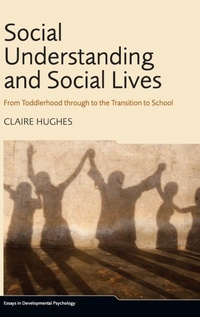
Social Understanding and Social Lives
From Toddlerhood through to the Transition to School
1st Edition
Published on 23. March 2011
Book
Hardback
252 pages
978-1-84169-735-2 (ISBN)
Description
Winner of the British Psychological Society Book Award (Academic Monograph category) 2013!
Over the past thirty years, researchers have documented a remarkable growth in children's social understanding between toddlerhood and the early school years. However, it is still unclear why some children's awareness of others' thoughts and feelings lags so far behind that of their peers. Based on research that spans an extended developmental period, this book examines this question from both social and cognitive perspectives, and investigates the real-life significance of individual differences in theory of mind.
After tracing the key age-related changes in the development of theory of mind, this book examines individual differences in relation to children's cognitive abilities and their social experiences. Why might language or executive function matter for children's social understanding? And how do children's linguistic environments and relationships with parents and siblings contribute to their ability to reflect on people's thoughts and feelings?
The book also reviews the evidence for predictive links between early social understanding and later social behaviour. Using information gathered from classmates, teachers and the children themselves, the author investigates links between individual differences in early social understanding and in the quality of children's interactions with friends, in their ability to resolve conflict, and in diverse aspects of school adjustment.
Drawing on rich observational data gathered in this extended longitudinal study, as well as skills acquired during her early experimental studies of children with autism and a six year collaboration with Professor Judy Dunn, the author integrates both cognitive and social accounts of theory of mind. The book is ideal reading for researchers actively working in the field, graduate and undergraduate students specializing in developmental psychology, educational and health professionals, and parents interested in learning about children's early social development.
Over the past thirty years, researchers have documented a remarkable growth in children's social understanding between toddlerhood and the early school years. However, it is still unclear why some children's awareness of others' thoughts and feelings lags so far behind that of their peers. Based on research that spans an extended developmental period, this book examines this question from both social and cognitive perspectives, and investigates the real-life significance of individual differences in theory of mind.
After tracing the key age-related changes in the development of theory of mind, this book examines individual differences in relation to children's cognitive abilities and their social experiences. Why might language or executive function matter for children's social understanding? And how do children's linguistic environments and relationships with parents and siblings contribute to their ability to reflect on people's thoughts and feelings?
The book also reviews the evidence for predictive links between early social understanding and later social behaviour. Using information gathered from classmates, teachers and the children themselves, the author investigates links between individual differences in early social understanding and in the quality of children's interactions with friends, in their ability to resolve conflict, and in diverse aspects of school adjustment.
Drawing on rich observational data gathered in this extended longitudinal study, as well as skills acquired during her early experimental studies of children with autism and a six year collaboration with Professor Judy Dunn, the author integrates both cognitive and social accounts of theory of mind. The book is ideal reading for researchers actively working in the field, graduate and undergraduate students specializing in developmental psychology, educational and health professionals, and parents interested in learning about children's early social development.
Reviews / Votes
"Hughes's book focuses primarily on findings from theory-of-mind research, teaching readers about infants' and toddlers' ability to understand their own and others' false beliefs, intentions, emotions, and behaviors. Readers learn a perspective on how toddlers see the world, negotiate the microcontexts they face daily, and prepare to enter the relatively impersonal world of schooling." - Theresa A. Thorkildsen, in PsycCRITIQUES"This book is exceptionally clear and thorough, on a topic of much current interest to psychologists. The author has brought together the findings from her project with skill and clarity and considers the current field in a sensible and informed way. I read it with real enthusiasm and interest" - Judy Dunn, Professor of Developmental Psychology, Institute of Psychiatry, King's College London UK
"This book is a unique tour de force. It skillfully integrates aspects of children's own cognitive abilities with features of their social environment to explain the individual differences found in children's theory of mind and the consequences of these differences for their social lives at home and school. It will be an invaluable resource for researchers and professionals in developmental psychology, child health, and education." - Janet Wilde Astington, Institute of Child Study, University of Toronto, Canada "[An] engaging, lucid and authoritative book. What makes this book such an important reading - not just for academics and students working in this area but also for professionals in education and health - is not simply Hughes's skilful ability to weave together the key themes emerging from a large, and rapidly growing, literature with the delightfully accessible findings of her own very substantial research programme. More than that, Hughes accomplishes the crucial task of setting a clear agenda for future work that builds on all of this progress. ... Hughes puts us all in a good position to maximize the strength and applied value of work on children's social-cognitive development." - Robin Banerjee, University of Sussex, UK, in Infant and Child Development
"Hughes's book focuses primarily on findings from theory-of-mind research, teaching readers about infants' and toddlers' ability to understand their own and others' false beliefs, intentions, emotions, and behaviors. Readers learn a perspective on how toddlers see the world, negotiate the microcontexts they face daily, and prepare to enter the relatively impersonal world of schooling." - Theresa A. Thorkildsen, in PsycCRITIQUES
"This book is exceptionally clear and thorough, on a topic of much current interest to psychologists. The author has brought together the findings from her project with skill and clarity and considers the current field in a sensible and informed way. I read it with real enthusiasm and interest" - Judy Dunn, Professor of Developmental Psychology, Institute of Psychiatry, King's College London UK
"This book is a unique tour de force. It skilfully integrates aspects of children's own cognitive abilities with features of their social environment to explain the individual differences found in children's theory of mind and the consequences of these differences for their social lives at home and school. It will be an invaluable resource for researchers and professionals in developmental psychology, child health, and education." - Janet Wilde Astington, Institute of Child Study, University of Toronto, Canada
More details
Series
Language
English
Place of publication
Hove
United Kingdom
Publishing group
Taylor & Francis Ltd
Target group
College/higher education
Illustrations
5 s/w Tabellen, 14 s/w Photographien bzw. Rasterbilder, 1 s/w Abbildung
5 Tables, black and white; 14 Halftones, black and white; 1 Illustrations, black and white
Dimensions
Height: 240 mm
Width: 161 mm
Thickness: 18 mm
Weight
552 gr
ISBN-13
978-1-84169-735-2 (9781841697352)
Copyright in bibliographic data and cover images is held by Nielsen Book Services Limited or by the publishers or by their respective licensors: all rights reserved.
Schweitzer Classification
Other editions
Additional editions
Claire Hughes
Social Understanding and Social Lives
From Toddlerhood through to the Transition to School
Book
01/2014
1st Edition
Psychology Press Ltd
€71.50
Shipment within 3-4 weeks

Claire Hughes
Social Understanding and Social Lives
From Toddlerhood through to the Transition to School
E-Book
03/2011
1st Edition
Psychology Press Ltd
€64.49
Available for download

Claire Hughes
Social Understanding and Social Lives
From Toddlerhood through to the Transition to School
E-Book
03/2011
1st Edition
Psychology Press Ltd
€64.49
Available for download
Person
Claire Hughes is Professor of Developmental Psychology at Newnham College, Cambridge.
Content
Part 1. Cognitive Perspectives on Social Understanding. 1. Milestones in Social Understanding, from Infancy to School Age. 2. Executive Function and Children's Understanding of Mind. 3. Language and Theory of Mind: A Cognitive Perspective. Part 2. Social Influences on Children's Understanding of Mind. 4. Language and Theory of Mind: A Social Perspective. 5. Parenting and Children's Social Understanding. 6. Siblings and Children's Social Understanding. Part 3. Social Understanding and Social Outcomes. 7. Social Understanding and Antisocial Behaviour. 8. Social Understanding and Positive Social Behaviours. 9. Social Understanding and School Life. 10. Emerging Themes.