

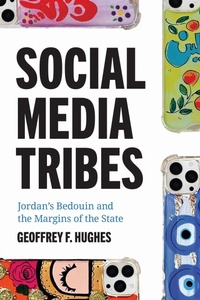
Social Media Tribes
Jordan's Bedouin and the Margins of the State
Will be published approx. on 13. October 2026
Book
Paperback/Softback
240 pages
978-1-4773-3472-0 (ISBN)
Description
An examination of the uses of social media in Jordan through the experiences of Bedouin tribespeople.
It has become something of a cliche to say that social media is making us tribal. But what do self-styled tribespeople themselves think about social media, and how might they help us better understand the role of the internet in our current political moment? Drawing on in-depth ethnographic fieldwork among Bedouin in Jordan, Social Media Tribes underscores the varied but broadly intelligible ways in which distinctive groups domesticate social media to suit their needs.
Organized around key concepts in Bedouin life (including tribalism, envy, and mercy), Social Media Tribes moves between Facebook-mediated tribal truces, upstart online media platforms, palatial urban villas where self-appointed sheikhs dispense justice, and street clashes organized over WhatsApp in rural communities ignored by state development projects. A meticulous researcher and insightful participant-observer, Geoffrey Hughes reframes social media as part of a global renegotiation of the state-society divide that both preceded the emergence of social media platforms and, in turn, feeds off of them. In this telling, the internet represents a new frontier that, like older frontiers, heralds both novel freedoms and novel forms of social control.
It has become something of a cliche to say that social media is making us tribal. But what do self-styled tribespeople themselves think about social media, and how might they help us better understand the role of the internet in our current political moment? Drawing on in-depth ethnographic fieldwork among Bedouin in Jordan, Social Media Tribes underscores the varied but broadly intelligible ways in which distinctive groups domesticate social media to suit their needs.
Organized around key concepts in Bedouin life (including tribalism, envy, and mercy), Social Media Tribes moves between Facebook-mediated tribal truces, upstart online media platforms, palatial urban villas where self-appointed sheikhs dispense justice, and street clashes organized over WhatsApp in rural communities ignored by state development projects. A meticulous researcher and insightful participant-observer, Geoffrey Hughes reframes social media as part of a global renegotiation of the state-society divide that both preceded the emergence of social media platforms and, in turn, feeds off of them. In this telling, the internet represents a new frontier that, like older frontiers, heralds both novel freedoms and novel forms of social control.
Reviews / Votes
"Social Media Tribes offers a fascinating, original, and wonderfully written political anthropology of social media use among Jordanian tribesmen. Geoffrey Hughes sidesteps the rather stale debates about the political effects of the internet by shifting the lens toward richly observed ethnography of how Jordanians actually use social media-and, crucially, how they themselves think about how their social media use has changed their lives, politics, and culture. Along the way, Hughes gives one of the best observed descriptions of the practice of journalism in a country like Jordan that I've read recently." - Marc Lynch, author of America's Middle East: The Ruination of a Region"Geoffrey Hughes offers a rich, on-the-ground perspective that adds depth and local context to the discussion of tribalism, a theme that is often avoided or underexplored in the field. One of the key contributions of Social Media Tribes is its reframing of tribalism, not as a relic of the past but as a dynamic political force that continues to shape governance, social structures, and online interactions. This book expands the theoretical vocabulary available for analyzing Middle Eastern societies beyond conventional state-centric and modernist frameworks and offers a more nuanced take in which tribalism is dynamic and evolving rather than obsolete." - Haian Dukhan, author of State and Tribes in Syria: Informal Alliances and Conflict Patterns
More details
Language
English
Place of publication
Austin, TX
United States
Target group
Professional and scholarly
Dimensions
Height: 229 mm
Width: 152 mm
Weight
454 gr
ISBN-13
978-1-4773-3472-0 (9781477334720)
Copyright in bibliographic data and cover images is held by Nielsen Book Services Limited or by the publishers or by their respective licensors: all rights reserved.
Schweitzer Classification
Person
Geoffrey F. Hughes is a senior lecturer in anthropology at the University of Exeter. He is the author of Kinship, Islam, and the Politics of Marriage in Jordan: Affection and Mercy.
Content
List of Illustrations
Note on Transliteration
Introduction: Tribalism and the Politics of an Accusation
Chapter 1. The Many Faces of the State-The Sheikh, The Policeman, and the Journalist
Chapter 2. Tribalism
Chapter 3. Envy
Chapter 4. Face
Chapter 5. The Deep State
Chapter 6. Mercy
Epilogue: Locking Down
Acknowledgments
Notes
Works Cited
Index
Note on Transliteration
Introduction: Tribalism and the Politics of an Accusation
Chapter 1. The Many Faces of the State-The Sheikh, The Policeman, and the Journalist
Chapter 2. Tribalism
Chapter 3. Envy
Chapter 4. Face
Chapter 5. The Deep State
Chapter 6. Mercy
Epilogue: Locking Down
Acknowledgments
Notes
Works Cited
Index