

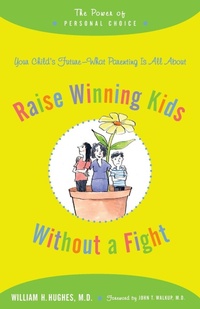
Raise Winning Kids without a Fight
The Power of Personal Choice
Published on 10. December 2009
Book
Paperback/Softback
184 pages
978-0-8018-9340-7 (ISBN)
Description
This guide offers parents fresh perspectives and simple skills to encourage good behavior in children and reduce stress for the entire family. Emphasizing personal choice, free will, and dispassionate parent-child interactions, Dr. William H. Hughes's step-by-step approach has been developed, tested, and proven to work time and again by child psychiatrists. Dr. Hughes demonstrates how parents must allow their children to decide for themselves whether they will cooperate and how they will act. Effective parenting builds character and increases self-confidence. Here, kids learn that they can choose to behave-and be rewarded for it. Dr. Hughes recommends that parents: * Set expectations. Make clear what the expected behavior is, whether it's doing homework or taking out the trash. * Monitor behavior. Keep an eye on what children are supposed to be doing, but let them decide for themselves whether they will complete the task. * Reward. Verbally praise good behavior and offer kids a reward. Let them play video games for an hour or invite a friend to a sleepover. Many parents are convinced that reward systems simply do not work. Dr.
Hughes explains why his approach gets the desired results while other approaches do not. By not engaging in power struggles and giving rewards only when expectations have been met, parents teach their kids that in choosing good behavior they are choosing rewards-and rewards will motivate kids to act better. Dr. Hughes also outlines a clear strategy for dealing with kids who just won't take no for an answer. The book encourages parents to modify their own behavior, teaching them to shift their focus away from battling with their kids and to use their energy to help their children develop winning habits and attitudes for life.
Hughes explains why his approach gets the desired results while other approaches do not. By not engaging in power struggles and giving rewards only when expectations have been met, parents teach their kids that in choosing good behavior they are choosing rewards-and rewards will motivate kids to act better. Dr. Hughes also outlines a clear strategy for dealing with kids who just won't take no for an answer. The book encourages parents to modify their own behavior, teaching them to shift their focus away from battling with their kids and to use their energy to help their children develop winning habits and attitudes for life.
Reviews / Votes
[It] gave me a lot of food for thought. I think most families could pull useful ideas from this book. -- Dave H. Book Bargains and Previews 2010More details
Language
English
Place of publication
Baltimore, MD
United States
Product notice
Paperback (trade)
Illustrations
6 s/w Zeichnungen
6 Line drawings, black and white
Dimensions
Height: 216 mm
Width: 140 mm
Thickness: 10 mm
Weight
242 gr
ISBN-13
978-0-8018-9340-7 (9780801893407)
DOI
10.56021/9780801893391
Copyright in bibliographic data and cover images is held by Nielsen Book Services Limited or by the publishers or by their respective licensors: all rights reserved.
Schweitzer Classification
Other editions
Additional editions
E-Book
12/2009
Johns Hopkins University Press
€13.49
Available for download
Book
12/2009
Johns Hopkins University Press
€43.50
Article not available for order
Persons
William H. Hughes, M.D., is director of family services at the Sutter Center for Psychiatry in Sacramento, California.
Content
Foreword, by John T. Walkup, M.D.
Preface
Introduction
1. When Is a Problem a Problem?
2. Illness, Stress, and Personality Development
3. A Parent's Dilemma: Insist and Cause Conflict or Don't Insist and Walk on Eggshells
4. The Failed Inspection
5. Why Rewards Don't Work and Why Rewards Do Matter
6. Laying the Foundation for a Schedule
7. Putting Together a Schedule
8. Homework
9. When Evening Comes
10. Weekends, Holidays, and Long-Term Rewards
11. Troubleshooting: Complaining, Disrespectful, Out-of-Control Behavior
12. Presenting the Schedule to Your Child
13. Teaching Virtue
Conclusion
References
Index
Preface
Introduction
1. When Is a Problem a Problem?
2. Illness, Stress, and Personality Development
3. A Parent's Dilemma: Insist and Cause Conflict or Don't Insist and Walk on Eggshells
4. The Failed Inspection
5. Why Rewards Don't Work and Why Rewards Do Matter
6. Laying the Foundation for a Schedule
7. Putting Together a Schedule
8. Homework
9. When Evening Comes
10. Weekends, Holidays, and Long-Term Rewards
11. Troubleshooting: Complaining, Disrespectful, Out-of-Control Behavior
12. Presenting the Schedule to Your Child
13. Teaching Virtue
Conclusion
References
Index