

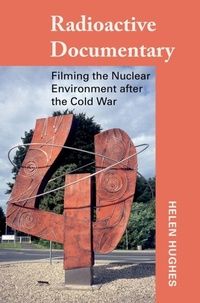
Radioactive Documentary
Filming the Nuclear Environment after the Cold War
Published on 23. September 2021
Book
Hardback
160 pages
978-1-78938-384-3 (ISBN)
Description
How have nuclear issues been covered in documentary since the end of the Cold War? This original new book explores how the sometimes elusive, sometimes dramatic effects of uranium products on the landscape, on architecture and on social organisation continue to show up on-screen, maintaining a record of moving images that goes back to the early twentieth century.
It is the first book to analyse independent documentary films about nuclear energy - it suggests an approach to documentary films as agents of change.
Each chapter of this book focuses on one of ten different documentary films made in Europe and North America since 1989. Each of these films works the material and the ideological heritage of the nuclear power industry into visions of the future. Dealing with the legacy of how ignorance and neglect led to accidents and failures the films offer different ways of understanding and moving on from the past. The documentary form itself can be understood as a collective means for the discovery of creative solutions and the communication of new narratives. In the case of these films the concepts of radioactivity and deep time in particular are used to bring together narrative and formal aesthetics in the process of reimagining the relationships between people and their environments.
Focusing on the representation of radioactive spaces in documentary and experimental art films, the study shows how moving images do more than communicate the risks and opportunities, and the tumultuous history, associated with atomic energy. They embody the effects of Cold War technologies as they persist into the present, acting as a reminder that the story is not over yet.
Primary readership will be academics and students working in environmental communication and in environmental humanities more broadly. For students of independent film or documentary it will also provide a clear picture of contemporary themes and creative practice.
It is the first book to analyse independent documentary films about nuclear energy - it suggests an approach to documentary films as agents of change.
Each chapter of this book focuses on one of ten different documentary films made in Europe and North America since 1989. Each of these films works the material and the ideological heritage of the nuclear power industry into visions of the future. Dealing with the legacy of how ignorance and neglect led to accidents and failures the films offer different ways of understanding and moving on from the past. The documentary form itself can be understood as a collective means for the discovery of creative solutions and the communication of new narratives. In the case of these films the concepts of radioactivity and deep time in particular are used to bring together narrative and formal aesthetics in the process of reimagining the relationships between people and their environments.
Focusing on the representation of radioactive spaces in documentary and experimental art films, the study shows how moving images do more than communicate the risks and opportunities, and the tumultuous history, associated with atomic energy. They embody the effects of Cold War technologies as they persist into the present, acting as a reminder that the story is not over yet.
Primary readership will be academics and students working in environmental communication and in environmental humanities more broadly. For students of independent film or documentary it will also provide a clear picture of contemporary themes and creative practice.
More details
Language
English
Place of publication
United Kingdom
Publishing group
Intellect
Target group
Professional and scholarly
Illustrations
10
Dimensions
Height: 250 mm
Width: 175 mm
Thickness: 14 mm
Weight
494 gr
ISBN-13
978-1-78938-384-3 (9781789383843)
DOI
10.1286/9781789383843
Copyright in bibliographic data and cover images is held by Nielsen Book Services Limited or by the publishers or by their respective licensors: all rights reserved.
Schweitzer Classification
Other editions
Additional editions
E-Book
07/2021
Intellect Books
€78.49
Available for download
Person
Helen Hughes is a senior lecturer in German and film studies at the University of Surrey. She is the author of Green Documentary (2014) and co-editor of Documentary and Disability (2017) and has published articles in journals and books on documentary, experimental and German-language cinema.
Content
Chapter 1: Introduction: Radioactive documentaries and a homage to Erik Barnouw
Chapter 2: Radioactive past: Volker Koepp's Die Wismut (1993, Germany) and Suzan Baraza's Uranium Drive-In (2013, US)
Chapter 3: Radioactive present: Toshi Fujiwara's Mujin Chitai (No Man's Zone, 2012, Japan) and Nikolaus Geyrhalter's Pripyat (1999, Austria, Ukraine)
Chapter 4: Radioactive future: Michael Madsen's Into Eternity (2010, Denmark) and Peter Gallison and Rob Moss's Containment (2015, US)
Chapter 5: Radioactive past conditional: Volker Sattel's Unter Kontrolle (Under Control, 2011, Germany) and Ivy Meerapol's Indian Point (2015, US)
Chapter 6: Radioactive future conditional: Rob Stone's Pandora's Promise (2013, US) and Mika Taanila and Jussi Eerola's Atomin Paluu (Return of the Atom, 2015, Finland)
Chapter 7: Conclusion: Radioactive continuous present: Mark Cousin's Atomic: Living in Dread and Promise (2015, UK)
Chapter 2: Radioactive past: Volker Koepp's Die Wismut (1993, Germany) and Suzan Baraza's Uranium Drive-In (2013, US)
Chapter 3: Radioactive present: Toshi Fujiwara's Mujin Chitai (No Man's Zone, 2012, Japan) and Nikolaus Geyrhalter's Pripyat (1999, Austria, Ukraine)
Chapter 4: Radioactive future: Michael Madsen's Into Eternity (2010, Denmark) and Peter Gallison and Rob Moss's Containment (2015, US)
Chapter 5: Radioactive past conditional: Volker Sattel's Unter Kontrolle (Under Control, 2011, Germany) and Ivy Meerapol's Indian Point (2015, US)
Chapter 6: Radioactive future conditional: Rob Stone's Pandora's Promise (2013, US) and Mika Taanila and Jussi Eerola's Atomin Paluu (Return of the Atom, 2015, Finland)
Chapter 7: Conclusion: Radioactive continuous present: Mark Cousin's Atomic: Living in Dread and Promise (2015, UK)