

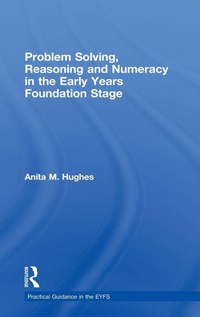
Problem Solving, Reasoning and Numeracy in the Early Years Foundation Stage
1st Edition
Published on 4. December 2008
Book
Hardback
156 pages
978-0-415-47840-3 (ISBN)
Description
The Practical Guidance in the Early Years Foundation Stage series will assist practitioners in the smooth and successful implementation of the Early Years Foundation Stage.
Each book gives clear and detailed explanations of each aspect of Learning and Development and encourages readers to consider each area within its broadest context to expand and develop their own knowledge and good practice.
Practical ideas and activities for all age groups are offered along with a wealth of expertise of how elements from the practice guidance can be implemented within all early years settings. The books include suggestions for the innovative use of everyday ressources, popular books and stories.
This book offers an in-depth understanding of children's thinking skills from a psychological perspective. The book introduces the Learning Tools model, a vital cognitive tool used by children to learn and solve problems, and gives practical ideas on how practitioners can use everyday materials to promote problem solving and early numeracy skills through play.
Readers are encouraged to reflect on their own practice and understanding to help them provide learning opportunities to meet the unique needs of all children in their setting.
Each book gives clear and detailed explanations of each aspect of Learning and Development and encourages readers to consider each area within its broadest context to expand and develop their own knowledge and good practice.
Practical ideas and activities for all age groups are offered along with a wealth of expertise of how elements from the practice guidance can be implemented within all early years settings. The books include suggestions for the innovative use of everyday ressources, popular books and stories.
This book offers an in-depth understanding of children's thinking skills from a psychological perspective. The book introduces the Learning Tools model, a vital cognitive tool used by children to learn and solve problems, and gives practical ideas on how practitioners can use everyday materials to promote problem solving and early numeracy skills through play.
Readers are encouraged to reflect on their own practice and understanding to help them provide learning opportunities to meet the unique needs of all children in their setting.
Reviews / Votes
"...Written by Anita Hughes, a chartered educational psychologist, who offers in-depth understanding of children's thinking skills from a psychological perspective. It introduces the learning tools model, a vital cognitive tool used by children to learn and solve problems. It also offers practical ideas on how to use everyday materials to promote problem-solving and early numeracy skills through play. Readers are encourages to reflect on their own practice and understanding to help them provide learning opportunities to meet the unique needs of all children in their setting." - Early Years Update (Issue 65, February 2009)More details
Series
Language
English
Place of publication
London
United Kingdom
Publishing group
Taylor & Francis Ltd
Target group
Professional and scholarly
Primary & secondary/elementary & high school
Professional Practice & Development
Dimensions
Height: 240 mm
Width: 161 mm
Thickness: 13 mm
Weight
411 gr
ISBN-13
978-0-415-47840-3 (9780415478403)
Copyright in bibliographic data and cover images is held by Nielsen Book Services Limited or by the publishers or by their respective licensors: all rights reserved.
Schweitzer Classification
Other editions
Additional editions
E-Book
11/2012
1st Edition
Routledge
€40.99
Available for download
E-Book
11/2012
1st Edition
Routledge
€40.99
Available for download
Anita M. Hughes
Problem Solving, Reasoning and Numeracy in the Early Years Foundation Stage
Edited by SANDY GREEN
Book
12/2008
1st Edition
Routledge
€45.50
Shipment within 15-20 days
Person
Anita M Hughes is a Chartered Educational Psychologist.
Content
Chapter 1: Understanding how children think Chapter 2: The Learning Tools Chapter 3: Numbers as labels for counting Chapter 4: Calculating Chapter 5: Shape, Space and Measures