

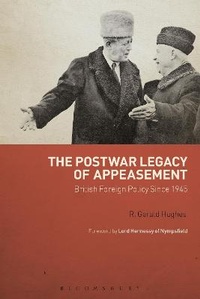
The Postwar Legacy of Appeasement
British Foreign Policy Since 1945
Published on 16. January 2014
Book
Paperback/Softback
352 pages
978-1-78093-583-6 (ISBN)
Description
Focusing on the Cold War and the post-Cold War eras, R. Gerald Hughes explores the continuing influence of Appeasement on British foreign policy and re-evaluates the relationship between British society and Appeasement, both as historical memory and as a foreign policy process.
The Postwar Legacy of Appeasement explores the reaction of British policy makers to the legacies of the era of Appeasement, the memory of Appeasement in public opinion and the media and the use of Appeasement as a motif in political debate regarding threats faced by Britain in the post-war era. Using many previously unpublished archival sources, this book clearly demonstrates that many of the core British beliefs and cultural norms that had underpinned the Chamberlainite Appeasement of the 1930s persisted in the postwar period.
The Postwar Legacy of Appeasement explores the reaction of British policy makers to the legacies of the era of Appeasement, the memory of Appeasement in public opinion and the media and the use of Appeasement as a motif in political debate regarding threats faced by Britain in the post-war era. Using many previously unpublished archival sources, this book clearly demonstrates that many of the core British beliefs and cultural norms that had underpinned the Chamberlainite Appeasement of the 1930s persisted in the postwar period.
Reviews / Votes
Hughes has made a major contribution to understanding British foreign policy in the post-war era ... [A] highly original work that will reward study by anyone interested in the history of international relations. -- George C. Peden, University of Stirling * Intelligence and National Security * Gerald Hughes' first-rate book deserves to be read and digested not only by historians and international relations specialists, but also by politicians, their speech writers and their diplomats. -- Christopher Waters, Deakin University * Australian Journal of Politics and History * Hughes has produced a readable account of the uses and abuses of the appeasement analogy, reminding us of the dangers of history turning into a political battleground on which the decisions for the future are made. -- Helene von Bismarck, Independent Scholar * American Historical Review * [Hughes] presents the argument in a manner likely to retain the interest of the reader whilst resisting the temptations towards over simplification. It is a highly interesting book that would be of interest to scholars and students alike. -- Andrew Crines * The Historian *More details
Language
English
Place of publication
London
United Kingdom
Publishing group
Bloomsbury Publishing PLC
Dimensions
Height: 232 mm
Width: 156 mm
Thickness: 20 mm
Weight
540 gr
ISBN-13
978-1-78093-583-6 (9781780935836)
DOI
CBID177002
Copyright in bibliographic data and cover images is held by Nielsen Book Services Limited or by the publishers or by their respective licensors: all rights reserved.
Schweitzer Classification
Other editions
Additional editions
E-Book
01/2014
1st Edition
Bloomsbury Academic
€39.99
Available for download
E-Book
01/2014
1st Edition
Bloomsbury Academic
€39.99
Available for download
Person
R. Gerald Hughes is Reader in the Department of International Politics at Aberystwyth University, UK.
Content
List of figures
Acknowledgements
Foreword by Lord Hennessy of Nympsfield
Introduction: Present histories and past follies: the legacy of appeasement and British foreign policy since 1945
1. In the footsteps of Cromwell: an empire against two evils, 1941-53
2. Churchill and Locarno, Eden and Geneva: the limits and possibilities of diplomacy
3. 'I have never thought Nasser a Hitler': Suez and the shadow of Munich
4. 'I will be no Mr. Chamberlain': Harold Macmillan and Berlin, 1958-62
5. Helsinki, 1975: Nuclear age Westphalia, Versailles or Munich?
6. 'We have ceased to be a nation in retreat': Margaret Thatcher, the Falklands War and the negation of Munich and Suez
7. In pursuit of a 'New World Order': liberating Kuwait, 1990-1
8. Appeasement and the politics of obstructionism: Britain and the dissolution of Bosnia
9. 'History will be my judge': Blair's wars and the moral case against appeasement
Conclusion: Appeasement, British foreign policy and history
Bibliography
Index
Acknowledgements
Foreword by Lord Hennessy of Nympsfield
Introduction: Present histories and past follies: the legacy of appeasement and British foreign policy since 1945
1. In the footsteps of Cromwell: an empire against two evils, 1941-53
2. Churchill and Locarno, Eden and Geneva: the limits and possibilities of diplomacy
3. 'I have never thought Nasser a Hitler': Suez and the shadow of Munich
4. 'I will be no Mr. Chamberlain': Harold Macmillan and Berlin, 1958-62
5. Helsinki, 1975: Nuclear age Westphalia, Versailles or Munich?
6. 'We have ceased to be a nation in retreat': Margaret Thatcher, the Falklands War and the negation of Munich and Suez
7. In pursuit of a 'New World Order': liberating Kuwait, 1990-1
8. Appeasement and the politics of obstructionism: Britain and the dissolution of Bosnia
9. 'History will be my judge': Blair's wars and the moral case against appeasement
Conclusion: Appeasement, British foreign policy and history
Bibliography
Index