

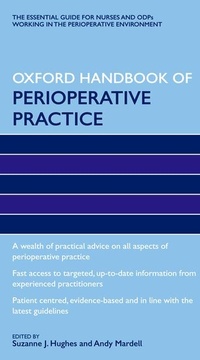
Oxford Handbook of Perioperative Practice
Published on 30. July 2009
Book
Paperback/Softback
672 pages
978-0-19-923964-1 (ISBN)
Description
The Oxford Handbook of Perioperative Practice offers readers practical, easily accessible, concise and up-to-date evidence-based information on the essential elements of perioperative practice. It provides a thorough introduction to the principles and practice of anaesthetics, intraoperative care and recovery nursing, focussing on the patients' journey before, during and after surgery.
Containing many helpful illustrations and diagrams to guide the reader, along with references to national and international guidelines, the Oxford Handbook of Perioperative Practice assists practitioners in meeting the individual needs of surgical patients while ensuring safe and efficient care delivery. It enables readers to easily locate information about essential skills, patients' medical conditions, and perioperative and surgical patient management. It covers all steps of the perioperative
process, and also contains an extensive section on pharmacology, as well as a section on perioperative emergencies.
The book is clearly laid out, and written in an easily readable note-based style. Blank pages are included for the reader, so that notes, observations, and local protocols can be included, thereby individualising the Handbook.
Written by teaching staff and clinicians from the fields of nursing, operating department practice and pharmacy, the Oxford Handbook of Perioperative Practice offers an inter-disciplinary and inter-professional approach to perioperative practice for those studying the subject and those practising within the perioperative environment.
Containing many helpful illustrations and diagrams to guide the reader, along with references to national and international guidelines, the Oxford Handbook of Perioperative Practice assists practitioners in meeting the individual needs of surgical patients while ensuring safe and efficient care delivery. It enables readers to easily locate information about essential skills, patients' medical conditions, and perioperative and surgical patient management. It covers all steps of the perioperative
process, and also contains an extensive section on pharmacology, as well as a section on perioperative emergencies.
The book is clearly laid out, and written in an easily readable note-based style. Blank pages are included for the reader, so that notes, observations, and local protocols can be included, thereby individualising the Handbook.
Written by teaching staff and clinicians from the fields of nursing, operating department practice and pharmacy, the Oxford Handbook of Perioperative Practice offers an inter-disciplinary and inter-professional approach to perioperative practice for those studying the subject and those practising within the perioperative environment.
Reviews / Votes
This book offers instant access to perioperative information that practitioners' will find useful within their clinical practice... It indeed provides a valuable guide and I would recommend it to student nurses and operating department practitioners. * Open Forum * Written for nurses and operating theatre pratitioners, this handbook is an easy-to-read guide to all aspects of peri-operative care...useful in the clinical area, as well as being a good revision guide for exams * Anne Mottram, University of Salford *More details
Series
Language
English
Place of publication
Oxford
United Kingdom
Target group
Professional and scholarly
Illustrations
50 black and white illustrations
Dimensions
Height: 180 mm
Width: 100 mm
Thickness: 19 mm
Weight
308 gr
ISBN-13
978-0-19-923964-1 (9780199239641)
Copyright in bibliographic data and cover images is held by Nielsen Book Services Limited or by the publishers or by their respective licensors: all rights reserved.
Schweitzer Classification
Persons
Suzanne Hughes
Suzanne works as a lecturer in the Cardiff School of Nursing and Midwifery Studies at Cardiff University. She is involved in teaching and curriculum development for both pre and post registration nurses. She also acts as a project manager for learning and teaching within the university, where she leads the evaluation strand. Her research interests are in nurse education and perioperative education, through which she keeps up-to-date with current developments in perioperative practice.
Andy Mardell
Andy has been an operating theatre nurse in the scrub area for over twenty years, and has worked in a number of surgical specialties. He is now involved with education and training at the Main Theatre Department at the University Hospital of Wales in Cardiff, and also still practices in clinical settings.
Suzanne works as a lecturer in the Cardiff School of Nursing and Midwifery Studies at Cardiff University. She is involved in teaching and curriculum development for both pre and post registration nurses. She also acts as a project manager for learning and teaching within the university, where she leads the evaluation strand. Her research interests are in nurse education and perioperative education, through which she keeps up-to-date with current developments in perioperative practice.
Andy Mardell
Andy has been an operating theatre nurse in the scrub area for over twenty years, and has worked in a number of surgical specialties. He is now involved with education and training at the Main Theatre Department at the University Hospital of Wales in Cardiff, and also still practices in clinical settings.
Content
1. Perioperative practice ; 2. Professional issues in perioperative practice ; 3. Admission of surgical patients ; 4. Pre-assessment of surgical patients ; 5. Patients with pre-existing diseases ; 6. Preparing the patient for theatre ; 7. Principles of anaesthesia ; 8. Essential anaesthetic equipment ; 9. Scientific principles ; 10. Airway management ; 11. Complications associated with anaesthesia ; 12. Specialist anaesthesia ; 13. Decontamination and sterilisation ; 14. Thermoregulation ; 15. Skin preparation ; 16. Operating theatre practice ; 17. Patient positioning for surgery ; 18. Wound management ; 19. Surgical equipment ; 20. Preparation of recovery ; 21. Caring for the post anaesthesia patient ; 22. Perioperative pharmacology ; 23. Pain management ; 24. Perioperative drugs ; 25. Fluid therapy and fluid replacement ; 26. Emergency care