

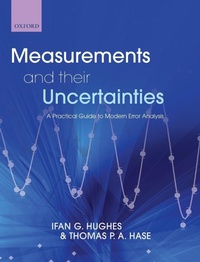
Measurements and their Uncertainties
A practical guide to modern error analysis
Published on 1. July 2010
Book
Hardback
152 pages
978-0-19-956632-7 (ISBN)
Description
This hands-on guide is primarily intended to be used in undergraduate laboratories in the physical sciences and engineering. It assumes no prior knowledge of statistics. It introduces the necessary concepts where needed, with key points illustrated with worked examples and graphic illustrations. In contrast to traditional mathematical treatments it uses a combination of spreadsheet and calculus-based approaches, suitable as a quick and easy on-the-spot reference. The emphasis throughout is on practical strategies to be adopted in the laboratory.
Error analysis is introduced at a level accessible to school leavers, and carried through to research level. Error calculation and propagation is presented though a series of rules-of-thumb, look-up tables and approaches amenable to computer analysis. The general approach uses the chi-square statistic extensively. Particular attention is given to hypothesis testing and extraction of parameters and their uncertainties by fitting mathematical models to experimental data. Routines implemented by most contemporary data analysis packages are analysed and explained. The book finishes with a discussion of advanced fitting strategies and an introduction to Bayesian analysis.
Error analysis is introduced at a level accessible to school leavers, and carried through to research level. Error calculation and propagation is presented though a series of rules-of-thumb, look-up tables and approaches amenable to computer analysis. The general approach uses the chi-square statistic extensively. Particular attention is given to hypothesis testing and extraction of parameters and their uncertainties by fitting mathematical models to experimental data. Routines implemented by most contemporary data analysis packages are analysed and explained. The book finishes with a discussion of advanced fitting strategies and an introduction to Bayesian analysis.
Reviews / Votes
With the shift from analytic methods to spreadsheet-based techniques, this book will enable students simultaneously to (a) become fluent in the choice and application of appropriate methods (b) understand the underlying principles. * David Saxon, University of Glasgow * This is a rather beautiful little book. * David J. Hand, International Statistical Review *More details
Language
English
Place of publication
Oxford
United Kingdom
Target group
College/higher education
Undergraduate students in the physical sciences - physics, chemistry and engineering. Also graduate students and lecturers in the physical sciences. Students in other scientific disciplines, such as geophysics or mathematical biology.
Illustrations
75 b/w line illustrations
Dimensions
Height: 260 mm
Width: 208 mm
Thickness: 13 mm
Weight
572 gr
ISBN-13
978-0-19-956632-7 (9780199566327)
Copyright in bibliographic data and cover images is held by Nielsen Book Services Limited or by the publishers or by their respective licensors: all rights reserved.
Schweitzer Classification
Other editions
Additional editions
Ifan Hughes | Thomas Hase
Measurements and their Uncertainties
A practical guide to modern error analysis
E-Book
07/2010
OUP eBook
€25.99
Available for download
Ifan Hughes | Thomas Hase
Measurements and their Uncertainties
A practical guide to modern error analysis
Book
07/2010
Oxford University Press
€35.00
Shipment within 15-20 days
Persons
Ifan Hughes took his BSc at Imperial College London, his DPhil at Oxford University, and undertook post-doctoral research at Oxford, Yale and Sussex. He has been at Durham University since 1999, where he is now a Senior Lecturer.
Thomas Hase has been an Associate Professor at Warwick University since 2007. Prior to that, he did his BSc, PhD and post-doctoral research at Durham University.
Thomas Hase has been an Associate Professor at Warwick University since 2007. Prior to that, he did his BSc, PhD and post-doctoral research at Durham University.
Content
1. Errors in the physical sciences ; 2. Random errors in measurement ; 3. Uncertainties as probabilities ; 4. Error propagation ; 5. Data visualisation and reduction ; 6. Least-squares fitting of complex functions ; 7. Computer minimisation and the error matrix ; 8. Hypothesis testing - how good are our models ; 9. Topics for further summary